

On September 25, 2024, WordPress.org said WP Engine “needs a trademark license.” It cited WP Engine’s “legal claims,” “attacks on us” and “locking down a WordPress core feature.”1 It had already blocked the host from its update servers. Would signed updates have helped? My answer: in open source infrastructure, signing can’t reopen a server. It can make a second one safe to use.
Guess first: WordPress’s update signing key expired on April 1, 2021. What happened to your site’s updates after that? Did they stop, or keep going? Pick one before you read on.
Estimated reading time: 16 minutes
Key takeaways
- The big picture: WordPress’s key list holds one key, and it expired on April 1, 2021. Since June 2024, the updater also skips the signature check by default.
- Why it matters: Every written cutoff rule in my table covers a registry or infrastructure accounts, not the project itself. Even WordPress’s Guideline 18 covers only plugins and developer access.
- Yes, but: One central server is faster and simpler, because one operator can publish a fix for every site. FAIR’s own spec also says federation “can present a bootstrapping problem.”
- What to do: Map where each part of your site updates from, then ask every source two things: who pays, and which written rule covers a cutoff.
WP Engine said its customers were blocked “from updating and installing plugins and themes via WP Admin.”2 I wanted to know who could do that elsewhere, so I checked the infrastructure at twelve open source projects. I picked projects whose release and infrastructure pages are public. Each got five questions. Who runs the download server, and who pays for it? Who signs releases? Does the client check signatures by default? And what written rule covers cutting off access?
My ties, before any verdict
I work at Pantheon, a WordPress and Drupal host that competes with WP Engine, another WordPress host. It also competes with WordPress VIP, the enterprise service from Automattic, the company behind WordPress.com. At GoDaddy, I started and ran its Five for the Future program, which pledges staff time to WordPress, until July 2026.
Separately, I chose which groups GoDaddy funded:
- The PHP Foundation, which pays developers to work on the PHP language.
- OpenJS, the foundation behind Node.js and other JavaScript projects.
- W3C, the World Wide Web Consortium, a web standards body.
- PHP_CodeSniffer, a tool that checks code style.
- The WPOCC, a WordPress community collective where I’m a co-founding board member.
I’m an active member of the Technical Steering Committee for FAIR, the FAIR Package Manager. It’s a Linux Foundation project, and the Linux Foundation is a nonprofit that hosts open source projects. FAIR is one of the twelve projects below, so it gets the same questions as the rest. Pantheon is also a platinum Drupal Certified Partner, and Drupal is another row, so read that row with this tie in mind. Finally, four exhibits in WP Engine’s lawsuit against Automattic and its CEO, Matt Mullenweg, include my words. WP Engine filed two, and Automattic and Mullenweg filed two. I’m not a party to the case.3
What release signing checks, and what it can’t
Release signing means a project signs each update with a private key. Your site checks it with the public key. A match shows which key signed and that nobody changed the file since.
HTTPS, the encrypted web connection, doesn’t cover a hacked server. WordPress’s signing ticket warned that “if an attacker can compromise api.wordpress.org, they can issue a fake WordPress update.”4 A signature check would let your site reject it.
On November 21, 2026, trunk, WordPress’s working code, held this key list.5
“php if ( time() < 1617235200 ) { // WordPress.org Key #1 - This key is only valid before April 1st, 2021. $trusted_keys[] = 'fRPyrxb/MvVLbdsYi+OOEv4xc+Eqpsj+kkAS6gNOkI0='; } // TODO: Add key #2 with longer expiration. “
That number is midnight on April 1, 2021, in Coordinated Universal Time (UTC).6 All 20 release branches from 5.2 through 7.1 hold that same single key.7
My test for any update source uses the last two questions. Does the client check signatures by default? Does a written rule name who can switch access off? The Python Package Index (PyPI) lets the Python Software Foundation (PSF) suspend access “at any time, with or without cause.”8 That doesn’t protect you. It tells you in advance who decides, so you can plan a backup. Among these twelve projects, I found no public report of a check stopping a tampered file, or a rule stopping a cutoff.9 A check that works may leave no record, so that’s an open question.

Text description of the check the seal illustration
What the check the seal illustration shows about release signing
- Subject: what a release signature check can show about an open source project’s infrastructure.
- First panel: A man in a violet hoodie holds a magnifying glass over the wax seal on a parcel labeled UPDATE. A card with a key outline hangs on the corkboard.
- Second panel: Next, a close up shows the key in the seal and the key on the card side by side. They match, beside the word MATCH and a check mark.
- Third panel: Then a young developer in a wheelchair opens the parcel. The laptop shows a check mark, and the reviewer gives a thumbs up.
- Text in the image: UPDATE and MATCH.
- Not shown: any real project, key or server. Fictional scene.
How WordPress turned the signature check off
In March 2019, changeset 44954, a numbered code change, added a signature check that “does not reject unverified packages.”10 On August 16, 2019, a core committer, someone who can add code to WordPress, proposed rolling it back to “ensure it’s done properly.”11 That day, the ticket’s reporter, Paragon Initiative Enterprises, wrote that it would “strongly recommend against removing the signature verification for core updates.”12 Three days later, the committer replied that the check “only generates a warning.”13 The check stayed.
After April 2021, no key in WordPress’s own list was valid. On the 6.0 release branch, a failed check prints as “a normal feedback, and not as an error.”14 Then a later comment reads “Pretend this error didn’t happen.”15 As error handling goes, that’s honest (and trunk still carries the comment).16
In June 2024, changeset 58319 gave its reason. The warning “had no actionability and only led to more support.” So it turned off package signature verification “at least until software signing is fully implemented on wordpress.org.”17 In trunk’s class-wp-upgrader.php, line 307 sets the default, and line 880 runs plugin and theme updates.18
“php public function download_package( $package, $check_signatures = false, $hook_extra = array() ) { $download = $this->download_package( $options['package'], false, $options['hook_extra'] ); “
In trunk’s class-core-upgrader.php, line 128 runs core updates.19
“php $download = $this->download_package( $current->packages->$to_download, false ); “
Both update calls pass false as $check_signatures. By default, the expired key never broke updates, because the check only warned.
What the record shows about the September 2024 cutoff
Both WordPress.org News posts below carry Mullenweg’s byline.2021 Citing Mullenweg’s declaration, a 2024 court order calls Mullenweg Automattic’s “founder, President, and CEO” and “the manager of the wordpress.org website.”22
The week, date by date
| Date (2024) | Source | Stated reason or words | What happened |
|---|---|---|---|
| September 23 | WP Engine’s legal timeline23 | “stop making and retract false, harmful, and disparaging statements” | A cease and desist letter to Automattic and Mullenweg |
| September 25, 21:58 UTC | WP Engine status page24 | “WordPress.org has blocked WP Engine customers from updating and installing plugins and themes via WP Admin.” | At 01:11 UTC on September 26, it linked manual update steps. |
| September 25, 22:50 UTC | WordPress.org News, “WP Engine is banned from WordPress.org”25 | “WP Engine needs a trademark license.” It also cited “their disabling and locking down a WordPress core feature,” “their legal claims and litigation against WordPress.org” and “their attacks on us.” | It listed “update servers” among what WP Engine must now run. |
| September 27, 21:03 UTC | WordPress.org News, “WP Engine Reprieve”26 | “I’ve heard from WP Engine customers that they are frustrated.” | It lifted “the blocks of their servers from accessing ours, until October 1, UTC 00:00,” hoping this “helps them spin up their mirrors.” |
| September 30 | WP Engine’s legal timeline27 | “interruptions to customer access to WordPress.org” | It says it deployed a solution “without relying on the WordPress.org API.” |
| October 1 | Court order, citing a WP Engine declaration28 | None found29 | The court says “Mullenweg again blocked WPEngine’s access.” |
| October 2 | WP Engine’s complaint30 | “to stop Defendants from continuing to harm WPE and its customer relationships” | WP Engine sued Automattic and Mullenweg. Its FAQ says it didn’t sue WordPress.org.31 |
What release signing would have changed that week
Suppose WordPress’s updater had checked signatures with a fresh key. On September 25, that changes nothing. A signature check runs only on a downloaded file. When the server won’t answer, there’s nothing to check.
But the September 27 post pointed WP Engine to mirrors, copies of a server’s files that someone else runs. The defendants said WP Engine’s fix “fully restored” its dashboard within five days. It “could have created its own mirror … at any time,” they added.32 WP Engine’s reply declaration, quoted by the court, says its partial mirror carried only the latest versions. Building or updating one “can often take several days.”33
Signing solves a different problem. A signature shows which key signed, so it can make a second server safe to use. But signing can’t reopen the first server. Also, it can’t show a copy is current.34
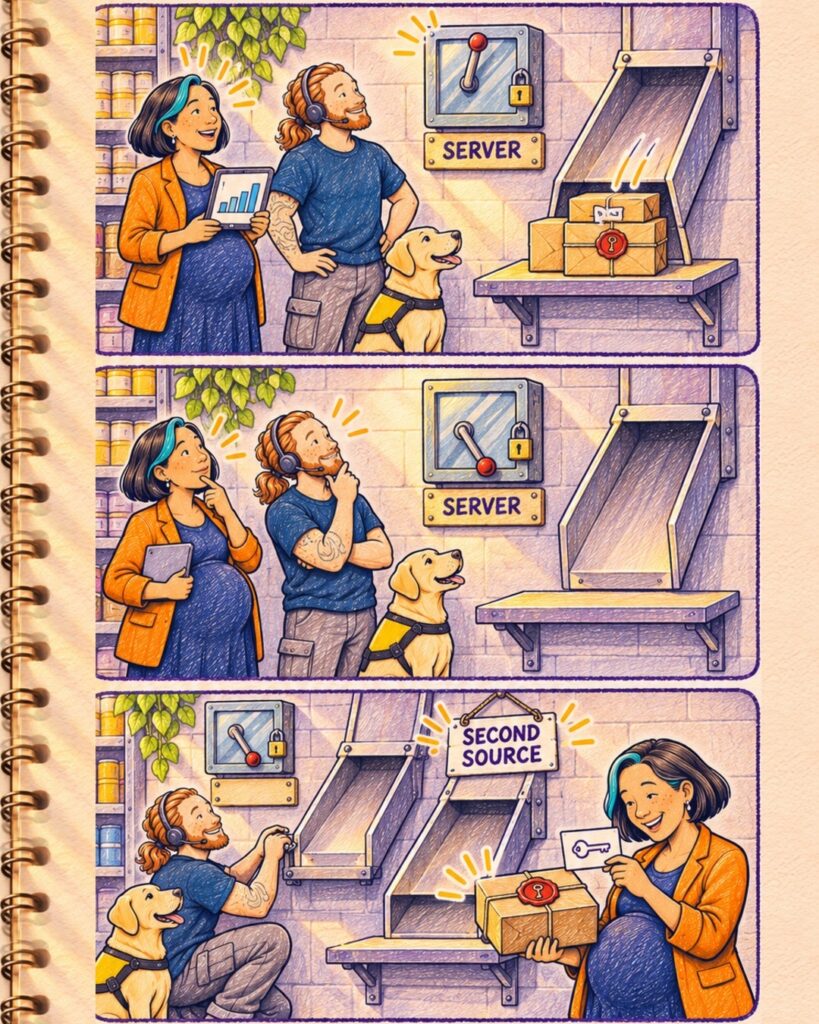
Text description of the second source illustration
What the second source illustration shows about the update server
- Subject: who holds the update switch in an open source project’s infrastructure, and what a second source can do.
- First panel: Parcels slide down a chute onto a shelf. Above it, a lever sits in a locked glass case labeled SERVER, and nobody stands near it.
- Second panel: Later, the lever is down and the chute is empty. So a pregnant woman and a man with a service dog look at the shelf.
- Third panel: Then he fits a second chute tagged SECOND SOURCE. Next, she compares a new parcel’s wax key seal with a key card.
- Text in the image: SERVER, SERVER and SECOND SOURCE.
- Not shown: who pulled the lever, or why. Fictional scene.
Who paid for a substitute update server
The September 25 post asked, “Why should WordPress.org provide these services to WP Engine for free, given their attacks on us?”35
The defendants said running wordpress.org “incurs an estimated $800,000.00 in administrative, server and developer costs per year.” They also asked for a $1.6 million bond. However, WP Engine said the extra cost of its access “is likely a tiny fraction of the amount cited by Defendants.” The court required no bond.36 The defendants gave an estimate, and WP Engine gave no number. Also, I found no published budget for WordPress.org’s update servers.37 In my years in WordPress, I’ve never seen a way for others to help pay for them. The records I searched don’t say whether any of them run on Automattic’s infrastructure.38
The defendants’ brief said the block “prevented WP Engine’s dashboard from continuing to link to updated plugins.” But it called that dashboard “a tool of convenience,” since plugins stayed downloadable by hand. It called the injuries “self-inflicted.”39 Citing WP Engine’s reply declaration, the court called manual updates “too onerous and time consuming to be workable” across several sites. For now, it said workaround costs, “as necessitated by Mullenweg’s conduct,” supported the injunction.40
What the court has ruled so far
Only the 2024 order below ruled on access. The later two are pleading stage rulings, which test whether a claim is stated, not proved. The jury trial date is October 19, 2027.41 By 2026, the WordPress Foundation, a nonprofit that owns WordPress trademarks, had also filed counterclaims, claims back against WP Engine. So had WooCommerce, Inc., by then a defendant.42
Each ruling, both sides
| Date | Stage | Rulings that favored WP Engine | Rulings that favored the defendants or counterclaimants |
|---|---|---|---|
| 2024-12-1043 | Preliminary injunction, docket entry (Dkt.) 64 | Granted “with modifications”: access restored, including api.wordpress.org, downloads.wordpress.org, logins and plugin listings, with no bond | One limit: it doesn’t stop wordpress.org from ensuring “security and operability” |
| 2025-09-1244 | Motion to dismiss (Dkt. 169) | Counts went forward for interference, unfair competition, false advertising, libel and slander, unjust enrichment, part of promissory estoppel, and one of two computer fraud counts; Counts 7 and 8 weren’t challenged | Antitrust counts and the other computer fraud count dismissed with leave to amend, a chance to refile; attempted extortion dismissed without leave; trademark misuse kept only as a defense |
| 2026-09-2445 | Motions to dismiss amended claims and counterclaims (Dkt. 410) | Amended antitrust counts allowed to proceed; claims against WooCommerce for interference, unfair competition and a declaration that WP Engine doesn’t infringe kept; trademark counterclaims dismissed as brought by Automattic and Mullenweg, who don’t own the marks; the false advertising part of one counterclaim dismissed with leave | The amended computer fraud count dismissed without leave; WP Engine’s claim for a declaration that it doesn’t dilute WooCommerce’s marks dismissed; the other counterclaims survived, including the WordPress Foundation’s and WooCommerce’s trademark claims |
Both sides claimed a win in 2025, and each claim matched part of the order.464748 My post on the Advanced Custom Fields fork covers a plugin listing that order returned.49
Who runs the update server in open source infrastructure
Every written cutoff rule in my table covers a registry or infrastructure accounts, and a registry isn’t the open source project it serves.505152 So I read each by the standard I use for WordPress’s Plugin Guideline 18: whom does it cover?53
Besides WordPress, I tested the default check in client code only for FAIR and Drupal, the rows tied to me. The other nine say “Not tested.”
WordPress.org’s post listed a trademark license first, so I read six trademark policies, from the WordPress Foundation, the PSF, Drupal, Joomla, MariaDB and the Rust Foundation.5455565758 None of these open source policies ties infrastructure access to a trademark license. Only MariaDB’s mentions access, as a mission of “free, open and perpetual access to the repository.”59 That shows what these policies cover, not whether the block was justified.
“Not stated” below means not stated in the pages I cite for that row. Where those pages name a package registry, I list it too.
Twelve projects: who runs the update server, and who pays
| Project | Who runs the download server | Who pays for it, per its pages |
|---|---|---|
| Debian60 | Debian’s archive operations team | Donations, held in trust by Software in the Public Interest (SPI), pay for machines; sponsors donate hosting and hardware61 |
| Drupal626364 | Drupal Association | Drupal Association, funded by partner and member fees, donations, DrupalCon and grants65 |
| FAIR666768 | Each vendor picks; FAIR’s own operator not stated | Not stated; its Governing Board “will manage budgets”69 |
| Joomla7071 | Open Source Matters | Not stated |
| Linux72 | kernel.org, managed by the Linux Foundation | The Linux Foundation gives “full technical, financial and staffing support”73 |
| MariaDB74 | MariaDB Foundation runs the mirror selector; volunteer mirrors serve files | Not stated |
| Node.js757677 | Node.js: the project, on Cloudflare Workers and R2.78 npm registry: npm, Inc. | Node.js: partners donate test machines, and Cloudflare gives free Workers and R2 access.79 npm: not stated |
| PHP80 | Not stated | DigitalOcean “provides VMs and bandwidth for all PHP web services”81 |
| Python828384 | CPython and PyPI: the PSF | CPython: not stated. PyPI: sponsors such as AWS and Fastly “donate infrastructure”85 |
| Rust868788 | Rust: not stated. crates.io: its team, with the Rust Foundation as “the official legal entity” | Rust: not stated. crates.io: Amazon Web Services donates file hosting, and Fastly donates its content delivery network89 |
| TYPO390 | TYPO3’s website team maintained get.typo3.org in 2022 | Not stated |
| WordPress919293 | WordPress.org; a 2024 court order calls Mullenweg its manager94 | Not stated95 |
Twelve projects: who signs, who checks, and what rule covers a cutoff
| Project | Who signs releases | Client checks signatures by default? | Written rule on cutting off access, and whom it covers |
|---|---|---|---|
| Debian96 | Archive key per release, plus a stable key | Not tested | Machine policy: revoke access “without prior notice”; developer accounts |
| Drupal979899 | The Update Framework (TUF), a signing system, on an optional mirror; key holders not named | No; the default template skips the signed mirror100 | Drupal.org terms: block “any user account at any time”; Board hears appeals |
| FAIR101102103 | Vendor keys; signing is a “SHOULD” | FAIR Connect: yes for FAIR packages; the spec requires checks only for signed ones104105 | Not stated |
| Joomla106107 | TUF for core; key holders not named | Not tested | Extensions Directory: “Any listing can be removed at any time without notice” |
| Linux108 | Linus Torvalds signs main release tags | Not tested | Not stated |
| MariaDB109 | One organization key | Not tested | Not stated |
| Node.js110111112 | 8 named releasers, for Node.js itself | Not tested | npm’s terms: “at any time with notice”; all users |
| PHP113 | 3 people per version | Not tested | Not stated |
| Python114115116 | One Sigstore identity per CPython release line | Not tested | PyPI’s terms: “at any time, with or without cause”; all users |
| Rust117118119 | One organization key, for Rust itself | Not tested | crates.io’s policy: “account suspension, account termination, or removal of content” |
| TYPO3120 | 3 people plus a team key | Not tested | Not stated |
| WordPress121122123 | Client trusts one key, expired 2021; signer not named | No; unchecked since 2024; before that, failures only warned124125 | Guideline 18: plugins and developer access only |
The best case for one central update server
The best case for one central server is speed. It’s also simpler. A site trusts one source, and one operator can publish a fix for every site that updates from it. Guideline 18 reserves the right “to make changes to a plugin, without developer consent, in the interest of public safety.” It also promises to use that power “sparingly.”126
FAIR’s own spec says federation “can present a bootstrapping problem.” A new site must first find a trusted source.127
For my own open source infrastructure, I’d still take federation’s extra servers, as long as each has a written rule. Which would you want on your worst day: one fast operator, or several you can switch between?
Where FAIR falls short of my own test
If one source can switch you off, you want a second source. That’s why I work on FAIR. In FAIR’s protocol, a vendor “may choose any Repository, including running their own.”128
FAIR fails my own test, though. Its governance page doesn’t name who can remove access.129 Its spec also says a package “SHOULD” carry a signature. Clients “MUST reject the artifact” only when a signature isn’t valid.130 So the spec lets an unsigned package pass. FAIR Connect, FAIR’s WordPress plugin, goes further. By default, it rejects a FAIR download whose signature fails or is empty.131132 It checks keys from that package’s own identity record, not WordPress’s expired key.133
Draw your own update map
Picture the open source infrastructure behind one site: WordPress core, a free WordPress.org plugin and a paid plugin from its vendor. Two operators and two sets of rules decide its updates.
On courtneyr.dev, I’d miss WordPress.org first. Core and my free plugins come from it. Who pays for those servers, though? And which written rule would they point to? WordPress.org’s own pages don’t say. Several rows in my table don’t either, so I’d ask both of every source.
Footnotes (133)
- Matt Mullenweg. “WP Engine is banned from WordPress.org.” WordPress.org News. 2024-09-25. https://wordpress.org/news/2024/09/wp-engine-banned/. Accessed 2026-11-21. ↩︎
- WP Engine. “Plugin and Theme Update Restrictions.” wpenginestatus.com. 2024-09-25. https://wpenginestatus.com/incidents/640187. Accessed 2026-11-21. ↩︎
- United States District Court, Northern District of California. “Exhibit 5” and “Exhibit 29” (Dkt. 18-5 and 18-28, filed 2024-10-18), “Exhibit 15” (Dkt. 69-16, filed 2024-12-19) and “Exhibit 4” (Dkt. 107-4, filed 2025-02-19), WPEngine, Inc. v. Automattic Inc., No. 3:24-cv-06917-AMO. CourtListener. https://storage.courtlistener.com/recap/gov.uscourts.cand.437474/gov.uscourts.cand.437474.18.5.pdf [PDF], https://storage.courtlistener.com/recap/gov.uscourts.cand.437474/gov.uscourts.cand.437474.18.28.pdf [PDF], https://storage.courtlistener.com/recap/gov.uscourts.cand.437474/gov.uscourts.cand.437474.69.16.pdf [PDF] and https://storage.courtlistener.com/recap/gov.uscourts.cand.437474/gov.uscourts.cand.437474.107.4.pdf [PDF]. Accessed 2026-11-21. WP Engine filed Dkt. 18-5 and 18-28 with a declaration supporting its injunction motion (Dkt. 18); Automattic and Mullenweg filed Dkt. 69-16 and 107-4 with requests for judicial notice (Dkt. 69 and 107). Exhibit 15 is a copy of Matt Mullenweg’s post “WordCamp US & Ecosystem Thinking” (ma.tt, September 2024) with its comments, one of them mine (Dkt. 69, Exhibit 15). Exhibit numbers are as printed on each cover page; they don’t follow the docket attachment numbers. The 2026 orders cited here carry case number 4:24-cv-06917-AMO; the earlier filings cited carry 3:24-cv-06917-AMO. ↩︎
- WordPress. “Ticket 39309: Secure WordPress Against Infrastructure Attacks,” description and comments 85 (2019-04-24) and 97 (2019-08-16). WordPress Core Trac. https://core.trac.wordpress.org/ticket/39309. Accessed 2026-11-21. ↩︎
- WordPress. “src/wp-admin/includes/file.php,” functions
wp_trusted_keys()(line 1542) andverify_file_signature()(line 1407; its “no signature was found” error is at lines 1465 to 1477). GitHub, WordPress/wordpress-develop, trunk. https://raw.githubusercontent.com/WordPress/wordpress-develop/trunk/src/wp-admin/includes/file.php. Accessed 2026-11-21. ↩︎ - WordPress. “src/wp-admin/includes/file.php,” functions
wp_trusted_keys()(line 1542) andverify_file_signature()(line 1407; its “no signature was found” error is at lines 1465 to 1477). GitHub, WordPress/wordpress-develop, trunk. https://raw.githubusercontent.com/WordPress/wordpress-develop/trunk/src/wp-admin/includes/file.php. Accessed 2026-11-21. ↩︎ - WordPress. “src/wp-admin/includes/file.php,” function
wp_trusted_keys(), on the release branches 5.2, 5.3, 5.4, 5.5, 5.6, 5.7, 5.8, 5.9, 6.0, 6.1, 6.2, 6.3, 6.4, 6.5, 6.6, 6.7, 6.8, 6.9, 7.0 and 7.1, the 20 numbered branches from 5.2 on. GitHub, WordPress/wordpress-develop. https://raw.githubusercontent.com/WordPress/wordpress-develop/5.2/src/wp-admin/includes/file.php through https://raw.githubusercontent.com/WordPress/wordpress-develop/7.1/src/wp-admin/includes/file.php. Accessed 2026-11-21. ↩︎ - Python Software Foundation. “Trademarks” and “PyPI Terms of Service.” python.org and policies.python.org. https://www.python.org/psf/trademarks/ and https://policies.python.org/pypi.org/Terms-of-Service/. Accessed 2026-11-21. The terms’ “PSF May Terminate” section holds the quoted clause. Their definitions say “You” means “the individual person, company, or organization that has visited or is using the Website or Service,” and “Website” includes pythonhosted.org. ↩︎
- WordPress. “Ticket 39309,” all comments, “Changeset 44954” and “Changeset 58319.” WordPress Core Trac. https://core.trac.wordpress.org/ticket/39309. Accessed 2026-11-21. Also searched 2026-11-21: the release, signing and infrastructure pages cited for the twelve projects in this post, and a web search for a signature check that rejected a tampered package from a compromised mirror. The top web results were general guides and user reports of failed checks on corrupted downloads. None I found reported a check stopping a tampered file, or a written rule stopping a cutoff. On mirrors and old files: The Update Framework. “Security.” theupdateframework.io. https://theupdateframework.io/docs/security/. Accessed 2026-11-21. It lists “rollback attacks,” where “An attacker presents files to a software update system that are older than those the client has already seen.” ↩︎
- WordPress. “Changeset 44954.” WordPress Core Trac. 2019-03-21. https://core.trac.wordpress.org/changeset/44954. Accessed 2026-11-21. ↩︎
- WordPress. “Ticket 39309: Secure WordPress Against Infrastructure Attacks,” description and comments 85 (2019-04-24) and 97 (2019-08-16). WordPress Core Trac. https://core.trac.wordpress.org/ticket/39309. Accessed 2026-11-21. ↩︎
- WordPress. “Ticket 39309,” comments 98 (2019-08-16) and 100 (2019-08-19, by the committer who wrote comment 97). WordPress Core Trac. Opened 2016-12-16; status “assigned” on 2026-11-21. https://core.trac.wordpress.org/ticket/39309. Accessed 2026-11-21. ↩︎
- WordPress. “Ticket 39309,” comments 98 (2019-08-16) and 100 (2019-08-19, by the committer who wrote comment 97). WordPress Core Trac. Opened 2016-12-16; status “assigned” on 2026-11-21. https://core.trac.wordpress.org/ticket/39309. Accessed 2026-11-21. ↩︎
- WordPress. “src/wp-admin/includes/class-wp-upgrader.php,” lines 775 to 797, and “src/wp-admin/includes/class-core-upgrader.php,” lines 124 to 143, on the 6.0 release branch. GitHub, WordPress/wordpress-develop. https://raw.githubusercontent.com/WordPress/wordpress-develop/6.0/src/wp-admin/includes/class-wp-upgrader.php and https://raw.githubusercontent.com/WordPress/wordpress-develop/6.0/src/wp-admin/includes/class-core-upgrader.php. Accessed 2026-11-21. Both calls pass
truethere; the 5.7, 5.8 and 6.5 branches match, and the 6.6 branch passesfalse. ↩︎ - WordPress. “src/wp-admin/includes/class-wp-upgrader.php,” lines 775 to 797, and “src/wp-admin/includes/class-core-upgrader.php,” lines 124 to 143, on the 6.0 release branch. GitHub, WordPress/wordpress-develop. https://raw.githubusercontent.com/WordPress/wordpress-develop/6.0/src/wp-admin/includes/class-wp-upgrader.php and https://raw.githubusercontent.com/WordPress/wordpress-develop/6.0/src/wp-admin/includes/class-core-upgrader.php. Accessed 2026-11-21. Both calls pass
truethere; the 5.7, 5.8 and 6.5 branches match, and the 6.6 branch passesfalse. ↩︎ - WordPress. “Changeset 58319,” “src/wp-admin/includes/class-core-upgrader.php” lines 128 and 147, and “src/wp-admin/includes/class-wp-upgrader.php” lines 307, 880 and 902. WordPress Core Trac and GitHub, WordPress/wordpress-develop, trunk. 2024-06-04. https://core.trac.wordpress.org/changeset/58319, https://raw.githubusercontent.com/WordPress/wordpress-develop/trunk/src/wp-admin/includes/class-core-upgrader.php and https://raw.githubusercontent.com/WordPress/wordpress-develop/trunk/src/wp-admin/includes/class-wp-upgrader.php. Accessed 2026-11-21. ↩︎
- WordPress. “Changeset 58319,” “src/wp-admin/includes/class-core-upgrader.php” lines 128 and 147, and “src/wp-admin/includes/class-wp-upgrader.php” lines 307, 880 and 902. WordPress Core Trac and GitHub, WordPress/wordpress-develop, trunk. 2024-06-04. https://core.trac.wordpress.org/changeset/58319, https://raw.githubusercontent.com/WordPress/wordpress-develop/trunk/src/wp-admin/includes/class-core-upgrader.php and https://raw.githubusercontent.com/WordPress/wordpress-develop/trunk/src/wp-admin/includes/class-wp-upgrader.php. Accessed 2026-11-21. ↩︎
- WordPress. “Changeset 58319,” “src/wp-admin/includes/class-core-upgrader.php” lines 128 and 147, and “src/wp-admin/includes/class-wp-upgrader.php” lines 307, 880 and 902. WordPress Core Trac and GitHub, WordPress/wordpress-develop, trunk. 2024-06-04. https://core.trac.wordpress.org/changeset/58319, https://raw.githubusercontent.com/WordPress/wordpress-develop/trunk/src/wp-admin/includes/class-core-upgrader.php and https://raw.githubusercontent.com/WordPress/wordpress-develop/trunk/src/wp-admin/includes/class-wp-upgrader.php. Accessed 2026-11-21. ↩︎
- WordPress. “Changeset 58319,” “src/wp-admin/includes/class-core-upgrader.php” lines 128 and 147, and “src/wp-admin/includes/class-wp-upgrader.php” lines 307, 880 and 902. WordPress Core Trac and GitHub, WordPress/wordpress-develop, trunk. 2024-06-04. https://core.trac.wordpress.org/changeset/58319, https://raw.githubusercontent.com/WordPress/wordpress-develop/trunk/src/wp-admin/includes/class-core-upgrader.php and https://raw.githubusercontent.com/WordPress/wordpress-develop/trunk/src/wp-admin/includes/class-wp-upgrader.php. Accessed 2026-11-21. ↩︎
- Matt Mullenweg. “WP Engine is banned from WordPress.org.” WordPress.org News. 2024-09-25. https://wordpress.org/news/2024/09/wp-engine-banned/. Accessed 2026-11-21. ↩︎
- Matt Mullenweg. “WP Engine Reprieve.” WordPress.org News. 2024-09-27. https://wordpress.org/news/2024/09/wp-engine-reprieve/. Accessed 2026-11-21. ↩︎
- United States District Court, Northern District of California. “Order Granting Motion for Preliminary Injunction,” WPEngine, Inc. v. Automattic Inc., No. 3:24-cv-06917-AMO, Dkt. 64. 2024-12-10. https://storage.courtlistener.com/recap/gov.uscourts.cand.437474/gov.uscourts.cand.437474.64.0.pdf [PDF]. Accessed 2026-11-21. ↩︎
- WP Engine. “Ensuring Stability and Security: WP Engine’s Legal Actions Against Matt Mullenweg and Automattic,” entries for September 23 and September 30, 2024, and FAQ 2 (“Did WP Engine sue WordPress.org? No.”). wpengine.com. Updated 2026-09-25. https://wpengine.com/blog/ensuring-stability-and-security/. Accessed 2026-11-21. ↩︎
- WP Engine. “Plugin and Theme Update Restrictions.” wpenginestatus.com. 2024-09-25. https://wpenginestatus.com/incidents/640187. Accessed 2026-11-21. ↩︎
- Matt Mullenweg. “WP Engine is banned from WordPress.org.” WordPress.org News. 2024-09-25. https://wordpress.org/news/2024/09/wp-engine-banned/. Accessed 2026-11-21. ↩︎
- Matt Mullenweg. “WP Engine Reprieve.” WordPress.org News. 2024-09-27. https://wordpress.org/news/2024/09/wp-engine-reprieve/. Accessed 2026-11-21. ↩︎
- WP Engine. “Ensuring Stability and Security: WP Engine’s Legal Actions Against Matt Mullenweg and Automattic,” entries for September 23 and September 30, 2024, and FAQ 2 (“Did WP Engine sue WordPress.org? No.”). wpengine.com. Updated 2026-09-25. https://wpengine.com/blog/ensuring-stability-and-security/. Accessed 2026-11-21. ↩︎
- United States District Court, Northern District of California. “Order Granting Motion for Preliminary Injunction,” WPEngine, Inc. v. Automattic Inc., No. 3:24-cv-06917-AMO, Dkt. 64. 2024-12-10. https://storage.courtlistener.com/recap/gov.uscourts.cand.437474/gov.uscourts.cand.437474.64.0.pdf [PDF]. Accessed 2026-11-21. ↩︎
- WordPress.org News. Archives for September 2024 and October 2024, page 2. wordpress.org. https://wordpress.org/news/2024/09/ and https://wordpress.org/news/2024/10/page/2/. Accessed 2026-11-21. Between “WP Engine Reprieve” (2024-09-27, 21:03 UTC) and “WordPress 6.7 Beta 1” (2024-10-01, 04:41 UTC), the archive lists no posts. Also searched 2026-11-21: Make WordPress daily archives for 2024-09-28 to 2024-10-01 (core, meta, plugins, updates and project; no post there mentions WP Engine), status.wordpress.org’s search for “WP Engine” (nothing found), and ma.tt’s September and October 2024 archives. Matt Mullenweg’s 2024-09-28 post, “Where is Lee Wittlinger?”, says WP Engine “hasn’t done a trademark deal”; neither it nor the 2024-09-29 post mentions an October 1 block. https://make.wordpress.org/core/2024/10/01/, https://status.wordpress.org/?s=WP+Engine, https://ma.tt/2024/09/ and https://ma.tt/2024/10/. ↩︎
- United States District Court, Northern District of California. “Complaint,” WPEngine, Inc. v. Automattic Inc., No. 3:24-cv-06917-AMO, Dkt. 1, paragraph 7. 2024-10-02. https://storage.courtlistener.com/recap/gov.uscourts.cand.437474/gov.uscourts.cand.437474.1.0.pdf [PDF]. Accessed 2026-11-21. ↩︎
- WP Engine. “Ensuring Stability and Security: WP Engine’s Legal Actions Against Matt Mullenweg and Automattic,” entries for September 23 and September 30, 2024, and FAQ 2 (“Did WP Engine sue WordPress.org? No.”). wpengine.com. Updated 2026-09-25. https://wpengine.com/blog/ensuring-stability-and-security/. Accessed 2026-11-21. ↩︎
- United States District Court, Northern District of California. “Defendants Automattic Inc. and Matthew Charles Mullenweg’s Opposition to WPEngine, Inc.’s Motion for Preliminary Injunction,” WPEngine, Inc. v. Automattic Inc., No. 3:24-cv-06917-AMO, Dkt. 40, pages 5, 9, 14 and 23. 2024-10-30. https://storage.courtlistener.com/recap/gov.uscourts.cand.437474/gov.uscourts.cand.437474.40.0.pdf [PDF]. Accessed 2026-11-21. Page numbers are the brief’s own. The order granting the injunction names this brief as the opposition (Dkt. 64, page 25: “ECF 40”). ↩︎
- United States District Court, Northern District of California. “Order Granting Motion for Preliminary Injunction,” WPEngine, Inc. v. Automattic Inc., No. 3:24-cv-06917-AMO, Dkt. 64. 2024-12-10. https://storage.courtlistener.com/recap/gov.uscourts.cand.437474/gov.uscourts.cand.437474.64.0.pdf [PDF]. Accessed 2026-11-21. ↩︎
- WordPress. “Ticket 39309,” all comments, “Changeset 44954” and “Changeset 58319.” WordPress Core Trac. https://core.trac.wordpress.org/ticket/39309. Accessed 2026-11-21. Also searched 2026-11-21: the release, signing and infrastructure pages cited for the twelve projects in this post, and a web search for a signature check that rejected a tampered package from a compromised mirror. The top web results were general guides and user reports of failed checks on corrupted downloads. None I found reported a check stopping a tampered file, or a written rule stopping a cutoff. On mirrors and old files: The Update Framework. “Security.” theupdateframework.io. https://theupdateframework.io/docs/security/. Accessed 2026-11-21. It lists “rollback attacks,” where “An attacker presents files to a software update system that are older than those the client has already seen.” ↩︎
- Matt Mullenweg. “WP Engine is banned from WordPress.org.” WordPress.org News. 2024-09-25. https://wordpress.org/news/2024/09/wp-engine-banned/. Accessed 2026-11-21. ↩︎
- United States District Court, Northern District of California. “Order Granting Motion for Preliminary Injunction,” WPEngine, Inc. v. Automattic Inc., No. 3:24-cv-06917-AMO, Dkt. 64. 2024-12-10. https://storage.courtlistener.com/recap/gov.uscourts.cand.437474/gov.uscourts.cand.437474.64.0.pdf [PDF]. Accessed 2026-11-21. ↩︎
- Search notes, 2026-11-21. Searched: wordpress.org/about/; WordPress.org News search for “budget,” “server costs,” “hosting costs” and “infrastructure” (no post in the first page of results gives a budget or server costs); wordpress.org/donate/, which redirects to the WordPress Foundation’s donate page; and the Foundation’s 2024 and 2025 financials. The donate page says money raised “will be used to ensure free access to supported software projects, protect the WordPress trademark, and fund a variety of programs.” Neither year’s financials lists a server or hosting expense. The defendants’ brief gives the $800,000 as an estimate and cites no exhibit for it (Dkt. 40, page 25). https://wordpress.org/about/, https://wordpress.org/news/?s=budget, https://wordpress.org/news/?s=server+costs, https://wordpressfoundation.org/donate/, https://wordpressfoundation.org/about/financials/2024_financials/, https://wordpressfoundation.org/2025-financials/ and https://storage.courtlistener.com/recap/gov.uscourts.cand.437474/gov.uscourts.cand.437474.40.0.pdf [PDF]. Accessed 2026-11-21. ↩︎
- Search notes, 2026-11-21. Searched: WordPress.org News for “Automattic servers” and “data center” (no post on where wordpress.org’s servers run), wordpress.org/about/, and the text of Dkt. 40 and Dkt. 64 for “server.” The defendants’ brief says the website “is managed by Matt individually to benefit the WordPress community” (Dkt. 40, page 3) and names no hosting provider. https://wordpress.org/news/?s=Automattic+servers, https://wordpress.org/news/?s=data+center, https://storage.courtlistener.com/recap/gov.uscourts.cand.437474/gov.uscourts.cand.437474.40.0.pdf [PDF] and https://storage.courtlistener.com/recap/gov.uscourts.cand.437474/gov.uscourts.cand.437474.64.0.pdf [PDF]. Accessed 2026-11-21. ↩︎
- United States District Court, Northern District of California. “Defendants Automattic Inc. and Matthew Charles Mullenweg’s Opposition to WPEngine, Inc.’s Motion for Preliminary Injunction,” WPEngine, Inc. v. Automattic Inc., No. 3:24-cv-06917-AMO, Dkt. 40, pages 5, 9, 14 and 23. 2024-10-30. https://storage.courtlistener.com/recap/gov.uscourts.cand.437474/gov.uscourts.cand.437474.40.0.pdf [PDF]. Accessed 2026-11-21. Page numbers are the brief’s own. The order granting the injunction names this brief as the opposition (Dkt. 64, page 25: “ECF 40”). ↩︎
- United States District Court, Northern District of California. “Order Granting Motion for Preliminary Injunction,” WPEngine, Inc. v. Automattic Inc., No. 3:24-cv-06917-AMO, Dkt. 64. 2024-12-10. https://storage.courtlistener.com/recap/gov.uscourts.cand.437474/gov.uscourts.cand.437474.64.0.pdf [PDF]. Accessed 2026-11-21. ↩︎
- United States District Court, Northern District of California. “Order Granting Motion to Modify Expert Discovery and Summary Judgment Deadlines,” WPEngine, Inc. v. Automattic Inc., No. 4:24-cv-06917-AMO, Dkt. 373, page 3 (“Jury Trial (10 days),” “October 19, 2027, at 8:30 a.m.”). 2026-09-11. https://storage.courtlistener.com/recap/gov.uscourts.cand.437474/gov.uscourts.cand.437474.373.0.pdf [PDF]. Accessed 2026-11-21. ↩︎
- United States District Court, Northern District of California. “Order re Motions to Dismiss,” WPEngine, Inc. v. Automattic Inc., No. 4:24-cv-06917-AMO, Dkt. 410, pages 2 and 12 (the WordPress Foundation among the counterclaimants). 2026-09-24. https://storage.courtlistener.com/recap/gov.uscourts.cand.437474/gov.uscourts.cand.437474.410.0.pdf [PDF]. Accessed 2026-11-21. ↩︎
- United States District Court, Northern District of California. “Order Granting Motion for Preliminary Injunction,” WPEngine, Inc. v. Automattic Inc., No. 3:24-cv-06917-AMO, Dkt. 64. 2024-12-10. https://storage.courtlistener.com/recap/gov.uscourts.cand.437474/gov.uscourts.cand.437474.64.0.pdf [PDF]. Accessed 2026-11-21. ↩︎
- United States District Court, Northern District of California. “Order re Motion to Dismiss,” WPEngine, Inc. v. Automattic Inc., No. 3:24-cv-06917-AMO, Dkt. 169. 2025-09-12. https://storage.courtlistener.com/recap/gov.uscourts.cand.437474/gov.uscourts.cand.437474.169.0.pdf [PDF]. Accessed 2026-11-21. ↩︎
- United States District Court, Northern District of California. “Order re Motions to Dismiss,” WPEngine, Inc. v. Automattic Inc., No. 4:24-cv-06917-AMO, Dkt. 410, pages 2 and 12 (the WordPress Foundation among the counterclaimants). 2026-09-24. https://storage.courtlistener.com/recap/gov.uscourts.cand.437474/gov.uscourts.cand.437474.410.0.pdf [PDF]. Accessed 2026-11-21. ↩︎
- WP Engine. “Ensuring Stability and Security: WP Engine’s Legal Actions Against Matt Mullenweg and Automattic,” entry for September 12, 2025. wpengine.com. Updated 2026-09-25. https://wpengine.com/blog/ensuring-stability-and-security/. Accessed 2026-11-21. ↩︎
- My tally from Dkt. 169, which ruled on Counts 1 to 6 and 9 to 20; the motion didn’t challenge Counts 7 and 8 (page 1). Went forward: Counts 1 and 2, interference (page 26); 5, unfair competition (page 18); 9 to 11, libel and slander (pages 22 to 24); 19, computer fraud (page 18); 20, unjust enrichment (page 27); 17 and 18, unfair competition and false advertising (page 29); and 6, promissory estoppel, in part (page 25). Dismissed: Counts 12 to 15, antitrust, with leave to amend (page 9); 16, trademark misuse, except as a defense (page 10); 4, attempted extortion, without leave (page 12); and 3, computer fraud, with leave (page 14). WP Engine said it was “pleased the majority of our claims are moving forward,” and 11 of these 18 counts went forward, at least in part. Mullenweg posted that “antitrust, monopolization, and extortion have been knocked out!” That day, the order had dismissed the antitrust counts with leave to amend and attempted extortion without leave. In 2026, Dkt. 410 let the amended antitrust counts proceed and dismissed WP Engine’s amended Count 3, computer fraud, without leave (pages 16 to 17). https://storage.courtlistener.com/recap/gov.uscourts.cand.437474/gov.uscourts.cand.437474.169.0.pdf [PDF] and https://storage.courtlistener.com/recap/gov.uscourts.cand.437474/gov.uscourts.cand.437474.410.0.pdf [PDF]. Accessed 2026-11-21. ↩︎
- Matt Mullenweg. “Legal Win.” ma.tt. 2025-09-13 UTC (September 12, Pacific). https://ma.tt/2025/09/legal-win/. Accessed 2026-11-21. ↩︎
- United States District Court, Northern District of California. “Order Granting Motion for Preliminary Injunction,” WPEngine, Inc. v. Automattic Inc., No. 3:24-cv-06917-AMO, Dkt. 64. 2024-12-10. https://storage.courtlistener.com/recap/gov.uscourts.cand.437474/gov.uscourts.cand.437474.64.0.pdf [PDF]. Accessed 2026-11-21. ↩︎
- Python Software Foundation. “Trademarks” and “PyPI Terms of Service.” python.org and policies.python.org. https://www.python.org/psf/trademarks/ and https://policies.python.org/pypi.org/Terms-of-Service/. Accessed 2026-11-21. The terms’ “PSF May Terminate” section holds the quoted clause. Their definitions say “You” means “the individual person, company, or organization that has visited or is using the Website or Service,” and “Website” includes pythonhosted.org. ↩︎
- Node.js. “About.” nodejs.org; npm. “Open-Source Terms.” docs.npmjs.com. 2022-03-10. https://nodejs.org/en/about and https://docs.npmjs.com/policies/open-source-terms/. Accessed 2026-11-21. npm’s terms cover anyone “accessing or using npm Services without creating an account,” and say “Either you or npm may terminate this Agreement at any time with notice to the other.” ↩︎
- crates.io. “Usage Policy” (svelte/src/routes/policies/+page.svelte) and “README.” GitHub, rust-lang/crates.io, main. https://github.com/rust-lang/crates.io/blob/main/svelte/src/routes/policies/%2Bpage.svelte and https://github.com/rust-lang/crates.io/blob/main/README.md. Accessed 2026-11-21. The README calls crates.io “the official package registry for the Rust programming language.” The policy names the Rust Foundation “the official legal entity providing the crates.io service.” The README adds: “File hosting is donated by Amazon Web Services, with CDN services donated by Fastly.” The policy’s “Violations and Enforcement” section lists “account suspension, account termination, or removal of content.” The live page, https://crates.io/policies, didn’t load in this session, so I read the source it’s built from. ↩︎
- WordPress. “Detailed Plugin Guidelines,” guideline 18. developer.wordpress.org. Last updated 2024-03-15. https://developer.wordpress.org/plugins/wordpress-org/detailed-plugin-guidelines/. Accessed 2026-11-21. ↩︎
- WordPress Foundation. “Trademark Policy.” wordpressfoundation.org. Modified 2026-05-08. https://wordpressfoundation.org/trademark-policy/. Accessed 2026-11-21. The policy covers use of the WordPress names and logos. It doesn’t mention wordpress.org’s servers or access to them. ↩︎
- Python Software Foundation. “Trademarks” and “PyPI Terms of Service.” python.org and policies.python.org. https://www.python.org/psf/trademarks/ and https://policies.python.org/pypi.org/Terms-of-Service/. Accessed 2026-11-21. The terms’ “PSF May Terminate” section holds the quoted clause. Their definitions say “You” means “the individual person, company, or organization that has visited or is using the Website or Service,” and “Website” includes pythonhosted.org. ↩︎
- Drupal. “Drupal trademark policy.” drupal.org. v1.0 August 2009, modified 2025-01-30. https://www.drupal.org/about/trademark. Accessed 2026-11-21. ↩︎
- Open Source Matters. “Joomla Property Management Policy” and “Joomla! Trademark.” opensourcematters.org and tm.joomla.org. Adopted 2020-06-04. https://www.opensourcematters.org/images/policies/Joomla_Property_Management_Policy.pdf [PDF] and https://tm.joomla.org/. Accessed 2026-11-21. Also Joomla Extensions Directory. “Terms of Service,” section 4.3.4: “Any listing can be removed at any time without notice”; section 7 covers developer account suspension. https://extensions.joomla.org/support/knowledgebase/about-the-jed/terms-of-service/. Accessed 2026-11-21. ↩︎
- Rust Foundation. “Rust Language Trademark Policy.” rustfoundation.org. https://rustfoundation.org/policy/rust-trademark-policy/. Accessed 2026-11-21. ↩︎
- MariaDB Foundation. “Trademark” and MariaDB. “GPG.” mariadb.org and mariadb.com. https://mariadb.org/about/trademark/ and https://mariadb.com/docs/server/server-management/install-and-upgrade-mariadb/installing-mariadb/binary-packages/gpg. Accessed 2026-11-21. The trademark page reproduces the 2014 license between MariaDB Corporation Ab and the MariaDB Foundation. It names a mission to “maintain free, open and perpetual access to the repository for the MDB Server,” and on termination requires keeping “the main source tree for MariaDB Server up to date and open for community developers.” Also Faustin Lammler. “Mirrorbits.” MariaDB Foundation. 2022-07-12, modified 2023-04-09. https://mariadb.org/mirrorbits/. Accessed 2026-11-21. It says the mirror system “is managed by us,” and “The MariaDB Foundation relies on public mirrors to distribute binaries and packages to the world.” ↩︎
- Debian. “Debian archive keys,” “Debian organizational structure” and “Debian keyring.” ftp-master.debian.org, debian.org and keyring.debian.org. https://ftp-master.debian.org/keys.html, https://www.debian.org/intro/organization and https://keyring.debian.org/. Accessed 2026-11-21. The keys page lists an automatic archive signing key for each release and a separate stable release key; “Stable releases are signed by both.” Also Debian. “Debian Machine Usage Policies,” section 2.2: “DSA reserves the right to revoke this privilege at any time, without prior notice.” https://www.debian.org/devel/dmup. Accessed 2026-11-21. ↩︎
- Debian. “Donations.” debian.org. https://www.debian.org/donations. Accessed 2026-11-21. It says donations “allow Debian to have machines, other hardware, domains,” and that SPI “holds assets in trust for Debian.” It thanks “hosting and hardware sponsors, mirror sponsors.” ↩︎
- Drupal. “Drupal trademark policy.” drupal.org. v1.0 August 2009, modified 2025-01-30. https://www.drupal.org/about/trademark. Accessed 2026-11-21. ↩︎
- Drupal. “Using packagist-signed.drupalcode.org.” drupal.org. 2025-05-02. https://www.drupal.org/docs/develop/using-composer/using-packagist-signeddrupalcodeorg. Accessed 2026-11-21. ↩︎
- Drupal. “Drupal.org Infrastructure Working Group charter.” project.pages.drupalcode.org. https://project.pages.drupalcode.org/governance/charters/drupalorg-infrastructure-working-group-charter/. Accessed 2026-11-21. Also Drupal Association. “Terms of Service,” section A.7: “We have the right to block any user account at any time in our sole discretion.” The terms cover “the Drupal.org website and all *.drupal.org subsites,” for guests and registered users. https://www.drupal.org/terms. Accessed 2026-11-21. ↩︎
- Drupal Association. “Drupal Association FAQ.” drupal.org. Modified 2026-07-31. https://www.drupal.org/association/faq. Accessed 2026-11-21. It lists Drupal Certified Partner fees, Sustaining Member contributions, individual memberships and donations, DrupalCon and grants, and says “Donations fund Drupal.org infrastructure.” ↩︎
- The Linux Foundation. “Linux Foundation Announces the FAIR Package Manager Project for Open Source Content Management System Stability.” linuxfoundation.org. 2025-06-06. https://www.linuxfoundation.org/press/linux-foundation-announces-the-fair-package-manager-project-for-open-source-content-management-system-stability. Accessed 2026-11-21. ↩︎
- FAIR Package Manager. “Policy and Governance.” fair.pm. https://fair.pm/governance/. Accessed 2026-11-21. The Governing Board “will manage budgets, membership, fundraising, strategic priorities, and non-technical policies.” ↩︎
- FAIR Package Manager. “FAIR Package Management Protocol” (specification.md). GitHub, fairpm/fair-protocol. https://github.com/fairpm/fair-protocol/blob/main/specification.md. Accessed 2026-11-21. ↩︎
- FAIR Package Manager. “Policy and Governance.” fair.pm. https://fair.pm/governance/. Accessed 2026-11-21. The Governing Board “will manage budgets, membership, fundraising, strategic priorities, and non-technical policies.” ↩︎
- Joomla! Magazine. “Tamper proof core updates for Joomla: TUF making it into 5.1.” magazine.joomla.org. April 2024. https://magazine.joomla.org/issues/2024/april-2024/tamper-proof-core-updates-for-joomla-tuf-making-it-into-5-1. Accessed 2026-11-21. ↩︎
- Open Source Matters. “Joomla Property Management Policy” and “Joomla! Trademark.” opensourcematters.org and tm.joomla.org. Adopted 2020-06-04. https://www.opensourcematters.org/images/policies/Joomla_Property_Management_Policy.pdf [PDF] and https://tm.joomla.org/. Accessed 2026-11-21. Also Joomla Extensions Directory. “Terms of Service,” section 4.3.4: “Any listing can be removed at any time without notice”; section 7 covers developer account suspension. https://extensions.joomla.org/support/knowledgebase/about-the-jed/terms-of-service/. Accessed 2026-11-21. ↩︎
- kernel.org. “Frequently asked questions” and “About.” kernel.org. https://www.kernel.org/category/faq.html and https://www.kernel.org/category/about.html. Accessed 2026-11-21. The About page says the Linux Foundation “provides full technical, financial and staffing support for running and maintaining the kernel.org infrastructure.” ↩︎
- kernel.org. “Frequently asked questions” and “About.” kernel.org. https://www.kernel.org/category/faq.html and https://www.kernel.org/category/about.html. Accessed 2026-11-21. The About page says the Linux Foundation “provides full technical, financial and staffing support for running and maintaining the kernel.org infrastructure.” ↩︎
- MariaDB Foundation. “Trademark” and MariaDB. “GPG.” mariadb.org and mariadb.com. https://mariadb.org/about/trademark/ and https://mariadb.com/docs/server/server-management/install-and-upgrade-mariadb/installing-mariadb/binary-packages/gpg. Accessed 2026-11-21. The trademark page reproduces the 2014 license between MariaDB Corporation Ab and the MariaDB Foundation. It names a mission to “maintain free, open and perpetual access to the repository for the MDB Server,” and on termination requires keeping “the main source tree for MariaDB Server up to date and open for community developers.” Also Faustin Lammler. “Mirrorbits.” MariaDB Foundation. 2022-07-12, modified 2023-04-09. https://mariadb.org/mirrorbits/. Accessed 2026-11-21. It says the mirror system “is managed by us,” and “The MariaDB Foundation relies on public mirrors to distribute binaries and packages to the world.” ↩︎
- Node.js. “About.” nodejs.org; npm. “Open-Source Terms.” docs.npmjs.com. 2022-03-10. https://nodejs.org/en/about and https://docs.npmjs.com/policies/open-source-terms/. Accessed 2026-11-21. npm’s terms cover anyone “accessing or using npm Services without creating an account,” and say “Either you or npm may terminate this Agreement at any time with notice to the other.” ↩︎
- Node.js. “README,” Release keys, and “Releases.” GitHub, nodejs/node. https://github.com/nodejs/node/blob/main/README.md#release-keys and https://github.com/nodejs/node/blob/main/doc/contributing/releases.md. Accessed 2026-11-21. ↩︎
- Node.js Release Working Group. “GOVERNANCE.md,” Offboarding releasers. GitHub, nodejs/Release. https://github.com/nodejs/Release/blob/main/GOVERNANCE.md. Accessed 2026-11-21. ↩︎
- Node.js. “Partners & Supporters.” nodejs.org. https://nodejs.org/en/about/partners. Accessed 2026-11-21. Infrastructure partners provide “hardware and machines for our continuous integration and testing processes.” Also flakey5. “Making Node.js Downloads Reliable.” Node.js blog. Last updated 2025-04-05. https://nodejs.org/en/blog/announcements/making-nodejs-downloads-reliable. Accessed 2026-11-21. The project’s release service runs on Cloudflare Workers and R2, and “Cloudflare was gracious enough to provide Node.js with free access to Workers and R2.” ↩︎
- Node.js. “Partners & Supporters.” nodejs.org. https://nodejs.org/en/about/partners. Accessed 2026-11-21. Infrastructure partners provide “hardware and machines for our continuous integration and testing processes.” Also flakey5. “Making Node.js Downloads Reliable.” Node.js blog. Last updated 2025-04-05. https://nodejs.org/en/blog/announcements/making-nodejs-downloads-reliable. Accessed 2026-11-21. The project’s release service runs on Cloudflare Workers and R2, and “Cloudflare was gracious enough to provide Node.js with free access to Workers and R2.” ↩︎
- The PHP Group. “GPG keys,” “release-process.rst” and “ServerAccess.rst.” php.net and GitHub. https://www.php.net/gpg-keys.php, https://github.com/php/policies/blob/main/release-process.rst and https://github.com/php/infrastructure/blob/main/docs/ServerAccess.rst. Accessed 2026-11-21. ↩︎
- The PHP Group. “Thanks.” php.net. https://www.php.net/thanks.php. Accessed 2026-11-21. ↩︎
- Python Software Foundation. “Trademarks” and “PyPI Terms of Service.” python.org and policies.python.org. https://www.python.org/psf/trademarks/ and https://policies.python.org/pypi.org/Terms-of-Service/. Accessed 2026-11-21. The terms’ “PSF May Terminate” section holds the quoted clause. Their definitions say “You” means “the individual person, company, or organization that has visited or is using the Website or Service,” and “Website” includes pythonhosted.org. ↩︎
- Python Software Foundation. “Sigstore” and “PEP 761: Deprecating PGP signatures for CPython artifacts.” python.org and peps.python.org. Resolution 2024-11-06. https://www.python.org/downloads/metadata/sigstore/ and https://peps.python.org/pep-0761/. Accessed 2026-11-21. The CPython download host, https://downloads.python.org/, reads “Hosted by the Python Software Foundation.” Accessed 2026-11-21. ↩︎
- Python Software Foundation. “PEP 541: Package Index Name Retention.” peps.python.org. 2017-01-12. https://peps.python.org/pep-0541/. Accessed 2026-11-21. ↩︎
- Python Software Foundation. “Sponsors.” pypi.org. https://pypi.org/sponsors/. Accessed 2026-11-21. Under “Infrastructure sponsors”: “The following sponsors donate infrastructure that keeps PyPI up and running.” The list includes AWS and Fastly (“PyPI uses Fastly’s CDN to quickly serve content to end-users”). ↩︎
- Rust Foundation. “Rust Language Trademark Policy.” rustfoundation.org. https://rustfoundation.org/policy/rust-trademark-policy/. Accessed 2026-11-21. ↩︎
- The Rust Project. “rust-lang/team” and “Rust signing key.” GitHub and static.rust-lang.org. https://github.com/rust-lang/team and https://static.rust-lang.org/rust-key.gpg.ascii. Accessed 2026-11-21. ↩︎
- crates.io. “Usage Policy” (svelte/src/routes/policies/+page.svelte) and “README.” GitHub, rust-lang/crates.io, main. https://github.com/rust-lang/crates.io/blob/main/svelte/src/routes/policies/%2Bpage.svelte and https://github.com/rust-lang/crates.io/blob/main/README.md. Accessed 2026-11-21. The README calls crates.io “the official package registry for the Rust programming language.” The policy names the Rust Foundation “the official legal entity providing the crates.io service.” The README adds: “File hosting is donated by Amazon Web Services, with CDN services donated by Fastly.” The policy’s “Violations and Enforcement” section lists “account suspension, account termination, or removal of content.” The live page, https://crates.io/policies, didn’t load in this session, so I read the source it’s built from. ↩︎
- crates.io. “Usage Policy” (svelte/src/routes/policies/+page.svelte) and “README.” GitHub, rust-lang/crates.io, main. https://github.com/rust-lang/crates.io/blob/main/svelte/src/routes/policies/%2Bpage.svelte and https://github.com/rust-lang/crates.io/blob/main/README.md. Accessed 2026-11-21. The README calls crates.io “the official package registry for the Rust programming language.” The policy names the Rust Foundation “the official legal entity providing the crates.io service.” The README adds: “File hosting is donated by Amazon Web Services, with CDN services donated by Fastly.” The policy’s “Violations and Enforcement” section lists “account suspension, account termination, or removal of content.” The live page, https://crates.io/policies, didn’t load in this session, so I read the source it’s built from. ↩︎
- TYPO3. “Release integrity.” docs.typo3.org. https://docs.typo3.org/permalink/t3coreapi:release-integrity. Accessed 2026-11-21. Also TYPO3. “typo3.org Website Team Report 2022 Q1.” TYPO3 News. 2022-06-07. https://news.typo3.com/article/typo3org-website-team-report-2022-q1. Accessed 2026-11-21. Its Q1 work list includes “Maintenance for typo3.org, get.typo3.org and extensions.typo3.org.” ↩︎
- WordPress. “src/wp-admin/includes/file.php,” functions
wp_trusted_keys()(line 1542) andverify_file_signature()(line 1407; its “no signature was found” error is at lines 1465 to 1477). GitHub, WordPress/wordpress-develop, trunk. https://raw.githubusercontent.com/WordPress/wordpress-develop/trunk/src/wp-admin/includes/file.php. Accessed 2026-11-21. ↩︎ - WordPress. “Changeset 58319,” “src/wp-admin/includes/class-core-upgrader.php” lines 128 and 147, and “src/wp-admin/includes/class-wp-upgrader.php” lines 307, 880 and 902. WordPress Core Trac and GitHub, WordPress/wordpress-develop, trunk. 2024-06-04. https://core.trac.wordpress.org/changeset/58319, https://raw.githubusercontent.com/WordPress/wordpress-develop/trunk/src/wp-admin/includes/class-core-upgrader.php and https://raw.githubusercontent.com/WordPress/wordpress-develop/trunk/src/wp-admin/includes/class-wp-upgrader.php. Accessed 2026-11-21. ↩︎
- WordPress. “Detailed Plugin Guidelines,” guideline 18. developer.wordpress.org. Last updated 2024-03-15. https://developer.wordpress.org/plugins/wordpress-org/detailed-plugin-guidelines/. Accessed 2026-11-21. ↩︎
- United States District Court, Northern District of California. “Order Granting Motion for Preliminary Injunction,” WPEngine, Inc. v. Automattic Inc., No. 3:24-cv-06917-AMO, Dkt. 64. 2024-12-10. https://storage.courtlistener.com/recap/gov.uscourts.cand.437474/gov.uscourts.cand.437474.64.0.pdf [PDF]. Accessed 2026-11-21. ↩︎
- Search notes, 2026-11-21. Searched: wordpress.org/about/; WordPress.org News search for “budget,” “server costs,” “hosting costs” and “infrastructure” (no post in the first page of results gives a budget or server costs); wordpress.org/donate/, which redirects to the WordPress Foundation’s donate page; and the Foundation’s 2024 and 2025 financials. The donate page says money raised “will be used to ensure free access to supported software projects, protect the WordPress trademark, and fund a variety of programs.” Neither year’s financials lists a server or hosting expense. The defendants’ brief gives the $800,000 as an estimate and cites no exhibit for it (Dkt. 40, page 25). https://wordpress.org/about/, https://wordpress.org/news/?s=budget, https://wordpress.org/news/?s=server+costs, https://wordpressfoundation.org/donate/, https://wordpressfoundation.org/about/financials/2024_financials/, https://wordpressfoundation.org/2025-financials/ and https://storage.courtlistener.com/recap/gov.uscourts.cand.437474/gov.uscourts.cand.437474.40.0.pdf [PDF]. Accessed 2026-11-21. ↩︎
- Debian. “Debian archive keys,” “Debian organizational structure” and “Debian keyring.” ftp-master.debian.org, debian.org and keyring.debian.org. https://ftp-master.debian.org/keys.html, https://www.debian.org/intro/organization and https://keyring.debian.org/. Accessed 2026-11-21. The keys page lists an automatic archive signing key for each release and a separate stable release key; “Stable releases are signed by both.” Also Debian. “Debian Machine Usage Policies,” section 2.2: “DSA reserves the right to revoke this privilege at any time, without prior notice.” https://www.debian.org/devel/dmup. Accessed 2026-11-21. ↩︎
- Drupal. “Drupal trademark policy.” drupal.org. v1.0 August 2009, modified 2025-01-30. https://www.drupal.org/about/trademark. Accessed 2026-11-21. ↩︎
- Drupal. “Using packagist-signed.drupalcode.org.” drupal.org. 2025-05-02. https://www.drupal.org/docs/develop/using-composer/using-packagist-signeddrupalcodeorg. Accessed 2026-11-21. ↩︎
- Drupal. “Drupal.org Infrastructure Working Group charter.” project.pages.drupalcode.org. https://project.pages.drupalcode.org/governance/charters/drupalorg-infrastructure-working-group-charter/. Accessed 2026-11-21. Also Drupal Association. “Terms of Service,” section A.7: “We have the right to block any user account at any time in our sole discretion.” The terms cover “the Drupal.org website and all *.drupal.org subsites,” for guests and registered users. https://www.drupal.org/terms. Accessed 2026-11-21. ↩︎
- Drupal. “composer/Template/RecommendedProject/composer.json.” git.drupalcode.org, project/drupal, main. https://git.drupalcode.org/project/drupal/-/raw/main/composer/Template/RecommendedProject/composer.json. Accessed 2026-11-21. Its only repository is https://packages.drupal.org/8; the 11.x branch matches. ↩︎
- The Linux Foundation. “Linux Foundation Announces the FAIR Package Manager Project for Open Source Content Management System Stability.” linuxfoundation.org. 2025-06-06. https://www.linuxfoundation.org/press/linux-foundation-announces-the-fair-package-manager-project-for-open-source-content-management-system-stability. Accessed 2026-11-21. ↩︎
- FAIR Package Manager. “Policy and Governance.” fair.pm. https://fair.pm/governance/. Accessed 2026-11-21. The Governing Board “will manage budgets, membership, fundraising, strategic priorities, and non-technical policies.” ↩︎
- FAIR Package Manager. “FAIR Package Management Protocol” (specification.md). GitHub, fairpm/fair-protocol. https://github.com/fairpm/fair-protocol/blob/main/specification.md. Accessed 2026-11-21. ↩︎
- FAIR Package Manager. “FAIR Package Management Protocol” (specification.md). GitHub, fairpm/fair-protocol. https://github.com/fairpm/fair-protocol/blob/main/specification.md. Accessed 2026-11-21. ↩︎
- FAIR Package Manager. “FAIR Connect,” version 1.5.0: “inc/updater/class-updater.php,” lines 83 to 90, and “inc/updater/namespace.php,” lines 171 to 241. GitHub, fairpm/fair-plugin, main, commit aef677f (2026-11-10). https://github.com/fairpm/fair-plugin. Accessed 2026-11-21. The filter
fair.packages.updater.verify_signaturesdefaults totrue, and a failed check returns an error instead of the file. The plugin’s docs folder (config.md and its decision records) doesn’t mention signatures. Inverify_signature_on_download(), the package’s signature goes to WordPress’sverify_file_signature(); an empty signature reaches that function’s “no signature was found” error, which FAIR Connect returns. Before that call, it hooksget_trusted_keys()onto WordPress’swp_trusted_keysfilter (inc/updater/namespace.php, line 211), which WordPress applies to its own key list (trunk file.php, line 1559).get_trusted_keys()(lines 248 to 279) returns only the Ed25519 keys in the package’s DID document, a public identity record, as picked byget_fair_signing_keys()(inc/packages/namespace.php, lines 63 to 72). WordPress’s expired Key #1 isn’t in that list. The raw files on main, fetched 2026-11-21, match commit aef677f. ↩︎ - Joomla! Magazine. “Tamper proof core updates for Joomla: TUF making it into 5.1.” magazine.joomla.org. April 2024. https://magazine.joomla.org/issues/2024/april-2024/tamper-proof-core-updates-for-joomla-tuf-making-it-into-5-1. Accessed 2026-11-21. ↩︎
- Open Source Matters. “Joomla Property Management Policy” and “Joomla! Trademark.” opensourcematters.org and tm.joomla.org. Adopted 2020-06-04. https://www.opensourcematters.org/images/policies/Joomla_Property_Management_Policy.pdf [PDF] and https://tm.joomla.org/. Accessed 2026-11-21. Also Joomla Extensions Directory. “Terms of Service,” section 4.3.4: “Any listing can be removed at any time without notice”; section 7 covers developer account suspension. https://extensions.joomla.org/support/knowledgebase/about-the-jed/terms-of-service/. Accessed 2026-11-21. ↩︎
- kernel.org. “Frequently asked questions” and “About.” kernel.org. https://www.kernel.org/category/faq.html and https://www.kernel.org/category/about.html. Accessed 2026-11-21. The About page says the Linux Foundation “provides full technical, financial and staffing support for running and maintaining the kernel.org infrastructure.” ↩︎
- MariaDB Foundation. “Trademark” and MariaDB. “GPG.” mariadb.org and mariadb.com. https://mariadb.org/about/trademark/ and https://mariadb.com/docs/server/server-management/install-and-upgrade-mariadb/installing-mariadb/binary-packages/gpg. Accessed 2026-11-21. The trademark page reproduces the 2014 license between MariaDB Corporation Ab and the MariaDB Foundation. It names a mission to “maintain free, open and perpetual access to the repository for the MDB Server,” and on termination requires keeping “the main source tree for MariaDB Server up to date and open for community developers.” Also Faustin Lammler. “Mirrorbits.” MariaDB Foundation. 2022-07-12, modified 2023-04-09. https://mariadb.org/mirrorbits/. Accessed 2026-11-21. It says the mirror system “is managed by us,” and “The MariaDB Foundation relies on public mirrors to distribute binaries and packages to the world.” ↩︎
- Node.js. “About.” nodejs.org; npm. “Open-Source Terms.” docs.npmjs.com. 2022-03-10. https://nodejs.org/en/about and https://docs.npmjs.com/policies/open-source-terms/. Accessed 2026-11-21. npm’s terms cover anyone “accessing or using npm Services without creating an account,” and say “Either you or npm may terminate this Agreement at any time with notice to the other.” ↩︎
- Node.js. “README,” Release keys, and “Releases.” GitHub, nodejs/node. https://github.com/nodejs/node/blob/main/README.md#release-keys and https://github.com/nodejs/node/blob/main/doc/contributing/releases.md. Accessed 2026-11-21. ↩︎
- Node.js Release Working Group. “GOVERNANCE.md,” Offboarding releasers. GitHub, nodejs/Release. https://github.com/nodejs/Release/blob/main/GOVERNANCE.md. Accessed 2026-11-21. ↩︎
- The PHP Group. “GPG keys,” “release-process.rst” and “ServerAccess.rst.” php.net and GitHub. https://www.php.net/gpg-keys.php, https://github.com/php/policies/blob/main/release-process.rst and https://github.com/php/infrastructure/blob/main/docs/ServerAccess.rst. Accessed 2026-11-21. ↩︎
- Python Software Foundation. “Trademarks” and “PyPI Terms of Service.” python.org and policies.python.org. https://www.python.org/psf/trademarks/ and https://policies.python.org/pypi.org/Terms-of-Service/. Accessed 2026-11-21. The terms’ “PSF May Terminate” section holds the quoted clause. Their definitions say “You” means “the individual person, company, or organization that has visited or is using the Website or Service,” and “Website” includes pythonhosted.org. ↩︎
- Python Software Foundation. “Sigstore” and “PEP 761: Deprecating PGP signatures for CPython artifacts.” python.org and peps.python.org. Resolution 2024-11-06. https://www.python.org/downloads/metadata/sigstore/ and https://peps.python.org/pep-0761/. Accessed 2026-11-21. The CPython download host, https://downloads.python.org/, reads “Hosted by the Python Software Foundation.” Accessed 2026-11-21. ↩︎
- Python Software Foundation. “PEP 541: Package Index Name Retention.” peps.python.org. 2017-01-12. https://peps.python.org/pep-0541/. Accessed 2026-11-21. ↩︎
- Rust Foundation. “Rust Language Trademark Policy.” rustfoundation.org. https://rustfoundation.org/policy/rust-trademark-policy/. Accessed 2026-11-21. ↩︎
- The Rust Project. “rust-lang/team” and “Rust signing key.” GitHub and static.rust-lang.org. https://github.com/rust-lang/team and https://static.rust-lang.org/rust-key.gpg.ascii. Accessed 2026-11-21. ↩︎
- crates.io. “Usage Policy” (svelte/src/routes/policies/+page.svelte) and “README.” GitHub, rust-lang/crates.io, main. https://github.com/rust-lang/crates.io/blob/main/svelte/src/routes/policies/%2Bpage.svelte and https://github.com/rust-lang/crates.io/blob/main/README.md. Accessed 2026-11-21. The README calls crates.io “the official package registry for the Rust programming language.” The policy names the Rust Foundation “the official legal entity providing the crates.io service.” The README adds: “File hosting is donated by Amazon Web Services, with CDN services donated by Fastly.” The policy’s “Violations and Enforcement” section lists “account suspension, account termination, or removal of content.” The live page, https://crates.io/policies, didn’t load in this session, so I read the source it’s built from. ↩︎
- TYPO3. “Release integrity.” docs.typo3.org. https://docs.typo3.org/permalink/t3coreapi:release-integrity. Accessed 2026-11-21. Also TYPO3. “typo3.org Website Team Report 2022 Q1.” TYPO3 News. 2022-06-07. https://news.typo3.com/article/typo3org-website-team-report-2022-q1. Accessed 2026-11-21. Its Q1 work list includes “Maintenance for typo3.org, get.typo3.org and extensions.typo3.org.” ↩︎
- WordPress. “src/wp-admin/includes/file.php,” functions
wp_trusted_keys()(line 1542) andverify_file_signature()(line 1407; its “no signature was found” error is at lines 1465 to 1477). GitHub, WordPress/wordpress-develop, trunk. https://raw.githubusercontent.com/WordPress/wordpress-develop/trunk/src/wp-admin/includes/file.php. Accessed 2026-11-21. ↩︎ - WordPress. “Changeset 58319,” “src/wp-admin/includes/class-core-upgrader.php” lines 128 and 147, and “src/wp-admin/includes/class-wp-upgrader.php” lines 307, 880 and 902. WordPress Core Trac and GitHub, WordPress/wordpress-develop, trunk. 2024-06-04. https://core.trac.wordpress.org/changeset/58319, https://raw.githubusercontent.com/WordPress/wordpress-develop/trunk/src/wp-admin/includes/class-core-upgrader.php and https://raw.githubusercontent.com/WordPress/wordpress-develop/trunk/src/wp-admin/includes/class-wp-upgrader.php. Accessed 2026-11-21. ↩︎
- WordPress. “Detailed Plugin Guidelines,” guideline 18. developer.wordpress.org. Last updated 2024-03-15. https://developer.wordpress.org/plugins/wordpress-org/detailed-plugin-guidelines/. Accessed 2026-11-21. ↩︎
- WordPress. “Changeset 58319,” “src/wp-admin/includes/class-core-upgrader.php” lines 128 and 147, and “src/wp-admin/includes/class-wp-upgrader.php” lines 307, 880 and 902. WordPress Core Trac and GitHub, WordPress/wordpress-develop, trunk. 2024-06-04. https://core.trac.wordpress.org/changeset/58319, https://raw.githubusercontent.com/WordPress/wordpress-develop/trunk/src/wp-admin/includes/class-core-upgrader.php and https://raw.githubusercontent.com/WordPress/wordpress-develop/trunk/src/wp-admin/includes/class-wp-upgrader.php. Accessed 2026-11-21. ↩︎
- WordPress. “src/wp-admin/includes/class-wp-upgrader.php,” lines 775 to 797, and “src/wp-admin/includes/class-core-upgrader.php,” lines 124 to 143, on the 6.0 release branch. GitHub, WordPress/wordpress-develop. https://raw.githubusercontent.com/WordPress/wordpress-develop/6.0/src/wp-admin/includes/class-wp-upgrader.php and https://raw.githubusercontent.com/WordPress/wordpress-develop/6.0/src/wp-admin/includes/class-core-upgrader.php. Accessed 2026-11-21. Both calls pass
truethere; the 5.7, 5.8 and 6.5 branches match, and the 6.6 branch passesfalse. ↩︎ - WordPress. “Detailed Plugin Guidelines,” guideline 18. developer.wordpress.org. Last updated 2024-03-15. https://developer.wordpress.org/plugins/wordpress-org/detailed-plugin-guidelines/. Accessed 2026-11-21. ↩︎
- FAIR Package Manager. “FAIR Package Management Protocol” (specification.md). GitHub, fairpm/fair-protocol. https://github.com/fairpm/fair-protocol/blob/main/specification.md. Accessed 2026-11-21. ↩︎
- FAIR Package Manager. “FAIR Package Management Protocol” (specification.md). GitHub, fairpm/fair-protocol. https://github.com/fairpm/fair-protocol/blob/main/specification.md. Accessed 2026-11-21. ↩︎
- FAIR Package Manager. “Policy and Governance.” fair.pm. https://fair.pm/governance/. Accessed 2026-11-21. The Governing Board “will manage budgets, membership, fundraising, strategic priorities, and non-technical policies.” ↩︎
- FAIR Package Manager. “FAIR Package Management Protocol” (specification.md). GitHub, fairpm/fair-protocol. https://github.com/fairpm/fair-protocol/blob/main/specification.md. Accessed 2026-11-21. ↩︎
- FAIR Package Manager. “FAIR Connect,” version 1.5.0: “inc/updater/class-updater.php,” lines 83 to 90, and “inc/updater/namespace.php,” lines 171 to 241. GitHub, fairpm/fair-plugin, main, commit aef677f (2026-11-10). https://github.com/fairpm/fair-plugin. Accessed 2026-11-21. The filter
fair.packages.updater.verify_signaturesdefaults totrue, and a failed check returns an error instead of the file. The plugin’s docs folder (config.md and its decision records) doesn’t mention signatures. Inverify_signature_on_download(), the package’s signature goes to WordPress’sverify_file_signature(); an empty signature reaches that function’s “no signature was found” error, which FAIR Connect returns. Before that call, it hooksget_trusted_keys()onto WordPress’swp_trusted_keysfilter (inc/updater/namespace.php, line 211), which WordPress applies to its own key list (trunk file.php, line 1559).get_trusted_keys()(lines 248 to 279) returns only the Ed25519 keys in the package’s DID document, a public identity record, as picked byget_fair_signing_keys()(inc/packages/namespace.php, lines 63 to 72). WordPress’s expired Key #1 isn’t in that list. The raw files on main, fetched 2026-11-21, match commit aef677f. ↩︎ - WordPress. “src/wp-admin/includes/file.php,” functions
wp_trusted_keys()(line 1542) andverify_file_signature()(line 1407; its “no signature was found” error is at lines 1465 to 1477). GitHub, WordPress/wordpress-develop, trunk. https://raw.githubusercontent.com/WordPress/wordpress-develop/trunk/src/wp-admin/includes/file.php. Accessed 2026-11-21. ↩︎ - FAIR Package Manager. “FAIR Connect,” version 1.5.0: “inc/updater/class-updater.php,” lines 83 to 90, and “inc/updater/namespace.php,” lines 171 to 241. GitHub, fairpm/fair-plugin, main, commit aef677f (2026-11-10). https://github.com/fairpm/fair-plugin. Accessed 2026-11-21. The filter
fair.packages.updater.verify_signaturesdefaults totrue, and a failed check returns an error instead of the file. The plugin’s docs folder (config.md and its decision records) doesn’t mention signatures. Inverify_signature_on_download(), the package’s signature goes to WordPress’sverify_file_signature(); an empty signature reaches that function’s “no signature was found” error, which FAIR Connect returns. Before that call, it hooksget_trusted_keys()onto WordPress’swp_trusted_keysfilter (inc/updater/namespace.php, line 211), which WordPress applies to its own key list (trunk file.php, line 1559).get_trusted_keys()(lines 248 to 279) returns only the Ed25519 keys in the package’s DID document, a public identity record, as picked byget_fair_signing_keys()(inc/packages/namespace.php, lines 63 to 72). WordPress’s expired Key #1 isn’t in that list. The raw files on main, fetched 2026-11-21, match commit aef677f. ↩︎

Leave a Reply