

Open source decision making settles disagreements in three ways. Some projects count votes against a written threshold. Some seek consensus, where anyone can block until a named body overrides. Others give one person, one company or one small group the final say. Most mix two, and the rule that settles a disagreement matters most.
Key takeaways
- The big picture: Projects end a disagreement with a vote, with consensus plus a block and an override, or with a final say.
- Why it matters: That rule decides whom your hours answer to, and whether anyone has to answer back.
- Yes, but: A written final say can still follow the room. Python’s founder or a delegate agreed with the community’s view in 99 percent of the proposals where one existed.
- What to check: Before you join a group, ask who decides its recommendations, and where the record lives.
🪑 Where I sat: a working group with no one to decide
The series’ incident set was built from consequential decisions, so it centers on the role that made them. In contrast, team work like plugin review and release squads follows written processes in the sample.
My link was “Set your timezone and date format.” The report also noted that these settings sit near “Week Starts On.”2 Then the recap recommended grouping them.3 Meanwhile, on a related ticket, my whole contribution was one line: “Hoping this is bumped up again.”4 Bold strategy.
The announcement promised that recommendations “will receive direct feedback from core team members.”5 Then Drew Jaynes, who led the chats, stepped away for 4.2 testing. In May, my question was “What’s the latest with NUX?” Ryan Boren answered that NUX was “waiting for @drew to recover from 4.2.”6 In June, Helen Hou-Sandí asked whether the assignments could start again.
After that, no closing post followed. I’ve since found no record of the recommendations reaching anyone who could decide them. But the record doesn’t say why.
Eleven years later, Week Starts On sits in the same row of General Settings.7 At least one of us stayed on task. So before you give a group your weekly hours, ask who decides its recommendations.
🗂️ Every relationship I disclose here
Open the full list
- Pantheon: my employer, a WordPress and Drupal host.
- GoDaddy: I was asked which foundations and projects I’d fund, and I named the obvious ones. Until July 2026, I managed its Five for the Future contributors.
- Training Team: former faculty member and rep. NUX also overlapped my first months on the team.
- Sustainability Team: 2024 posts, and I objected to its closure.
- Accessibility Team: my work sits alongside it.
- My own words: a 2015 flow report comment, a 2015 Trac comment and a 2015 chat question, all quoted in this post.
🧭 Three ways open source decision making settles a disagreement
Every project has disagreements, but the written rule that ends one differs. Across the 16 projects and bodies this series compares, three patterns show up. Which open source projects does Merge Conflicts compare explains the set.
- A vote: people with a defined role count yes and no against a written bar.
- Consensus: the group seeks agreement, but anyone can object. Apache calls the quiet version lazy consensus: “silence gives assent.”8 The IETF’s rough consensus means “all issues are addressed, but not necessarily accommodated.”9
- A final say: one person, one company or one small group settles it.
I work at Pantheon, a WordPress and Drupal host. At GoDaddy, I was asked which foundations and projects I’d fund, and I named the obvious ones. Some appear in this table.
📋 Project decision rules, side by side
| Project | Decision covered | What settles it | Who settles it |
|---|---|---|---|
| Backdrop CMS | Committee business, members and philosophy | A committee vote | A six member committee; an elected member breaks ties11 |
| ClassicPress | Project direction | A final say | Three directors, who “make decisions as allowed”12 |
| Drupal Association | At-Large board seats | A vote, then board ratification | Members elect two seats |
| Drupal core | Code and core policy | Consensus | Committers; the Project Lead breaks ties |
| Ghost | The product roadmap | A final say | The staff core team |
| Joomla (Open Source Matters) | Board elections and bylaws | A vote | Members in three classes: officers and coordinators, team leaders, team members |
| MariaDB Server | Code and governance changes | A council vote with a rationed veto | The Maintainer Council; the Foundation CEO breaks ties |
| MySQL | Code changes and strategy | A final say | Oracle as project lead; the core project lead “makes the final decision” |
| Node.js | Landing a pull request | Consensus | Any collaborator can block; the Technical Steering Committee overrides by vote |
| OpenJS Cross Project Council | Council business | Lazy consensus | Two thirds of all voting members can overrule an objection |
| PHP | Language changes by RFC | A vote | Code contributors with php.net accounts, plus chosen community representatives |
| TYPO3 Association | General Assembly business | A vote | Members, one vote each |
| W3C | Specifications and Formal Objections | Consensus, then a council | Anyone may object; a council decides |
| WHATWG | Standards changes and editors | Implementer support, then a final say | Two browser makers must support a change; a steering group decides |
| WordPress | Code, WordPress.org and community | A final say by named roles | A core leadership team; five lead developers on technical decisions |
| xz-utils | Code and releases | A final say | One lead maintainer, with no governance file |
🗳️ Open source voting: who counts, and what counts as a yes
In open source decision making, then, a vote needs three written numbers: who votes, the bar to pass, and the minimum turnout. But most projects write only the first two.
| Project | Who votes | What passes | Minimum turnout |
|---|---|---|---|
| Drupal Association | Members, including a free membership | Most approvals wins the At-Large seat; the board ratifies | None stated |
| Joomla (Open Source Matters) | Members: officers, coordinators, team leaders and team members | A majority of votes cast; bylaw changes need two thirds of all members | A majority of members present |
| PHP | Code contributors with php.net accounts, plus chosen community representatives | Yes at least twice No; abstentions don’t count | None |
| TYPO3 Association | Members, with three proxies at most | A simple majority; bylaw changes need two thirds | Any properly called assembly |
| WordPress | Team reps are elected by poll, open about two weeks | No product or technical decision goes to a count | None |
For example, PHP’s voting rules set a two thirds bar, and recent results show it working.13
- PHP: the Pipe Assignment Operator drew 14 yes, 12 no and 7 abstain in August 2026. It failed, because 14 isn’t twice 12.14 Somewhere, a math teacher smiles.
- Joomla: 63 of 84 eligible members voted for president in 2026.15
- Drupal Association: 307 of 1,274 eligible voters cast ballots in 2026, down from 528 of 1,459 in 2025.16
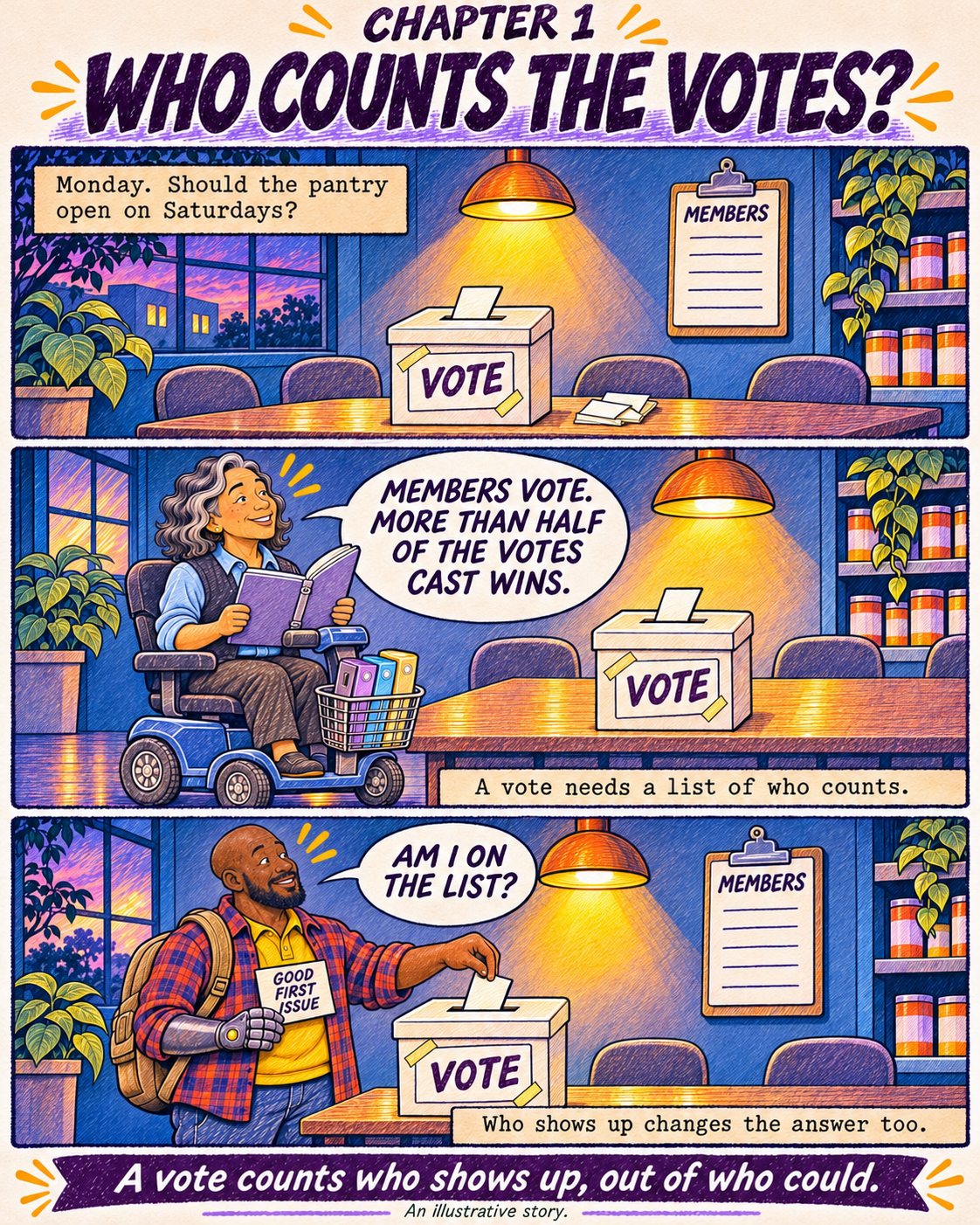
Text description of the chapter 1 comic page
What this illustration shows
- Subject: A three panel comic page titled “Chapter 1: Who counts the votes?” It acts out open source decision making by a members’ vote at a fictional community food pantry.
- Panel 1: An empty meeting room at dusk. A white ballot box labeled “Vote” sits on a table under a lamp. Meanwhile, a clipboard headed “Members” hangs on the wall, and a narration box reads “Monday. Should the pantry open on Saturdays?”
- Panel 2: The board member, who uses a four wheel mobility scooter with a basket of binders, reads from an open binder. Their balloon says, “Members vote. More than half of the votes cast wins.” Then the caption reads “A vote needs a list of who counts.”
- Panel 3: The newcomer drops a folded slip into the ballot box. Meanwhile, his prosthetic left hand holds a card that reads “Good first issue.” Next, his balloon asks, “Am I on the list?” Then the caption reads “Who shows up changes the answer too.”
- Relationships: In short, the rule counts only votes cast, so the members list and turnout decide who settles the question.
- Reading order: The title, then the panels top to bottom. Then the ribbon: “A vote counts who shows up, out of who could.” Finally, the footer reads “An illustrative story.”
📉 Who shows up to vote
Still, a vote counts only who shows up. PHP’s rules set no minimum turnout, so a 2 to 16 vote and a 40 to 0 vote carry equal weight.
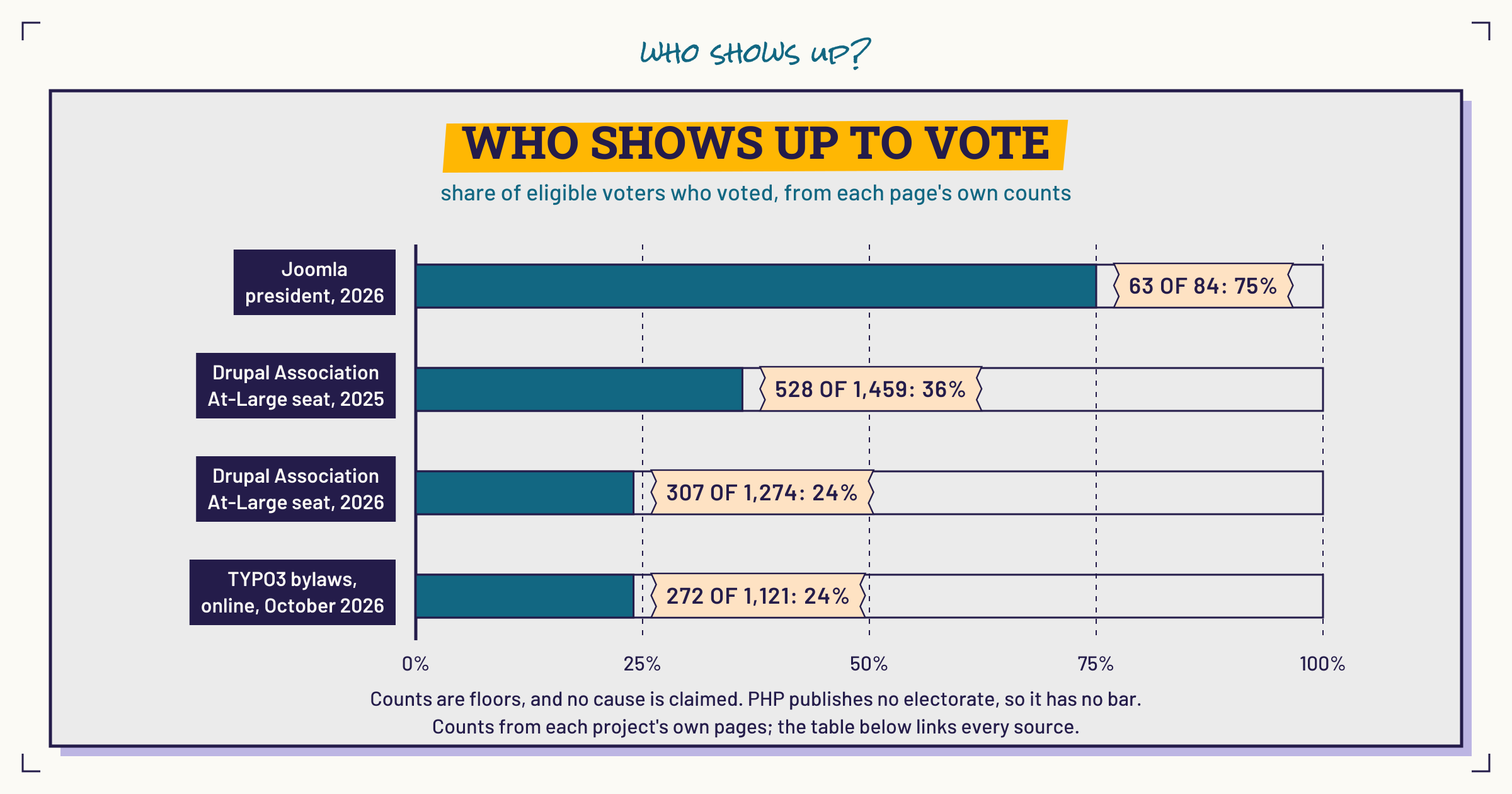
| Vote | Eligible | Voted | Share |
|---|---|---|---|
| Joomla president, 2026 | 84 | 63 | 75% |
| Drupal Association At-Large, 2025 | 1,459 | 528 | 36% |
| Drupal Association At-Large, 2026 | 1,274 | 307 | 24% |
| TYPO3 bylaws, online, October 2026 | 1,121 | 272 | 24% |
🔁 TYPO3: one term limit failed in April, another passed in October
- What happened: in April 2026, a member petition asked for a limit of two terms on the Board. It got 22 votes for and 44 against, so it failed.17 Then, in October, members voted online on a broader bylaw package. This time it passed 204 to 66, while 849 members didn’t vote.18
- Stated reasons: the petitioner wrote that the board “needs to be more diverse and also needs fresh faces.” However, the Board recommended rejection, citing “incomplete text, unresolved retroactivity” and more. Instead, it offered milder options, including “a cap of three instead of two consecutive terms.”19 Later, its September protocol proposed nine year limits and gave no reason there.20
- What decided it: members, by vote, both times. The new bylaws let Board members be reelected twice, then require a break of at least a year.21 In fact, that’s close to the Board’s April alternative.
- What cuts the other way: the October Assembly took note of the online result. The Association says a legal opinion made the online vote binding, but I found no link to the full opinion.22
Also, the 204 yes votes are 18 percent of 1,121 eligible members. So a rule can change with most members silent.
🤝 Consensus: how open source projects decide when nobody counts
In consensus projects, however, decisions start with three written answers: who must agree, how long silence counts, and what an objection does.
- Node.js: a change needs two approvals, or one after seven days. One collaborator’s objection blocks it until consensus or a committee vote.23
- OpenJS Cross Project Council: “silence indicates consent,” but objections must be resolved.24
- W3C: consensus means wide support with “no sustained objection from anybody in the set.”25
- WHATWG: a change needs support from “at least two implementers.” Since an edit on 2026-11-09, a positive standards position counts as support.26
- Drupal core: committers “use consensus decision-making,” and unresolved questions then go to the Project Lead.27
- WordPress: release candidates need “a double signoff by two different committers,” and “Every decision needs to be clearly made in public.”28
For example, here’s how open source projects decide by consensus on one WordPress ticket. In 2014, Mark Jaquith, now one of the five lead developers, proposed hiding the Week Starts On setting. It was punted: “Still looking for a consensus on the best way forward here.”29
In 2015, two changesets stored the week’s start per locale and hid the setting when it matched. Then rmccue wrote “Recommend revert,” because “it doesn’t seem like there was agreement here.” The revert landed, and the ticket closed as wontfix.30 Nobody voted, but every step is public.
However, consensus isn’t unanimity. Indeed, W3C’s process says dissenters can’t stop work “simply by saying” they can’t live with a decision.31
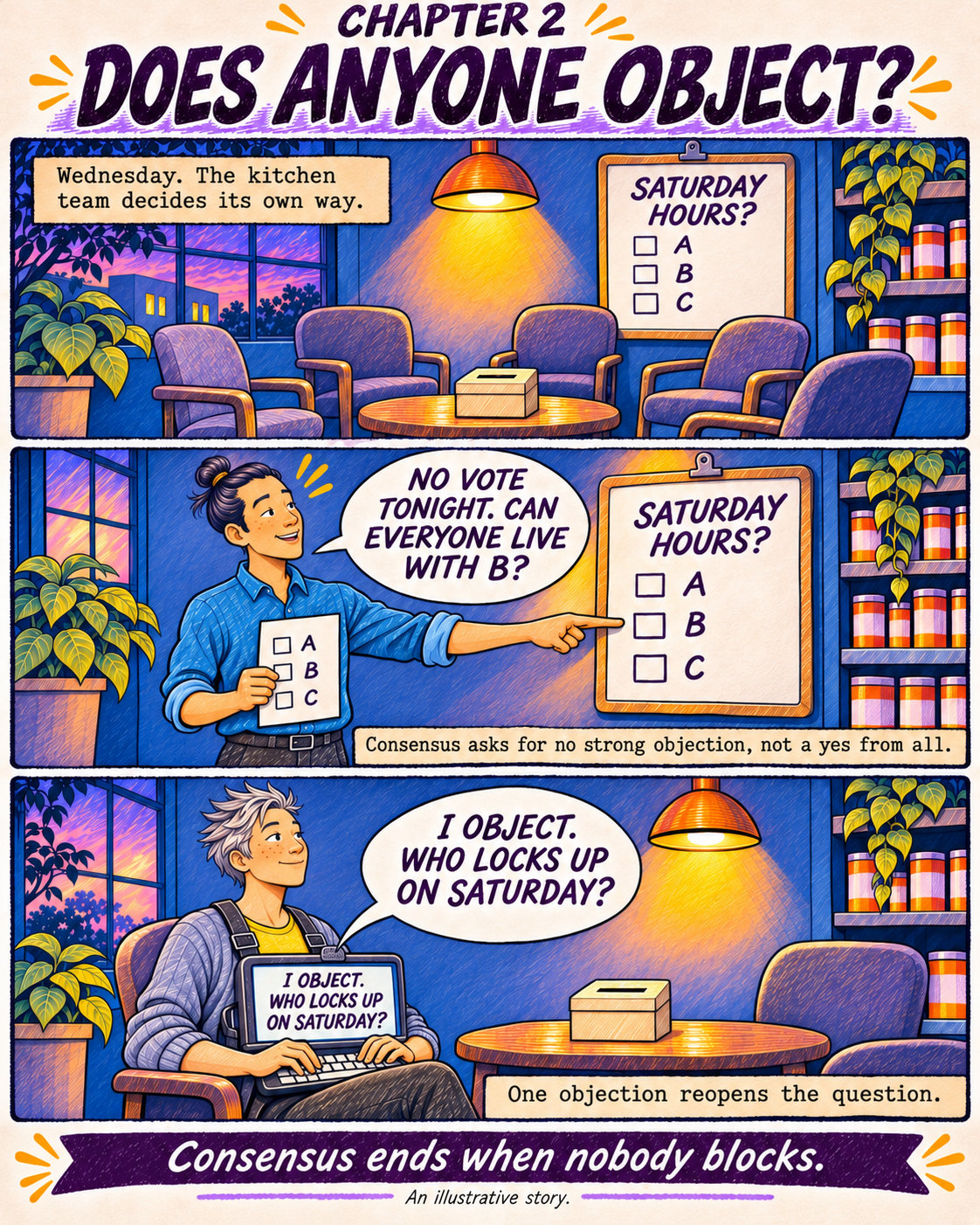
Text description of the chapter 2 comic page
What this illustration shows
- Subject: A three panel comic page titled “Chapter 2: Does anyone object?” The same fictional pantry tries to settle the same question by consensus, with no vote.
- Panel 1: A quiet kitchen with chairs in a circle around a low table. The slotted suggestion box sits on the table. Meanwhile, a board on the wall reads “Saturday hours?” over boxes for A, B and C. Then a narration box reads “Wednesday. The kitchen team decides its own way.”
- Panel 2: The team rep holds a printed sheet with the same three options and points at B on the board. His balloon asks, “No vote tonight. Can everyone live with B?” Then the caption reads “Consensus asks for no strong objection, not a yes from all.”
- Panel 3: The staff engineer types on the AAC tablet that hangs from a strap on her shoulders. Its screen and its speaker say, “I object. Who locks up on Saturday?” Then the caption reads “One objection reopens the question.”
- Relationships: In short, no one counts hands. Instead, a single stated objection keeps the question open.
- Reading order: The title, then the panels top to bottom. Then the ribbon: “Consensus ends when nobody blocks.” Finally, the footer reads “An illustrative story.”
🛑 Who can block a change in open source decision making
Still, in four of the compared projects, one person can stop a change in writing. But each writes a different way out.
| Project | Who can block | How the block ends |
|---|---|---|
| Apache (reference) | A binding no on a code change, with a technical reason | Only withdrawal; it “cannot be overruled nor overridden by anyone” |
| Backdrop CMS | Any committee member, on decisions that need unanimity | No written way out |
| Drupal core | No individual veto is written | The Project Lead “may proactively make or override these decisions” |
| MariaDB Server | Each council member, once every three years | A two thirds vote overrides |
| Node.js | Any collaborator, with a reason | Consensus, a committee vote, or dismissal after seven silent days |
| OpenJS Cross Project Council | Any objector | Two thirds of all voting members |
| PHP | No veto | A no from more than a third of yes and no votes defeats a proposal |
| W3C | No single block; anyone may file a Formal Objection | A council decides |
| WHATWG | Implementers, by declining to implement | The steering group can overrule an editor |
| WordPress | No written objection right | The release lead makes “big final decisions on feature readiness” |
Who decides the open source stack under WordPress also walks through Apache’s veto. Meanwhile, W3C publishes how its objection councils end.32
🏛️ How W3C objection councils end
- Count: the index lists ten completed formal cases from August 2023 to June 2026.
- Outcomes: five overruled the objection, one upheld it, three ended by a unanimous short circuit among council members, and one went to the CEO.
- Newest: a Digital Credentials council overruled its objection in June 2026.
Written override rules aren’t counts of overrides, though. In fact, no source read here counts how often an objection lost at Node.js or WHATWG.
🎯 A final say: one person, one company or one small group
Instead, some projects write the final say into a role. In that kind of open source decision making, though, the rule tells you who decides, not how often they overrule anyone.
- Drupal core: the Project Lead “acts as a tie-breaker when needed” and approves changes to governance. However, a footnote on the same page adds that the Project Lead “may proactively make or override these decisions.”33
- Ghost: staff decide, while feature votes are “not a democratic system.” Ghost keeps its roadmap private, because sharing it “turned out to be more distracting than helpful.”34
- MySQL: Oracle nominated the first committers and project leads, and “Oracle is the project lead.”35
- WHATWG: a steering group of browser makers has “final say in all matters.”36
- WordPress: the Core Handbook says a core leadership team “governs all aspects of the project,” led by Matt Mullenweg. Five lead developers also “have final authority on technical decisions.” But the page sets no term, election or removal rule.37
- xz-utils: one lead maintainer, but no governance file.38
Yes, but a written final say can still follow the room. Python had a founder with the final say until July 2018.39 For example, a study of about 1.5 million Python emails found the founder made most decisions on proposals. But where the community had reached a view, the founder or a delegate agreed with it in 99 percent of cases.40 In fact, the founder’s most common recorded reasons were consensus and lazy consensus.
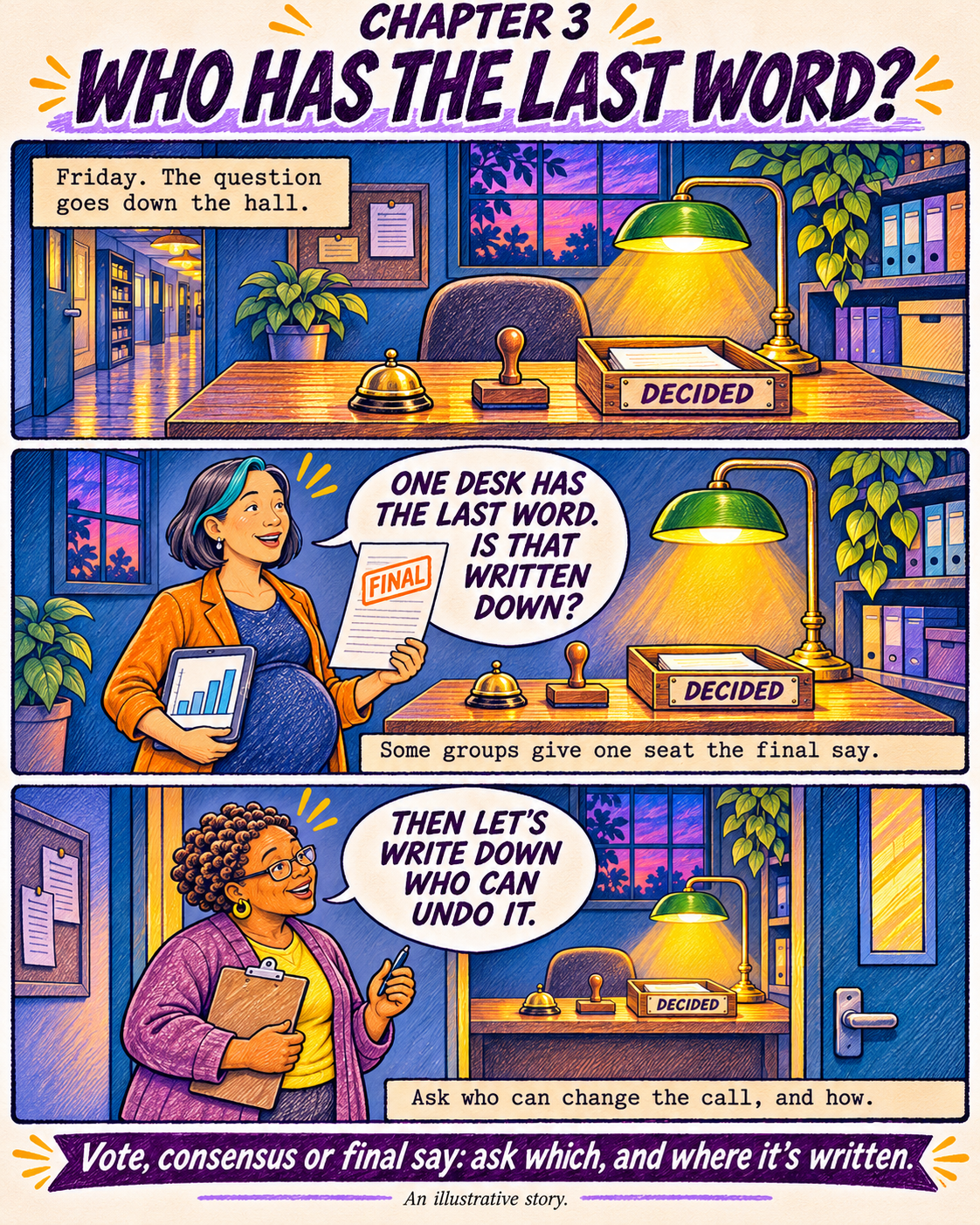
Text description of the chapter 3 comic page
What this illustration shows
- Subject: A three panel comic page titled “Chapter 3: Who has the last word?” The same fictional question reaches the one place where the pantry’s final say sits.
- Panel 1: A small office at dusk with nobody in it. On one desk under a green lamp sit a brass bell, a rubber stamp and a wooden tray labeled “Decided.” Meanwhile, the chair is pushed in, and a narration box reads “Friday. The question goes down the hall.”
- Panel 2: The program lead, who is pregnant, holds her tablet and a sheet from the tray. The sheet carries one stamped word: “Final.” Her balloon asks, “One desk has the last word. Is that written down?” Then the caption reads “Some groups give one seat the final say.”
- Panel 3: The pantry coordinator stands in the doorway with her clipboard and a pen. Her balloon says, “Then let’s write down who can undo it.” Then the caption reads “Ask who can change the call, and how.”
- Relationships: In short, the final say is drawn as a desk, a stamp and a tray, never as a person. Instead, the question shifts to who can reverse the call.
- Reading order: The title, then the panels top to bottom. Then the ribbon: “Vote, consensus or final say: ask which, and where it’s written.” Finally, the footer reads “An illustrative story.”
🔑 A written record of a final say
- What happened: in April 2026, Matt Mullenweg started Meta Janitors, 12 contributors with sandbox access to change WordPress.org.41
- Stated reason: “The goal is to move quickly, embrace experimentation, and rebuild WordPress.org.”
- What decided it: per the page, no team approves or gives feedback. Instead, the only approval it names is “me (Matt).”
- What cuts the other way: the page is public and also states its rule plainly. Still, it doesn’t say how members are chosen.
👥 Open source decision making inside teams
One level down: who decides inside a team, and who can undo it?
For example, WordPress answers on one shared page. Team Reps calls the rep role “mostly administrative in nature; it is not a Lead role.”42 Then it sets three tiers. If a change affects only your team, and “your team is agreement” (their typo, not mine), “go for it.” Changes that touch other teams need a written proposal, and with “significant opposition,” you “don’t proceed until we get the concerns addressed.” WordPress.org ideas need “Matt’s approval,” except “small/uncontroversial things like fixing typos.” Finally, the executive director or Matt “will make the final decision.”43
Of 26 team sites I checked, three publish a clear way to settle a contested decision: Core, CLI and Openverse. Sustainability, though, covers only minor changes. The rest describe approvals, elections or venues instead, with no tiebreaker.44 Two offer appeals for single rulings: theme suspensions go to the executive director or project lead, and conduct cases to a community team rep.4546 No page I read sets an appeal, or any procedure, for a change made from above.
⏱️ Nine times a team’s decision didn’t stand
I’m a former Training Team rep and Faculty member. In 2024 I wrote Sustainability Team posts, and I objected to its closure. My work sits alongside the Accessibility Team.
| When and team | Stated reason | What changed |
|---|---|---|
| Dec 2018, Core committers | “I would not recreate the old deliberation process”48 | Project lead alone approves commit access |
| Sep 2022, Performance | The default was “a lot for right now”49 | WebP by default came out of 6.1 |
| Mar 2024, Marketing | “not requests that I am able to fulfill”50 | Scope changed; then an archive plan in April |
| Jan 2025, Sustainability | “a good time to officially dissolve the team entirely”51 | Team dissolved and delisted |
| Apr to May 2026, Core committers | “have changed my mind and we’re doing this”52 | Akismet restored, although committers backed a revert |
| Apr 2026, Themes and Accessibility | “Somehow the #accessibility team put this requirement in?”53 | Link underline rule dropped |
| Apr 2026, Meta | “move quickly, embrace experimentation”54 | Janitors change WordPress.org without team approval |
| May 2026, Core | “a stable and reliable WordPress 7.0 release”55 | Real-time collaboration pulled from 7.0 |
| Aug 2026, Accessibility | “The team has overstepped its authority, usefulness, and charter.”56 | “Permanently delayed”; in October the team said “no themes will be delisted”57 |
Each was announced by post, ticket comment, handbook edit or Slack message. However, no page I read sets a procedure for these changes.
✅ When a team’s own call stood
🧩 Where other projects write the undo button
Other projects, however, write down the lever above a team.
| Project: who sits above the team | The written lever |
|---|---|
| Python: Steering Council | Recall a delegate, which “will overrule any prior acceptance or rejection”59; the proposal goes back to draft |
| Node.js: Technical Steering Committee (TSC) | “The only recourse” is to “revoke the entire charter”60 |
| Apache (reference): Board | End a project committee “by resolution”61 |
| Drupal: Review panel (conduct); Project Lead (core) | Panel overrides on appeal62; Lead may override core decisions63 |
| W3C: A council per case | Affirm or overturn on appeal64 |
| WordPress: Project lead; executive director | Final say written, but no override procedure |
WordPress writes down the org chart, but the undo button has no manual. Before you join a team, ask who can reverse its calls, and where that rule lives.
⚖️ Ties and deadlocks in open source decision making
A tie also needs a written way out. Overall, the exits fall into four kinds.
- A named person or office: Drupal’s Project Lead, and MySQL’s core project lead, who “makes the final decision.” Also, TYPO3’s chair on business items, with lots drawn in tied elections, and the W3C council chair.65666768
- Someone outside the deciding body: MariaDB’s Foundation CEO, “who must not be a member of the Council.”69
- Another vote: the Node.js committee votes, a tied PHP vote fails, and OpenJS overrules by two thirds.707172
- Nothing written: Ghost and xz-utils. In WordPress, meanwhile, Core Tech Lead cases “are usually escalated to project leadership,” a term the page doesn’t define.73
📜 Who changes the project decision rules
Who can rewrite the project decision rules is the sharpest dividing line in open source decision making.
- The voters: PHP voters set their own rules by the same two thirds vote. TYPO3 and Joomla members also amend their bylaws by two thirds.777879
- A board or council: the Drupal Association board, by two thirds of directors present, and MariaDB’s council, by two thirds.8081
- A second body: Node.js changes its committee charter only with approval from the OpenJS council. W3C’s Advisory Board drafts process changes for a member review of at least 28 days.8283
- No written path: Backdrop’s leadership rules, ClassicPress, Ghost, xz-utils and WordPress, whose organization and release team pages state no amendment step.8485
Even so, writing a path down doesn’t settle everything. PHP’s 2024 proposal to define who may vote is still a draft.86
🔎 Records you can check: how open source projects decide in public
Records turn open source decision making into something you can check.
Check it yourself: for example, open any PHP RFC page. The vote table then lists each voter’s username next to yes, no or abstain. For example, End PEAR Endorsement passed 40 to 0.87
- Named votes: PHP’s completed RFC votes list each voter’s username and choice.
- Named approvals: Node.js pull requests and their reviewer lines.88
- Positions in public issues: WHATWG steering group decisions.89
- Names without positions: W3C council reports name who took part but “must not attribute any position to any individual.”90
- Counts without names: TYPO3 protocols, Joomla’s motions registry and Drupal Association totals.
- Who asked: a 2026-11-13 Make WordPress Core post says a new theme became the flagship “at @matt’s request.”91
But do written rules match practice? For instance, one study covered 208 Apache Incubator projects. However, how much policy covered a topic had “no significant correlation” with how often projects did that work. Still, projects that followed voting protocols had better odds of graduating, which is a correlation, not a cause.93
❓ Questions to ask about open source decision making in any project
Ask these about open source decision making before you join, and again before you lead.
- Before you join: who decides this group’s recommendations, and by when?
- The bar: what counts as a yes, and out of whom?
- Blocks: who can stop a change, and who can lift the block?
- Ties: who breaks a tie or a deadlock?
- Rule changes: who can rewrite these rules?
- Records: where can you read who decided, and how?
When the answer is a page, read it. When it’s a person, write that down too.
💬 Quick answers about open source decision making
Some count votes against a written bar. Some seek consensus instead, where an objection can hold a change. Others give the final say to one person, one company or one small group. But most projects mix two.
A proposal goes ahead if nobody objects by the deadline its author announces. For example, the Apache Software Foundation describes it as “silence gives assent.”
In short, it depends on the written rules. Any Node.js collaborator can block a change until consensus or a committee vote. Each MariaDB Server council member gets one veto every three years, while PHP has no veto.
Next up, 2.3 asks what a fork can keep, and what stays behind when it leaves.
Footnotes (93)
- Drew Jaynes. “4.2 Community Initiative: NUX Working Group.” Make WordPress Core. 2015-02-05. https://make.wordpress.org/core/2015/02/05/4-2-community-initiative-nux-working-group/. Accessed 2026-11-13. ↩︎
- Tracy Levesque. “4.2 Nux Group Recap / Call to Action, March 3, 2015.” Make WordPress Test. 2015-03-08, with my comment of 2015-03-09 [CR]. https://make.wordpress.org/test/2015/03/08/4-2-nux-group-recap-call-to-action-march-3-2015/. Accessed 2026-11-13. ↩︎
- Tracy Levesque. “4.2 Nux Group Recap, March 17, 2015.” Make WordPress Test. 2015-03-17. https://make.wordpress.org/test/2015/03/17/4-2-nux-group-recap-march-17-2015/. Accessed 2026-11-13. ↩︎
- WordPress Trac. “#28344: Remove ‘Week Starts On’ setting UI.” core.trac.wordpress.org. 2014-05-24 to 2015-11-18, with changesets 35336, 35337 and 35685; my comment of 2015-02-24 [CR]. https://core.trac.wordpress.org/ticket/28344. Accessed 2026-11-13. ↩︎
- Drew Jaynes. “4.2 Community Initiative: NUX Working Group.” Make WordPress Core. 2015-02-05. https://make.wordpress.org/core/2015/02/05/4-2-community-initiative-nux-working-group/. Accessed 2026-11-13. ↩︎
- Making WordPress Slack. #core-test (named #core-flow in 2015), public channel. Messages of 2015-03-31, 2015-05-05 and 2015-06-11; my question of 2015-05-05 [CR]. https://wordpress.slack.com/ (sign-in required). Accessed 2026-11-13. ↩︎
- WordPress. “options-general.php.” wordpress-develop on GitHub, trunk. https://github.com/WordPress/wordpress-develop/blob/trunk/src/wp-admin/options-general.php. Accessed 2026-11-13. ↩︎
- The Apache Software Foundation. “Voting.” apache.org. https://www.apache.org/foundation/voting.html. Accessed 2026-11-13. ↩︎
- Pete Resnick. “RFC 7282: On Consensus and Humming in the IETF.” IETF. June 2014. https://datatracker.ietf.org/doc/html/rfc7282. Accessed 2026-11-13. ↩︎
- Merge Conflicts. “How does Merge Conflicts label evidence, stay fair and fix mistakes?” courtneyr.dev. https://courtneyr.dev/merge-conflicts-methods/. The finding is my analysis of the projects’ governing documents cited below. Accessed 2026-11-13. ↩︎
- Backdrop CMS. “Leadership.” backdropcms.org. https://backdropcms.org/about/leadership. Read through a summarizing tool. Accessed 2026-11-13. ↩︎
- ClassicPress. “Governance.” classicpress.net. Modified 2026-01-13. https://www.classicpress.net/governance/. Accessed 2026-11-13. ↩︎
- PHP. “Voting on PHP features.” wiki.php.net, modified 2025-02-10. https://wiki.php.net/rfc/voting. And “feature-proposals.rst.” php/policies on GitHub. https://github.com/php/policies/blob/main/feature-proposals.rst. Accessed 2026-11-13. ↩︎
- Caleb White. “PHP RFC: Pipe Assignment Operator.” wiki.php.net. Declined, poll closed August 2026. https://wiki.php.net/rfc/pipe_assignment_operator. Accessed 2026-11-13. ↩︎
- Open Source Matters. “2026 OSM President Election Results.” Joomla Community, Leadership blog. 2026. https://community.joomla.org/blogs/leadership/osm-president-election-results-2026.html. And “Amended and Restated By-laws of Open Source Matters, Inc.” 2021-12-13. https://www.opensourcematters.org/images/documents/20211213-OSM-Bylaws.pdf [PDF]. The results page labels 63 of 84 as 69.05 percent, which is 58 of 84 (the winner’s votes); 63 of 84 is 75 percent. Accessed 2026-11-13. ↩︎
- Drupal Association. “The Drupal Association Announces 2026 Board Election Winner.” drupal.org. 2026-08-31. https://www.drupal.org/association/blog/the-drupal-association-announces-2026-board-election-winner. And “The Drupal Association Announces 2025 Board Election Winner and Additional Board Members.” 2025-07-29. https://www.drupal.org/association/blog/the-drupal-association-announces-2025-board-election-winner-and-additional-board-members. Accessed 2026-11-13. ↩︎
- TYPO3 Association. “Protocol General Assembly 2026.” typo3.org. April 2026. https://typo3.org/fileadmin/Association/General_Assembly/2026/GA_2026_Protocol.pdf [PDF]. Accessed 2026-11-13. ↩︎
- Mathias Bolt Lesniak. “TYPO3 Association members approve new governance structure.” TYPO3 News. 2026-10-29. https://news.typo3.com/article/typo3-association-members-approve-new-governance-structure. And “EGA 2026 Protocol.” typo3.org. https://typo3.org/fileadmin/Association/General_Assembly/2026_extraordinary/EGA_2026_Protocol_signed.pdf [PDF]. Accessed 2026-11-13. ↩︎
- TYPO3 Association. “Protocol General Assembly 2026.” typo3.org. April 2026. https://typo3.org/fileadmin/Association/General_Assembly/2026/GA_2026_Protocol.pdf [PDF]. Accessed 2026-11-13. ↩︎
- Martin Helmich. “TYPO3 Association Board Meeting Protocol (30 September 2026).” TYPO3 News. Published 2026-10-22. https://news.typo3.com/article/typo3-association-board-meeting-protocol-30-september-2026. Accessed 2026-11-13. ↩︎
- TYPO3 Association. “Statuten der TYPO3 Association” (German original, valid since October 2026), Art. 15, 19 and 43. docs.typo3.org. https://docs.typo3.org/m/typo3/guide-policy/main/en-us/Association/BylawsAndProceedingsGermanOriginal.html. Translations are mine. Accessed 2026-11-13. ↩︎
- Mathias Bolt Lesniak. “TYPO3 Association members approve new governance structure.” TYPO3 News. 2026-10-29. https://news.typo3.com/article/typo3-association-members-approve-new-governance-structure. And “EGA 2026 Protocol.” typo3.org. https://typo3.org/fileadmin/Association/General_Assembly/2026_extraordinary/EGA_2026_Protocol_signed.pdf [PDF]. Accessed 2026-11-13. ↩︎
- Node.js. “GOVERNANCE.md” (last changed 2026-09-12) and “Collaborator Guide.” nodejs/node on GitHub. https://github.com/nodejs/node/blob/main/GOVERNANCE.md; https://github.com/nodejs/node/blob/main/doc/contributing/collaborator-guide.md. And “TSC Charter.” https://github.com/nodejs/TSC/blob/main/TSC-Charter.md. Accessed 2026-11-13. ↩︎
- OpenJS Foundation. “CPC Charter” (last changed 2026-02-03). openjs-foundation/cross-project-council on GitHub. https://github.com/openjs-foundation/cross-project-council/blob/main/CPC-CHARTER.md. Accessed 2026-11-13. ↩︎
- W3C. “W3C Process Document” (18 August 2025), sections 5.2, 5.5 and 5.6. w3.org. https://www.w3.org/policies/process/. Accessed 2026-11-13. ↩︎
- WHATWG. “Working Mode.” whatwg.org. https://whatwg.org/working-mode. And the edit of 2026-11-09, whatwg/sg commit f900d0a. https://github.com/whatwg/sg/commit/f900d0a4adeb38c5eee83c6c228781c3e15629c3. Accessed 2026-11-13. ↩︎
- Drupal. “Drupal core governance.” Drupal governance pages. https://project.pages.drupalcode.org/governance/core/drupal-core/. Accessed 2026-11-13. ↩︎
- WordPress. “WordPress Release Team and Focus Leads” (updated 2026-09-28), “Post and Comment Guidelines” and “Block Editor Release Process for Major Releases.” Core Handbook. https://make.wordpress.org/core/handbook/about/how-the-release-cycle-works/wordpress-release-team-and-focus-leads/; https://make.wordpress.org/core/handbook/best-practices/post-comment-guidelines/; https://make.wordpress.org/core/handbook/about/how-the-release-cycle-works/block-editor-release-process-for-major-releases/. Accessed 2026-11-13. ↩︎
- WordPress Trac. “#28344: Remove ‘Week Starts On’ setting UI.” core.trac.wordpress.org. 2014-05-24 to 2015-11-18, with changesets 35336, 35337 and 35685; my comment of 2015-02-24 [CR]. https://core.trac.wordpress.org/ticket/28344. Accessed 2026-11-13. ↩︎
- WordPress Trac. “#28344: Remove ‘Week Starts On’ setting UI.” core.trac.wordpress.org. 2014-05-24 to 2015-11-18, with changesets 35336, 35337 and 35685; my comment of 2015-02-24 [CR]. https://core.trac.wordpress.org/ticket/28344. Accessed 2026-11-13. ↩︎
- W3C. “W3C Process Document” (18 August 2025), sections 5.2, 5.5 and 5.6. w3.org. https://www.w3.org/policies/process/. Accessed 2026-11-13. ↩︎
- W3C. “W3C Council” index and the Digital Credentials council report (2026-06-19). w3.org. https://www.w3.org/about/council/; https://www.w3.org/2026/06/council-digital-credentials-report.html. Accessed 2026-11-13. ↩︎
- Drupal. “Drupal core governance.” Drupal governance pages. https://project.pages.drupalcode.org/governance/core/drupal-core/. Accessed 2026-11-13. ↩︎
- Ghost. “Product principles.” Ghost docs. https://docs.ghost.org/product. Accessed 2026-11-13. ↩︎
- Oracle. “MySQL Community Governance Model,” sections 3.2, 3.3 and 15.1. dev.mysql.com. https://dev.mysql.com/community/governance-model/. Section 10 (Conflict Resolution) also read. Read through a summarizing tool. Accessed 2026-11-13. ↩︎
- WHATWG. “Steering Group Agreement.” whatwg.org. 2017. https://whatwg.org/sg-agreement. And “Steering Group Policy.” https://whatwg.org/sg-policy. Accessed 2026-11-13. ↩︎
- WordPress. “Project Organization” (updated 2026-09-07). Core Handbook. https://make.wordpress.org/core/handbook/about/organization/. Accessed 2026-11-13. ↩︎
- Tukaani Project. “README” and “AUTHORS.” tukaani-project/xz on GitHub. https://github.com/tukaani-project/xz/blob/master/README. Accessed 2026-11-13. ↩︎
- Python. “PEP 13: Python Language Governance.” peps.python.org. https://peps.python.org/pep-0013/. Accessed 2026-11-13. ↩︎
- Pankajeshwara Nand Sharma, Bastin Tony Roy Savarimuthu and Nigel Stanger. “Influence of Roles in Decision-Making during OSS Development: A Study of Python.” EASE 2021. https://arxiv.org/abs/2106.02209. The 99 percent covers proposals where a community view was established, about 60 percent of them. The paper’s own counts differ in places (248 or 245 proposals; 415 of 466 proposals decided by the founder alongside a 73 percent share). Accessed 2026-11-13. ↩︎
- WordPress. “Meta Janitors.” Make WordPress Meta handbook. Updated 2026-04-23. https://make.wordpress.org/meta/handbook/about/projects/meta-janitors/. Accessed 2026-11-13. ↩︎
- WordPress. “Team Reps.” Make WordPress Updates. Updated 2026-09-28. https://make.wordpress.org/updates/team-reps/. Accessed 2026-11-14. ↩︎
- WordPress. “Team Reps.” Make WordPress Updates. Updated 2026-09-28. https://make.wordpress.org/updates/team-reps/. Accessed 2026-11-14. ↩︎
- WordPress. “Teams.” make.wordpress.org. https://make.wordpress.org/teams/. The count is my analysis of each team’s handbook and Make site, read 2026-11-14: 24 listed teams plus the Sustainability and Media Corps sites. Accessed 2026-11-14. ↩︎
- WordPress Themes Team. “Theme suspension.” Theme review handbook. https://make.wordpress.org/themes/handbook/review/theme-suspension/. Accessed 2026-11-14. ↩︎
- WordPress Community Team. “Incident report response procedure.” Community handbook. Updated 2023-08-10. https://make.wordpress.org/community/handbook/community-deputy/the-community-supporter-program/when-things-happen/incident-report-response-procedure/. Accessed 2026-11-14. ↩︎
- Making WordPress Slack. Public channels #core-committers, #sustainability and #themes; messages of 2018-12-15, 2025-01-08 and 2026-04-13. https://wordpress.slack.com/ (sign-in required). Accessed 2026-10-28. ↩︎
- Matt Mullenweg. Message in #core-committers, Making WordPress Slack. 2018-12-15. https://wordpress.slack.com/ (sign-in required). Accessed 2026-10-28. ↩︎
- Matt Mullenweg. “WebP in Core for 6.1.” Make WordPress Core. 2022-09-11. https://make.wordpress.org/core/2022/09/11/webp-in-core-for-6-1/. Accessed 2026-11-14. ↩︎
- Josepha Haden Chomphosy. “Making a WordPress Media Corps.” Make WordPress Marketing. 2024-03-20. https://make.wordpress.org/marketing/2024/03/20/making-a-wordpress-media-corps/. And “WordPress Media Corps Next Steps.” 2024-04-29. https://make.wordpress.org/marketing/2024/04/29/wordpress-media-corps-next-steps/. Accessed 2026-11-14. ↩︎
- Matt Mullenweg. Message in #sustainability, Making WordPress Slack. 2025-01-08. https://wordpress.slack.com/ (sign-in required). Accessed 2026-10-26. ↩︎
- WordPress Trac. “#65012.” core.trac.wordpress.org. Comments 38, 48 and 54, April to May 2026. https://core.trac.wordpress.org/ticket/65012. Accessed 2026-11-14. ↩︎
- Matt Mullenweg. Messages in #core-committers and #themes, Making WordPress Slack. 2026-04-13. https://wordpress.slack.com/ (sign-in required). Accessed 2026-10-28. ↩︎
- WordPress. “Meta Janitors.” Make WordPress Meta handbook. Updated 2026-04-23. https://make.wordpress.org/meta/handbook/about/projects/meta-janitors/. Accessed 2026-11-13. ↩︎
- annezazu. “Real-time collaboration will not ship in WordPress 7.0.” Make WordPress Core. 2026-05-08. https://make.wordpress.org/core/2026/05/08/rtc-removed-from-7-0/. Read through a summarizing tool. Accessed 2026-11-14. ↩︎
- Matt Mullenweg. Comments 73307 and 73308, 2026-08-01, on Joe Dolson, “Accessibility-ready Theme Reviews: Extending the Deadline.” Make WordPress Accessibility. 2026-07-23. https://make.wordpress.org/accessibility/2026/07/23/accessibility-ready-theme-reviews-extending-the-deadline/#comment-73307. Accessed 2026-11-14. ↩︎
- Joe Dolson. “Accessibility-ready directory changes coming!” Make WordPress Accessibility. 2026-10-05. https://make.wordpress.org/accessibility/2026/10/05/accessibility-ready-directory-changes-coming/. Accessed 2026-11-14. ↩︎
- Kathryn Presner. “Project Thread: Retiring the Faculty Program.” Make WordPress Training. 2024-07-02. https://make.wordpress.org/training/2024/07/02/project-thread-retiring-the-faculty-program/. Nora Ferreirós. “Sustainability Team self-approval system (formal decision).” Make WordPress Sustainability. 2024-03-15. https://make.wordpress.org/sustainability/2024/03/15/sustainability-team-self-approval-system-formal-decision/. And Marin Atanasov. “The Classic block stays in the inserter for WordPress 7.1.” Make WordPress Core. 2026-07-07. https://make.wordpress.org/core/2026/07/07/the-classic-block-stays-in-the-inserter-for-wordpress-7-1/. Accessed 2026-11-14. ↩︎
- Python. “PEP 1: PEP Purpose and Guidelines.” peps.python.org. https://peps.python.org/pep-0001/. Accessed 2026-11-14. ↩︎
- Node.js. “WORKING_GROUPS.md.” nodejs/TSC on GitHub. https://github.com/nodejs/TSC/blob/main/WORKING_GROUPS.md. Accessed 2026-11-14. ↩︎
- The Apache Software Foundation. “Bylaws,” section 6.3. apache.org. https://www.apache.org/foundation/bylaws.html. Accessed 2026-11-14. ↩︎
- Drupal. “Community Working Group charter.” Drupal governance pages. https://project.pages.drupalcode.org/governance/charters/community-working-group-charter/. Accessed 2026-11-14. ↩︎
- Drupal. “Drupal core governance.” Drupal governance pages. https://project.pages.drupalcode.org/governance/core/drupal-core/. Accessed 2026-11-13. ↩︎
- W3C. “W3C Process Document” (18 August 2025), sections 5.2, 5.5 and 5.6. w3.org. https://www.w3.org/policies/process/. Accessed 2026-11-13. ↩︎
- Drupal. “Drupal core governance.” Drupal governance pages. https://project.pages.drupalcode.org/governance/core/drupal-core/. Accessed 2026-11-13. ↩︎
- Oracle. “MySQL Community Governance Model,” sections 3.2, 3.3 and 15.1. dev.mysql.com. https://dev.mysql.com/community/governance-model/. Section 10 (Conflict Resolution) also read. Read through a summarizing tool. Accessed 2026-11-13. ↩︎
- TYPO3 Association. “Statuten der TYPO3 Association” (German original, valid since October 2026), Art. 15, 19 and 43. docs.typo3.org. https://docs.typo3.org/m/typo3/guide-policy/main/en-us/Association/BylawsAndProceedingsGermanOriginal.html. Translations are mine. Accessed 2026-11-13. ↩︎
- W3C. “W3C Process Document” (18 August 2025), sections 5.2, 5.5 and 5.6. w3.org. https://www.w3.org/policies/process/. Accessed 2026-11-13. ↩︎
- MariaDB. “governance.md,” sections 3.2 and 3.3. MariaDB/governance on GitHub. 2026-08-01. https://github.com/MariaDB/governance/blob/main/governance.md. Accessed 2026-11-13. ↩︎
- Node.js. “GOVERNANCE.md” (last changed 2026-09-12) and “Collaborator Guide.” nodejs/node on GitHub. https://github.com/nodejs/node/blob/main/GOVERNANCE.md; https://github.com/nodejs/node/blob/main/doc/contributing/collaborator-guide.md. And “TSC Charter.” https://github.com/nodejs/TSC/blob/main/TSC-Charter.md. Accessed 2026-11-13. ↩︎
- PHP. “Voting on PHP features.” wiki.php.net, modified 2025-02-10. https://wiki.php.net/rfc/voting. And “feature-proposals.rst.” php/policies on GitHub. https://github.com/php/policies/blob/main/feature-proposals.rst. Accessed 2026-11-13. ↩︎
- OpenJS Foundation. “CPC Charter” (last changed 2026-02-03). openjs-foundation/cross-project-council on GitHub. https://github.com/openjs-foundation/cross-project-council/blob/main/CPC-CHARTER.md. Accessed 2026-11-13. ↩︎
- WordPress. “WordPress Release Team and Focus Leads” (updated 2026-09-28), “Post and Comment Guidelines” and “Block Editor Release Process for Major Releases.” Core Handbook. https://make.wordpress.org/core/handbook/about/how-the-release-cycle-works/wordpress-release-team-and-focus-leads/; https://make.wordpress.org/core/handbook/best-practices/post-comment-guidelines/; https://make.wordpress.org/core/handbook/about/how-the-release-cycle-works/block-editor-release-process-for-major-releases/. Accessed 2026-11-13. ↩︎
- WP Tavern. “ClassicPress Community Votes to Re-Fork WordPress.” wptavern.com. 2023-01-11. https://wptavern.com/classicpress-community-votes-to-re-fork-wordpress. Accessed 2026-11-06. ↩︎
- ClassicPress. “Governance.” classicpress.net. Modified 2026-01-13. https://www.classicpress.net/governance/. Accessed 2026-11-13. ↩︎
- Jakub Zelenka and Larry Garfield. “PHP RFC: PHP Technical Committee.” Declined 10 to 21 on 2023-05-12. wiki.php.net. https://wiki.php.net/rfc/php_technical_committee. Accessed 2026-11-13. ↩︎
- PHP. “Voting on PHP features.” wiki.php.net, modified 2025-02-10. https://wiki.php.net/rfc/voting. And “feature-proposals.rst.” php/policies on GitHub. https://github.com/php/policies/blob/main/feature-proposals.rst. Accessed 2026-11-13. ↩︎
- TYPO3 Association. “Statuten der TYPO3 Association” (German original, valid since October 2026), Art. 15, 19 and 43. docs.typo3.org. https://docs.typo3.org/m/typo3/guide-policy/main/en-us/Association/BylawsAndProceedingsGermanOriginal.html. Translations are mine. Accessed 2026-11-13. ↩︎
- Open Source Matters. “2026 OSM President Election Results.” Joomla Community, Leadership blog. 2026. https://community.joomla.org/blogs/leadership/osm-president-election-results-2026.html. And “Amended and Restated By-laws of Open Source Matters, Inc.” 2021-12-13. https://www.opensourcematters.org/images/documents/20211213-OSM-Bylaws.pdf [PDF]. The results page labels 63 of 84 as 69.05 percent, which is 58 of 84 (the winner’s votes); 63 of 84 is 75 percent. Accessed 2026-11-13. ↩︎
- Drupal Association. “Second Restated Bylaws” (updated 2017-12-12). drupal.org. https://drupal.org/files/board-bylaws.pdf [PDF]. Accessed 2026-11-13. ↩︎
- MariaDB. “governance.md,” sections 3.2 and 3.3. MariaDB/governance on GitHub. 2026-08-01. https://github.com/MariaDB/governance/blob/main/governance.md. Accessed 2026-11-13. ↩︎
- Node.js. “GOVERNANCE.md” (last changed 2026-09-12) and “Collaborator Guide.” nodejs/node on GitHub. https://github.com/nodejs/node/blob/main/GOVERNANCE.md; https://github.com/nodejs/node/blob/main/doc/contributing/collaborator-guide.md. And “TSC Charter.” https://github.com/nodejs/TSC/blob/main/TSC-Charter.md. Accessed 2026-11-13. ↩︎
- W3C. “W3C Process Document” (18 August 2025), sections 5.2, 5.5 and 5.6. w3.org. https://www.w3.org/policies/process/. Accessed 2026-11-13. ↩︎
- WordPress. “Project Organization” (updated 2026-09-07). Core Handbook. https://make.wordpress.org/core/handbook/about/organization/. Accessed 2026-11-13. ↩︎
- WordPress. “WordPress Release Team and Focus Leads” (updated 2026-09-28), “Post and Comment Guidelines” and “Block Editor Release Process for Major Releases.” Core Handbook. https://make.wordpress.org/core/handbook/about/how-the-release-cycle-works/wordpress-release-team-and-focus-leads/; https://make.wordpress.org/core/handbook/best-practices/post-comment-guidelines/; https://make.wordpress.org/core/handbook/about/how-the-release-cycle-works/block-editor-release-process-for-major-releases/. Accessed 2026-11-13. ↩︎
- PHP. “Voting on PHP features.” wiki.php.net, modified 2025-02-10. https://wiki.php.net/rfc/voting. And “feature-proposals.rst.” php/policies on GitHub. https://github.com/php/policies/blob/main/feature-proposals.rst. Accessed 2026-11-13. ↩︎
- PHP. “PHP RFC: End PEAR Project Endorsement.” wiki.php.net. 2026. https://wiki.php.net/rfc/end_pear_endorsement. Accessed 2026-11-13. ↩︎
- Node.js. “GOVERNANCE.md” (last changed 2026-09-12) and “Collaborator Guide.” nodejs/node on GitHub. https://github.com/nodejs/node/blob/main/GOVERNANCE.md; https://github.com/nodejs/node/blob/main/doc/contributing/collaborator-guide.md. And “TSC Charter.” https://github.com/nodejs/TSC/blob/main/TSC-Charter.md. Accessed 2026-11-13. ↩︎
- WHATWG. “Steering Group Agreement.” whatwg.org. 2017. https://whatwg.org/sg-agreement. And “Steering Group Policy.” https://whatwg.org/sg-policy. Accessed 2026-11-13. ↩︎
- W3C. “W3C Process Document” (18 August 2025), sections 5.2, 5.5 and 5.6. w3.org. https://www.w3.org/policies/process/. Accessed 2026-11-13. ↩︎
- Henrique Iamarino. “Introducing Mētis, our new flagship theme.” Make WordPress Core. 2026-11-13. https://make.wordpress.org/core/2026/11/13/introducing-metis-our-new-flagship-theme/. Accessed 2026-11-13. ↩︎
- Anne McCarthy. “WordPress 7.1 Release Lead Decision Log.” nomad.blog. 2026-08-21. https://nomad.blog/2026/08/21/wordpress-7-1-release-lead-decision-log/. Accessed 2026-11-13. ↩︎
- Mahasweta Chakraborti, Curtis Atkisson, Stefan Stanciulescu, Vladimir Filkov and Seth Frey. “Do We Run How We Say We Run? Formalization and Practice of Governance in OSS Communities.” ACM, 2024. https://doi.org/10.1145/3613904.3641980; https://arxiv.org/abs/2309.14245. The authors call the graduation link correlational. Accessed 2026-11-13. ↩︎
Leave a Reply