

In Go, Python and Rust, a proposal has a recorded place to land. Someone named decides it, its status changes, and someone writes the answer down. That’s what an open source proposal process does. WordPress writes down what a proposal contains and asks for update posts. It has no shared list of endings for one.
Estimated reading time: 19 minutes
Key takeaways
- The big picture: Five projects’ documents name who decides a proposal, the states it can move through, and where the answer goes. Some proposals still stay open on purpose.
- Why it matters: When the endings aren’t written, a late reason can look like a moved goalpost. Silence can be read as a yes or a no.
- Yes, but: WordPress asks for public update posts and gives Trac tickets defined endings. And the 2026 Guidelines merge proposal got a written answer on its own post in 18 days.
Table of contents
- 🧾 What counts as a proposal, or a request for comments?
- ⚙️ How does a proposal process reach an answer?
- 📚 What WordPress writes down about its proposal process
- 🎯 Does a proposal have to meet the 80% rule?
- 🗂️ Three WordPress proposals, and what the record shows
- 🧠 Where do fallacies come into a proposal process?
- 🔍 Five closer looks at proposal process fallacies
- ✅ Questions to ask of any open source proposal process
🧾 What counts as a proposal, or a request for comments?
You’ve probably opened a Make WordPress post with “Proposal:” in its title and wondered whether you were being asked or told. Fair question. The word does three jobs, and the title doesn’t say which one it’s doing today.
Here’s a working definition that holds across projects. A proposal is a written request to change a project’s code, process or policy, made for review before a decision. In projects with a defined process, the documents add the details. They say who may file one and what it must contain. They also say who decides, which states it can move through and where the answer goes.
In practice, the same word covers three different posts:
- A request: the author wants feedback before anyone decides.
- An announcement: someone already decided, and the post explains it.
- An idea: nobody has asked for a decision yet.
Each kind is useful. The trouble starts when readers can’t tell which one they’re reading. Each asks something different of you: a comment, a reaction or patience.
Post 2.2 asked how projects decide. This post looks at the paperwork that comes first. (Yes, there’s paperwork. There’s always paperwork.) The methods page explains the evidence labels you’ll see below.
⚙️ How does a proposal process reach an answer?
I read the open source proposal process rules of five projects on November 17, 2026, each from the project’s own documents. Four parts show up again and again:
- The thing itself: a numbered document, a labeled issue or a named wiki page, so everyone knows what’s under review.
- A named decider: Python’s Steering Council, a Rust subteam, Go’s proposal review group.
- A list of states: the stages and outcomes a proposal can show.
- Somewhere for the answer: a header, a label or a set of minutes.
Some add a way to park a proposal nobody decides. Python lets the author or an editor mark a PEP Deferred “when no progress is being made on the PEP.”1 Under Go’s proposal README, the review group can move a proposal to Likely Decline when it finds “that the default of not accepting the proposal is appropriate.”2 Still, none of this means every proposal ends. PEP 1 says some PEPs stay Active “if they are never meant to be completed.”3
📋 Six projects, side by side
| Project | What it’s called | Who decides | Documented stages and outcomes | If nobody decides | Where the answer goes |
|---|---|---|---|---|---|
| Go | Proposal, filed as a GitHub issue4 | The proposal review group; if it can’t reach consensus, Go’s architects, then an arbiter | Incoming, Active, Likely Accept, Likely Decline, Accepted, Declined, Declined as Duplicate, Infeasible, Retracted, Obsolete, Hold | Without consensus, it can move to Likely Decline; Hold needs “a note of what it is waiting on” | The issue’s label and the review minutes |
| Kubernetes | KEP (Kubernetes Enhancement Proposal)5 | Approvers, who “decide when to move this KEP to the implementable state” | provisional, implementable, implemented, deferred, rejected, withdrawn, replaced | deferred: “proposed but not actively being worked on”; no automatic timeout | The KEP’s status field |
| PHP | RFC (Request for Comments)67 | Voters; a primary vote passes with “a 2/3 majority” | In Draft, Under Discussion, Voting, Accepted, Declined, Implemented (the howto’s list) | No forced vote: “The discussion is not required to go to a vote at any particular point.” | The RFC’s wiki page and the RFC index |
| Python | PEP (Python Enhancement Proposal)8 | The Steering Council, or a PEP-Delegate it approves | Draft, Active, Accepted, Provisional, Deferred, Rejected, Withdrawn, Final, Superseded | Deferred “when no progress is being made”; some PEPs stay Active on purpose | The PEP’s Status header; Standards Track PEPs also need a Resolution header |
| Rust | RFC9 | The relevant subteam, through a final comment period that “lasts ten calendar days” and can be canceled | Open, final comment period, merged (“active”), closed, postponed | Postponed is a closing choice; no timeout before that | The merged or closed pull request; a rationale comment when the thread doesn’t make it clear |
| WordPress | Proposal or merge proposal, posted on a Make blog10 | “the Core team,” for features | None listed for Make posts (Trac tickets have resolutions) | None listed for Make posts (Trac sends stalled tickets to Future Release) | Update posts are expected; no closing record is required |
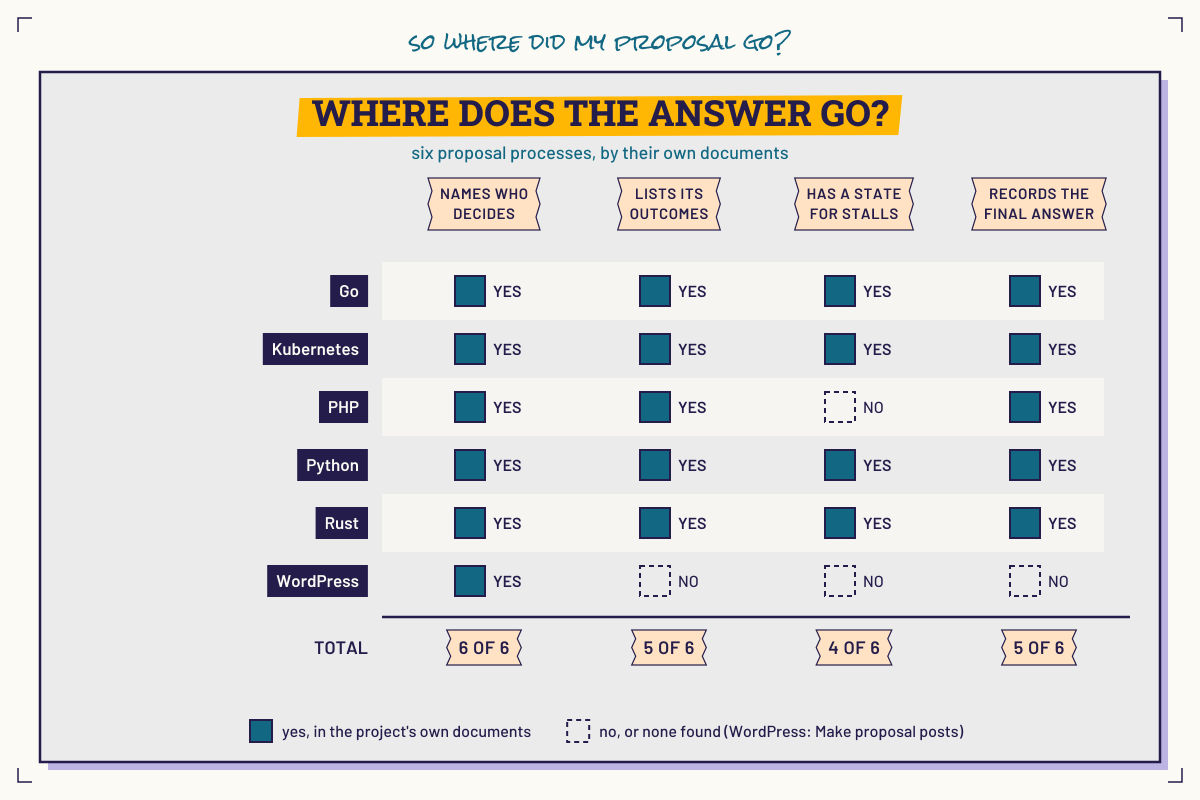 [PNG, 79.37 KB]
Text description and data for the four checks chart
What this chart shows
- What it shows: A grid with six projects in rows, A to Z, and four checks in columns. A filled box with “YES” means the project’s own documents say yes. A dashed box with “NO” means no, or none found in the documents read. Each column ends with a total out of 6.
- Names who decides, 6 of 6: Go, Kubernetes, PHP, Python, Rust and WordPress. For features, WordPress names “the Core team.”
- Lists its outcomes, 5 of 6: every project except WordPress. Make proposal posts have no listed outcomes, though Trac tickets have resolutions.
- Has a state for stalls, 4 of 6: Go (Likely Decline and Hold), Kubernetes (deferred), Python (Deferred) and Rust (postponed). PHP says discussion isn’t required to go to a vote. WordPress lists none for Make posts.
- Records the final answer, 5 of 6: Go’s issue label, the Kubernetes status field, PHP’s RFC page and index, Python’s Status header and Rust’s merged or closed pull request. WordPress expects update posts but requires no closing record.
📉 A written process still says no
A written process still says no a lot. A 2025 study of Go proposals counted 448 declined and 337 accepted. The median wait was 31 days for a no and 37 for a yes. The authors found 66 of the 448 declined proposals came back, and they say they may have missed some.11 (Its abstract says 1,091 proposals; the paper’s own table adds up to 1,095.) A written process doesn’t make the answers kinder. It makes them findable.
📚 What WordPress writes down about its proposal process
Credit first: WordPress writes down a lot about proposals, in three handbook pages and its bug tracker.
- Features as Plugins: New feature ideas arrive “in the form of a short proposal.” Update posts “are published publicly, tracking the progress and major decisions of the feature plugin.” A merge criterion asks for a plugin that “is used/tested by the community.” Then “the decision on whether a feature makes it into core rests in the hands of the Core team,” and “requirements will vary.”12
- The Trac handbook: “Feature requests: These are proposals for new features.” And: “If there is no progress on a ticket, please place it in the Future Release milestone.”13
- The Design handbook: A page called “Writing a design proposal” lists what the post should cover.14
- Trac resolutions: Tickets close as fixed, duplicate, invalid, worksforme, wontfix, maybelater or reported-upstream. The handbook adds, “It is not an exact science.”15 (Points for honesty.)
So WordPress writes down what a proposal contains, how it reports progress, and who decides features. That’s a good share of an open source proposal process. What a Make proposal post doesn’t get is a shared list of endings, or a required closing record on the post itself. The /random/ case study found a similar shape: a route that’s customary, not required.
To be fair, PHP doesn’t force a vote either, so an RFC can sit, too.16 The difference: its status field says “Under Discussion.”17
🎯 Does a proposal have to meet the 80% rule?
WordPress also writes down a test for what belongs in core. Here’s how that test meets the proposal process.
Its philosophy page calls it “the rule of thumb.” Core “should provide features that 80% or more of end users will actually appreciate and use.”18
- The philosophy page: It names the threshold and describes the typical user as someone who isn’t technical. It doesn’t say who counts the 80%, what counts as evidence or who applies the test. The page shows no date.19
- The roadmap: It lists the editor’s phases and the 2026 goals. It doesn’t say who sets the roadmap or how a feature gets onto it. Instead, it sends you to the Feature Projects Overview and the issue tracker.20
- Features as Plugins: The proposal route never mentions the 80% rule. It asks for a plugin “used/tested by the community” and weighs “positive feedback from the community.” The page was last updated February 7, 2018.21
So no proposal format asks you to show the 80%. The test lives on one page and the route on another, and nothing connects them.
🔀 Why didn’t /random/ go through a proposal process?
- Ticket 64498: It asked, “This ticket proposes discussing whether a minimal, opt-in core implementation should exist.” It’s now typed “task (blessed).” Jorbin changed its type after Beta 1: “Since we are now past beta 1, moving this to a blessed task.”22
- The stated reason: In comment 12, annezazu wrote, “@matt requested this in Core. That’s the root of why this is being added and why it’s not being pursued as a canonical plugin.”23
- The commits: A September 21 commit added a
?randomquery option, “disabled by default.”24 Two days later, a revert said, “The feature is intended to land in WordPress 7.2 but will need some work.”25 An October 16 commit by Aaron Jorbin added the/random/address. It names no feature plugin or proposal post.26 - Dev note: Jorbin’s November 5 note says, “The feature is on by default.” It gives no reason for the default and doesn’t mention a proposal or a feature plugin.27
Where the request was first made, and who decided the default. Nothing I checked names a decider. Unknown means the record doesn’t say, not that no one decided.
Disclosure: I tested /random/ and reported results on its ticket twice, as courane01.29 I also mentioned the ticket in the #core Slack channel.
🗣️ Did both sides read the 80% rule the same way?
In the comments, both sides reached for the same rule. David E. Smith asked whether core features should serve the majority. Jorbin replied, “I think the majority of people want their content to be discovered, so yes, this should be useful for the majority.”30 Joost de Valk asked, “Do we think 80% or even 50% could benefit from this feature?” Taco Verdonschot wrote, “But that is not 80% of the WP websites out there, it’s a niche.” Ben May named the route not taken: “Incubating this as a standalone feature plugin first would respect the established Core merge process.”31
⏳ How much notice did site owners get?
| Date (2026) | What happened | Where | Days before release |
|---|---|---|---|
| September 21 | ?random committed, off by default | Trac changeset34 | 78 |
| September 22 and 23 | Comments discuss “on/off by default” | Trac ticket35 | 77 |
| October 16 | /random/ address committed; the message doesn’t mention a default | Trac changeset36 | 53 |
| October 20 | Beta 1 post describes the feature without the word “default” | WordPress News37 | 49 |
| November 5 | Dev note: “The feature is on by default” | Make Core38 | 33 |
| November 17 | Release Candidate 1 | WordPress News39 | 21 |
/random/ default became public, by venue. Read 2026-11-18; day counts are my arithmetic, to the December 8 release.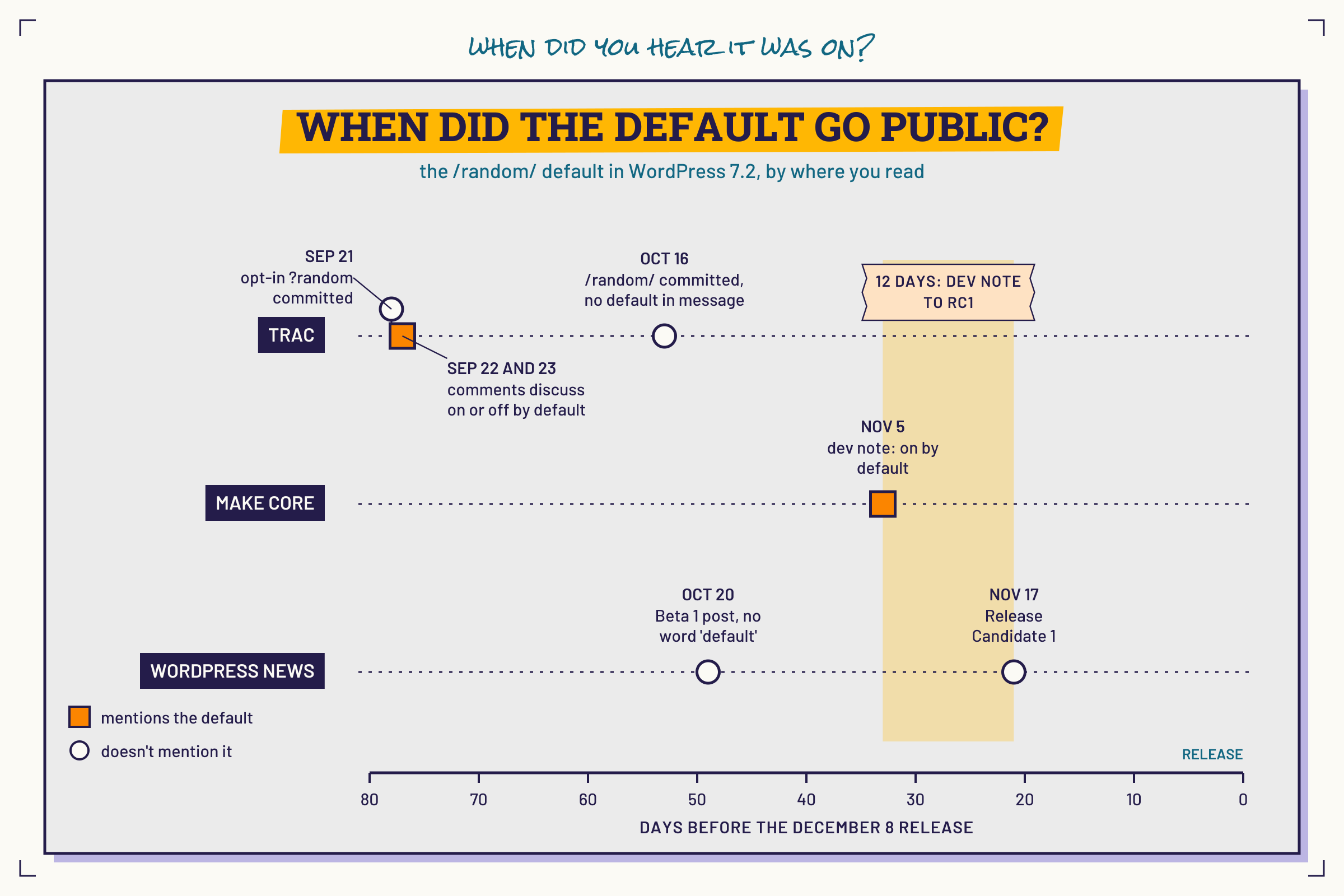
/random/ default went public, by where you read. Same dates as the table above; day counts are my arithmetic. Chart drawn with Claude at my direction.Text description of the notice timeline chart
What this chart shows
- What it shows: A timeline in days before the December 8, 2026 release, with one row each for Trac, Make Core and WordPress News.
- Trac: On September 21, 78 days out, an opt-in
?randomoption is committed. On September 22 and 23, 77 days out, comments discuss on or off by default. On October 16, 53 days out, the/random/address is committed, and the message doesn’t mention a default. - Make Core: On November 5, 33 days out, the dev note says the feature is on by default.
- WordPress News: On October 20, 49 days out, the Beta 1 post doesn’t use the word “default.” Then on November 17, 21 days out, Release Candidate 1 arrives.
- Markers: An orange square means the event mentions the default, and an ivory circle means it doesn’t. Each label also says it in words.
- Band: A yellow band marks the 12 days from the dev note to RC1. In addition, the notice table above holds the same dates and their sources.
So notice depended on what you read. Trac readers saw the default discussed 77 days out. Make Core readers got a plain statement 33 days out, 12 days before RC1. Turning it off takes a code filter, not a setting.
🗺️ When does the WordPress proposal process apply?
| Change | How it started | Where the answer sits |
|---|---|---|
| Renaming “invalid” on Trac | A meta Trac ticket in 2016, then a Make Core proposal post in 2020 | No decision recorded. The ticket is still open.41 |
| Database support policy | A Make Core proposal post in 2025 | A Hosting handbook pull request, merged July 2, 2025.42 The proposal page records no decision.43 |
| Guidelines built on Knowledge | A merge proposal post on Make Core in 2026 | A comment on the proposal: not proceeding for 7.1.44 |
/random/ | A Trac ticket, then commits | A dev note that says it’s on by default, with no stated reason.45 |
- One rule, two readings: Both sides argued from the same majority test. Neither cited a count.
- No referee: No page names who measures the 80% or who decides when readings differ. So the rule backed a yes and a no in the same thread.
- No map of routes: Four changes took four routes, and no page says which route a change needs. You can’t tell in advance whether a ticket is enough.
- The pattern: Each side argued from what most people want, with no number behind it. That’s the Bandwagon row in the fallacy tables below, with an estimate standing in for the crowd.
- What a written process adds: The table of six projects shows Python and Rust naming who decides. Add a rule for which changes need a proposal, and “80%” becomes a test someone can show their work on.

Text description of the four notes illustration
What this illustration shows
- Subject: A fictional pantry office at night, drawn as an inked and painted graphic novel page in a spiral sketchbook. A brass desk lamp lights the room, and the window behind her is dark blue.
- Person: A tall woman with short spiky gray hair, a yellow T-shirt and a blue cardigan stands in the middle of the room. She holds an AAC tablet worn on a strap across her body, and she smiles as she looks from note to note.
- Four notes: A sticky note on a cork board is tagged “TICKET.” A slip in a wire tray is tagged “COMMIT.” A page in a ring binder is tagged “DEV NOTE.” Finally, a note taped to a closed laptop is tagged “COMMENT.”
- The joke: A ball of red string sits unused in a glass jar on the desk. Nothing ties the four notes together.
- Text in the image: The four tags, plus her speech balloon from the tablet’s speaker: “Which one is the answer?”
- Not shown: any real project, person or record. The notes carry no readable text.
🔢 How often does a feature go through the proposal process?
I sampled 35 shipped features. Sixteen came from the 7.0 Field Guide, 10 from the 7.1 Field Guide and 9 from the 7.2 dev notes. 7.2 has no Field Guide yet.464748 Only 3 of the 35 had a Make post titled “Proposal” or “Merge Proposal”: the AI Client, Design System Theming and the Secrets API.49 The Secrets API was later reverted.
- Planning posts: In all, 21 of the 35 were listed in a planning or roadmap post, with the work tracked on GitHub or Trac. Those posts aren’t open intake. The 7.0 plan says, “Please do not use this as a spot to request folks to work on features.”50
- Tags: The Core proposal tag holds three posts from 2025 and 2026, and none from 2025.51
- One word, four things: “Proposal” names Trac tickets that “propose,” “Proposal:” posts and “Merge Proposal:” posts. The 7.1 Field Guide even calls a Classic block change “An initial proposal.”52
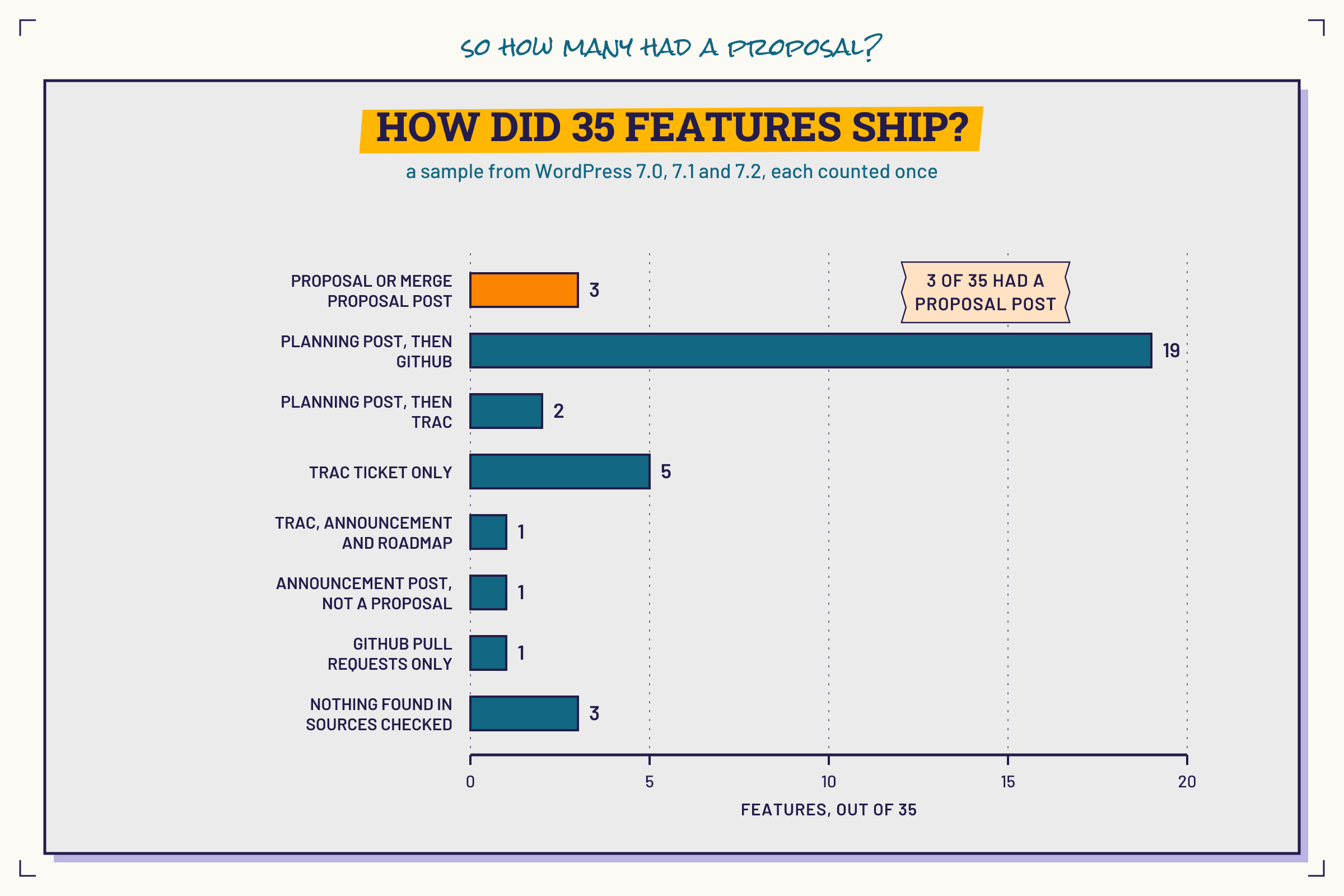
Text description and data for the routes chart
What this proposal process chart shows
A horizontal bar chart with one axis: features, out of 35. Each feature counts once, by its strongest record before the commit. It samples 16 features from the 7.0 Field Guide, 10 from the 7.1 Field Guide and 9 from the 7.2 dev notes. The proposal bar is orange, and the table below gives every count.
| Route | Features |
|---|---|
| Proposal or merge proposal post | 3 |
| Planning post, then GitHub | 19 |
| Planning post, then Trac | 2 |
| Trac ticket only | 5 |
| Trac, announcement and roadmap | 1 |
| Announcement post, not a proposal | 1 |
| GitHub pull requests only | 1 |
| Nothing found in the sources checked | 3 |
| Total | 35 |
🧪 Has WordPress tried a formal proposal process?
Yes, inside one project. In 2019, Riad Benguella proposed an RFC process for Gutenberg: “Anyone can submit an RFC.” The stated reason was that Slack “has proven to be an ineffective platform to engage in detailed, long-lived discourse around complex engineering problems.”53 By November, a meeting summary recorded that it “didn’t get as much traction as expected.”54 A comment on a later pull request called the experiment “not successful.”55
Committers named the gap again at WordCamp US 2025. Their notes say, “It’s often unclear who has the ability to make a specific decision.” That gap, they add, can lead to an impasse. The notes suggested “PHP RFC style voting amongst committers.”56
Whether committers adopted that voting idea. I found no later post that does.
🗂️ Three WordPress proposals, and what the record shows
Rules on paper are half the story, so I opened three proposal records on November 17, 2026. One has waited a long time. Another has no recorded answer. The third got a fast, written no. They’re examples, not a sample, so they can’t tell you how often anything happens. Names appear as each page shows them.
For each one, I read the post, every comment and every page it links to. Then I looked for a later post, a handbook change or a release note that settles it. That’s the same search a contributor would have to run by hand. It took me most of an afternoon for three proposals.
🎫 2016 to 2026: renaming “invalid” on Trac
- The proposal: pento opened meta Trac ticket #2192 on October 31, 2016. It says a ticket closed as “invalid” can feel like an insult to newcomers.58 On June 24, 2020, Sergey Biryukov posted “an official proposal for discussion” on Make Core to rename “invalid,” “worksforme” and “wontfix.”59
- What the record shows: The 2020 post drew 35 comments. On August 13, 2020, Francesca Marano asked, “are we moving forward with this?” and then asked about the next step. The page shows no reply.60 On November 6, 2020, SergeyBiryukov wrote on the ticket: “Next steps would be to summarize the various suggestions in the comments, and reach a conclusion.” That day, dd32 accepted the ticket, waiting on “the final line up of stati.” On January 23, 2024, dd32 removed the owner assignment with the comment “Still waiting on.” On February 18, 2026, chealer lowered its priority to low.61
- What cuts the other way: The ticket did record a next step. I found no recorded rejection, and an open ticket with recent activity isn’t one.
It’s a proposal about naming outcomes. It has now waited about ten years for one of its own.
🗄️ 2025: the database support policy
Disclosure: I work at Pantheon, a WordPress and Drupal host, and this proposal covers advice for hosts.
- The proposal: On June 27, 2025, Jonathan Desrosiers proposed that “only LTS releases of MySQL and MariaDB are officially supported.” LTS means long term support. The proposal would call innovation and rolling releases, which get short support windows, “not recommended” for production sites.62
- What the record shows: The post drew 10 comments, and the page no longer takes new ones. Joe McGill wasn’t “totally in agreement” with the “not recommended” wording. Desrosiers replied that the draft “purposefully steered away from ‘not supported’ because we do aim to support them.” The page records no decision.63
- What cuts the other way: The advice is already public. Desrosiers opened a Hosting handbook pull request on June 24, 2025, three days before the proposal, and it merged on July 2. It added “officially recommended Long Term Support versions” and says using innovation releases in production “is not recommended.”6465
So the handbook already gives hosts the advice. The proposal about Core’s own support policy still has no recorded answer on its page. Two documents, one author, and no line connecting them.
🧭 2026: Guidelines built on Knowledge
- The proposal: On June 22, 2026, Greg Ziółkowski proposed merging a new
wp_knowledgepost type into WordPress 7.1, with Guidelines as its first feature. The reason: without a shared foundation, “every plugin ships its own storage, its own permissions model, and its own REST surface.”66 - The stated reason for the answer: On July 10, annezazu answered in a comment. It reads: “This merge proposal was reviewed with @matt and the result is that this is not going to proceed for 7.1.” The comment relays the reason: Matt “doesn’t want to put things into Core that aren’t already driven by real-world adoption.”67
- What the record shows: The answer covers 7.1. Features as Plugins already asks for a plugin “used/tested by the community.”68 The new part is a weekly growth bar, “(think: double digits),” which the handbook doesn’t mention. That reason reaches the record secondhand, through the comment. The 7.1 Field Guide lists the proposal under changes that didn’t make the release.69
- What cuts the other way: The answer landed on the proposal itself, 18 days in, with a reason. Commenters had raised readiness concerns before it, and one called the merge “premature.” On August 18, the author opened a pull request to add Guidelines to the AI plugin.70 A September 3 comment on the proposal calls it “based on the feedback received in response to this proposal.”71 The pull request closed without merging on October 1.72
🧠 Where do fallacies come into a proposal process?
When no document says what counts as an answer, arguments fill the gap. A missing process doesn’t make anyone argue badly. It makes bad arguments harder to spot, and good arguments easier to mistake for bad ones.
So here’s a field guide to 25 logical fallacies that are easier to miss in an unwritten open source proposal process. A fallacy is a flaw in how someone builds an argument, not a flaw in the person. I made up every example in the tables to show a pattern.
These patterns are reasons to check the argument and the process. They don’t tell you which rule is missing, or who’s wrong.
🧩 Patterns 1 to 9: meaning, silence and changing bars
| Fallacy | How it sounds | What a written process can help clarify |
|---|---|---|
| Equivocation | “Someone posted it as a proposal, so it’s decided,” sliding from “suggested” to “announced” | Defined terms, like PEP |
| Argument from silence | “No one objected, so it’s approved,” with no rule saying silence counts | Written rules for what silence means |
| Appeal to ignorance | “Nobody posted an answer, so they rejected it.” | Listed outcomes, so “no answer” isn’t one |
| Moving the goalposts | A new bar replaces a met one, and nobody says why | Criteria the project writes before review starts |
| Ad hoc rescue | “No users need this.” Usage data appears. “Those must all be test accounts.” | Recorded reasons anyone can check |
| Special pleading | “That rule doesn’t apply to this one,” with no reason why | Written exceptions, if there are any |
| False dilemma | “Merge it this release or drop it,” when waiting is possible | Named states like Deferred or Hold |
| Appeal to tradition | “We’ve always done it this way, so it’s right.” | Its own rule for changing itself |
| Appeal to authority | “A senior person liked it,” offered as proof the idea works | Named deciders who record their reasons |
🧩 Patterns 10 to 17: proof, popularity and perfect rules
| Fallacy | How it sounds | What a written process can help clarify |
|---|---|---|
| Bandwagon | “Look at all the plus ones, so it must be right.” | Defined votes, or a rule that comments aren’t votes |
| Shifting the burden of proof | “This change will break every plugin. Prove it won’t.” | Proof from whoever makes the claim |
| Begging the question | “It’s not ready because it isn’t accepted, and it isn’t accepted because it’s not ready.” | Readiness criteria that stand apart from the decision |
| No true Scotsman | “Real proposals have user research.” One without it gets approved. “Then it wasn’t a real proposal.” | A written list of required contents |
| Texas sharpshooter | Picking criteria after the outcome, from the cases that fit | Criteria with dates before the decision |
| Nirvana fallacy | “No rule fits every case, so write none.” | Room to vary, written into the rule |
| Slippery slope | “Write one rule and soon we’ll vote on everything.” | Scope lines that say what the process covers |
| Appeal to consequences | “That security finding can’t be right. Fixing it would delay the release.” | Judging facts apart from the schedule |
🧩 Patterns 18 to 25: causes, critics and counting
| Fallacy | How it sounds | What a written process can help clarify |
|---|---|---|
| Composition | “Trac has endings, so the whole project’s proposals do too.” | Endings for each kind of record |
| Post hoc | “They declined it right after X, so X caused it.” | Recorded reasons |
| Straw man | Answering a summary that changes what the proposal says | Required sections the reviewer reads |
| Genetic fallacy | Judging a proposal by its author’s employer, when the employer has nothing to do with the change | Criteria about the change, not the author |
| Tu quoque | “Your project doesn’t write this down either.” | Comparing documents, not critics |
| Sunk cost | “We’ve spent two years on it, so we can’t stop now.” | Stall rules, like Deferred |
| Survivorship bias | Judging the process by the proposals that shipped | Public lists of every proposal and its state |
| Hasty generalization | One stalled proposal becomes “the process never works” | Counts by year, from that full list |
🔍 Five closer looks at proposal process fallacies
Five of those 25 get more than a table row here. The silence pair travels together, so that’s six fallacies in five looks. Each one gets the same three parts: the pattern, how it shows up when nothing is written, and what a written process does instead.
🔤 Equivocation: one word, three jobs
- The pattern: An argument depends on sliding between two meanings of the same word. Here, the word is “proposal.”
- When nothing is written: One reader treats a “Proposal:” post as a question and comments to shape it. Another treats it as an announcement and waits for the release. Then someone argues, “it was proposed, so it’s settled.” Both readers were being reasonable. The argument wasn’t.
- What a written process does: Go’s README tracks a new issue as Incoming and moves it to Active when review starts.73 The label tells you which conversation you’re in.
🤫 The argument from silence, and its twin
- The pattern: Reading meaning into silence. “No one objected, so it’s approved” is the argument from silence. “No answer, so it’s dead” is the appeal to ignorance. They’re twins who disagree about everything.
- When nothing is written: Either reading fits the same quiet thread, and they can’t both be right. This series has a rule against the second one: silence is never an admission.
- What a written process does: Silence needs a rule for the decision at hand. The Apache Software Foundation’s voting page calls lazy consensus “an announcement of ‘silence gives assent,’” and it uses that in some places.74 Other decisions there need an explicit vote. The rule tells you which silence you’re hearing.

Text description of the bulletin board illustration
What this illustration shows
- Subject: A fictional pantry scene, drawn as an inked and painted graphic novel page in a spiral sketchbook. It’s evening. Two people stand at a cork bulletin board under a brass wall lamp, beside a window gone dark blue.
- The board: Typed pages crowd the left half, under a tag reading “PROPOSALS.” Some pages have yellowed, and several have colored tabs. A tag reading “ANSWERS” tops the right half. It holds bare pushpins and one index card.
- People: A tall man in a blue hoodie pins a fresh tabbed proposal on the left half. Meanwhile, a woman in a purple cardigan holds a clipboard and gestures toward the right half.
- Text in the image: “PROPOSALS,” “ANSWERS” and her speech balloon, “Where do the answers go?”
- Not shown: any real project, person or proposal. The pages carry no readable text.
🥅 Moving the goalposts
- The pattern: A new requirement replaces one that’s already met, without a good reason.
- When nothing is written: Any late requirement can look moved, even one that’s sincere and long held. The Guidelines case shows why. Features as Plugins asks for community use. The answer named a sharper bar, weekly growth, and it gave its reason. Whether that bar stood before July 2026 is unknown. Unwritten criteria can’t defend themselves either.
- What a written process does: Rust’s subteam adds a comment explaining its decision when the thread doesn’t already make it clear.75 The reason sits next to the proposal.
🌈 The nirvana fallacy: “requirements will vary”
- The pattern: Turning down a workable rule because no rule is perfect.
- When nothing is written: “Every feature is different, so no checklist fits” sounds wise, and it’s half right. Features as Plugins says “requirements will vary,” and they do.76 The fallacy is the next step: deciding that variety means nothing can be written. The handbook doesn’t take that step. Only the argument pattern does.
- What a written process does: Go’s Hold state and Python’s PEP-Delegate are written ways to handle the case that doesn’t fit.7778 Variety, with a paper trail.
📊 Survivorship bias: the trap in counting proposals
- The pattern: Judging a process by the cases that made it through.
- When nothing is written: Proposals that ship get dev notes, field guides and links, so they’re easy to find. Quiet ones aren’t. I nearly fell into this one while researching this post. My first search found more proposals with recorded outcomes than I expected. My guess, and it’s only a guess, is that search results favor proposals that got a later post. So I can’t give you a reliable count from this search. That would take a defined set of proposals and the same outcome check for each.
- What a written process does: Python and Kubernetes keep every proposal in a repository with its state.7980 Counting becomes a query, not an expedition.
✅ Questions to ask of any open source proposal process
Try these on any open source proposal process you meet. Four match columns in the first table, and the first two extend it.
- Who can file a proposal, and where?
- What does a proposal have to contain?
- Who decides, and is that person or group named?
- Which states can a proposal move through, and which ones end it?
- Where does the answer get written down?
- What happens to a proposal nobody decides?
If a project answers all six from its own documents, you know what you’re walking into. If it answers three, you know which three to ask about out loud. Kindly. With links.
And if you’re writing a proposal where the open source proposal process can’t answer them, answer them in your own post. Say what you’re asking for, who you think decides and when you’ll post the outcome. You can’t write the project’s process for it. You can write your own.
🙋 Frequently asked questions
A proposal is a written request to change a project’s code, process or policy, made for review before a decision. Defined processes, like PEPs, KEPs and RFCs, also say who decides it, what states it can reach and where the answer goes.
Partly. Features as Plugins describes a short proposal, public update posts and a merge proposal, and the Core team decides features. What a Make proposal post doesn’t get is a shared list of endings or a required closing record.
That depends on the project. Python can mark a PEP Deferred, Go can move a proposal to Likely Decline, and Kubernetes has a deferred state. A Make WordPress proposal post has no written rule for it.
Only if a written rule says so. The Apache Software Foundation uses lazy consensus, where silence gives assent, for some decisions. Without a rule, silence means only that nobody answered.
Disclosures
- Pantheon: my employer, a WordPress and Drupal host.
- FAIR: I’m an active member of the FAIR Package Manager Technical Steering Committee.
- GoDaddy: my former employer, where I managed its Five for the Future contributors until July 2026.
- The WPOCC: cofounder and board member.
- WordPress Training Team: former faculty member and former rep.
- These three threads: no comments from me on any of them. I checked each comment list on November 17, 2026.
- The
/random/ticket: I tested the feature and commented on Trac ticket #64498 twice, as courane01, on November 3 and 7, 2026. I also mentioned it in the #core Slack channel and wrote about its default on November 7.
Next up, 2.8 asks how web standards governance decides what HTML and CSS mean.
Footnotes (80)
- Barry Warsaw, Jeremy Hylton, David Goodger and Alyssa Coghlan. “PEP 1: PEP Purpose and Guidelines.” Python Software Foundation, peps.python.org. https://peps.python.org/pep-0001/. Accessed 2026-11-17. ↩︎
- The Go Authors. “Proposing Changes to Go.” Go proposal repository. https://go.googlesource.com/proposal/+/master/README.md. Accessed 2026-11-17. ↩︎
- Kubernetes SIG Architecture. “KEP-0000: Kubernetes Enhancement Proposal Process.” GitHub. https://github.com/kubernetes/enhancements/blob/master/keps/sig-architecture/0000-kep-process/README.md. Accessed 2026-11-17. ↩︎
- The PHP Group. “Feature Proposals.” php/policies, GitHub. https://github.com/php/policies/blob/main/feature-proposals.rst. Accessed 2026-11-17. ↩︎
- The PHP Group. “How To Create an RFC.” PHP Wiki. Last modified 2026-02-20. https://wiki.php.net/rfc/howto. Accessed 2026-11-17. ↩︎
- Barry Warsaw, Jeremy Hylton, David Goodger and Alyssa Coghlan. “PEP 1: PEP Purpose and Guidelines.” Python Software Foundation, peps.python.org. https://peps.python.org/pep-0001/. Accessed 2026-11-17. ↩︎
- The Rust Project. “The Rust RFC Book.” rust-lang.github.io. https://rust-lang.github.io/rfcs/. Accessed 2026-11-17. ↩︎
- Make WordPress Core. “Features as Plugins.” Core Handbook. Last updated 2018-02-07. https://make.wordpress.org/core/handbook/about/how-the-release-cycle-works/features-as-plugins/. Accessed 2026-11-17. ↩︎
- Masanari Kondo, Mahmoud Alfadel, Shane McIntosh, Yasutaka Kamei and Naoyasu Ubayashi. “An empirical study on declined proposals: why are these proposals declined?” arXiv. 2025-10-08. https://arxiv.org/abs/2510.06984. Accessed 2026-11-17. ↩︎
- Make WordPress Core. “Features as Plugins.” Core Handbook. Last updated 2018-02-07. https://make.wordpress.org/core/handbook/about/how-the-release-cycle-works/features-as-plugins/. Accessed 2026-11-17. ↩︎
- Make WordPress Core. “The Bug Tracker (Trac).” Core Handbook. Last updated 2025-08-26. https://make.wordpress.org/core/handbook/contribute/trac/. Accessed 2026-11-17. ↩︎
- Make WordPress Design. “Writing a design proposal.” Design Handbook. Last updated 2021-06-06. https://make.wordpress.org/design/handbook/workflows/writing-a-call-for-design/. Accessed 2026-11-17. ↩︎
- Make WordPress Core. “The Bug Tracker (Trac).” Core Handbook. Last updated 2025-08-26. https://make.wordpress.org/core/handbook/contribute/trac/. Accessed 2026-11-17. ↩︎
- The PHP Group. “Feature Proposals.” php/policies, GitHub. https://github.com/php/policies/blob/main/feature-proposals.rst. Accessed 2026-11-17. ↩︎
- The PHP Group. “How To Create an RFC.” PHP Wiki. Last modified 2026-02-20. https://wiki.php.net/rfc/howto. Accessed 2026-11-17. ↩︎
- WordPress.org. “Philosophy.” wordpress.org. https://wordpress.org/about/philosophy/. Accessed 2026-11-18. ↩︎
- WordPress.org. “Philosophy.” wordpress.org. https://wordpress.org/about/philosophy/. Accessed 2026-11-18. ↩︎
- WordPress.org. “Roadmap.” wordpress.org. https://wordpress.org/about/roadmap/. Accessed 2026-11-18. ↩︎
- Make WordPress Core. “Features as Plugins.” Core Handbook. Last updated 2018-02-07. https://make.wordpress.org/core/handbook/about/how-the-release-cycle-works/features-as-plugins/. Accessed 2026-11-17. ↩︎
- annezazu. “Add core support for random content redirects.” WordPress Trac ticket #64498. https://core.trac.wordpress.org/ticket/64498. Accessed 2026-11-18. ↩︎
- annezazu. Comment 12 on WordPress Trac ticket #64498. 2026-09-21. https://core.trac.wordpress.org/ticket/64498#comment:12. Accessed 2026-11-18. ↩︎
- mcsf. “Support random content redirects via ?random qarg.” WordPress Trac changeset 63767. 2026-09-21. https://core.trac.wordpress.org/changeset/63767. Accessed 2026-11-18. ↩︎
- peterwilsoncc. “Rewrite Rules: Revert random content redirects feature.” WordPress Trac changeset 63906. 2026-09-23. https://core.trac.wordpress.org/changeset/63906. Accessed 2026-11-18. ↩︎
- jorbin. “Rewrite Rules: Add support for random content redirects.” WordPress Trac changeset 64402. 2026-10-16. https://core.trac.wordpress.org/changeset/64402. Accessed 2026-11-18. ↩︎
- Aaron Jorbin. “Your Content Is Going To Get More Random!” Make WordPress Core. 2026-11-05. https://make.wordpress.org/core/2026/11/05/your-content-is-going-to-get-more-random/. Comments by Aaron Jorbin and David E. Smith (2026-11-05), Joost de Valk and Taco Verdonschot (2026-11-06), Matt Mullenweg (2026-11-07) and Ben May (2026-11-08). Accessed 2026-11-18. ↩︎
- Aaron Jorbin. “Your Content Is Going To Get More Random!” Make WordPress Core. 2026-11-05. https://make.wordpress.org/core/2026/11/05/your-content-is-going-to-get-more-random/. Comments by Aaron Jorbin and David E. Smith (2026-11-05), Joost de Valk and Taco Verdonschot (2026-11-06), Matt Mullenweg (2026-11-07) and Ben May (2026-11-08). Accessed 2026-11-18. ↩︎
- courane01 (my own account). Comments 67 and 73 on WordPress Trac ticket #64498. 2026-11-03 and 2026-11-07. https://core.trac.wordpress.org/ticket/64498#comment:67. Accessed 2026-11-18. ↩︎
- Aaron Jorbin. “Your Content Is Going To Get More Random!” Make WordPress Core. 2026-11-05. https://make.wordpress.org/core/2026/11/05/your-content-is-going-to-get-more-random/. Comments by Aaron Jorbin and David E. Smith (2026-11-05), Joost de Valk and Taco Verdonschot (2026-11-06), Matt Mullenweg (2026-11-07) and Ben May (2026-11-08). Accessed 2026-11-18. ↩︎
- Aaron Jorbin. “Your Content Is Going To Get More Random!” Make WordPress Core. 2026-11-05. https://make.wordpress.org/core/2026/11/05/your-content-is-going-to-get-more-random/. Comments by Aaron Jorbin and David E. Smith (2026-11-05), Joost de Valk and Taco Verdonschot (2026-11-06), Matt Mullenweg (2026-11-07) and Ben May (2026-11-08). Accessed 2026-11-18. ↩︎
- Make WordPress Core. “WordPress 7.2.” Make WordPress Core. https://make.wordpress.org/core/7-2/. Accessed 2026-11-18. ↩︎
- WordPress.org. “Roadmap.” wordpress.org. https://wordpress.org/about/roadmap/. Accessed 2026-11-18. ↩︎
- mcsf. “Support random content redirects via ?random qarg.” WordPress Trac changeset 63767. 2026-09-21. https://core.trac.wordpress.org/changeset/63767. Accessed 2026-11-18. ↩︎
- peterwilsoncc and jorbin. Comments 18 and 19 on WordPress Trac ticket #64498. 2026-09-22 and 2026-09-23. https://core.trac.wordpress.org/ticket/64498#comment:18. Accessed 2026-11-18. ↩︎
- jorbin. “Rewrite Rules: Add support for random content redirects.” WordPress Trac changeset 64402. 2026-10-16. https://core.trac.wordpress.org/changeset/64402. Accessed 2026-11-18. ↩︎
- WordPress News. “WordPress 7.2 Beta 1 is ready for download and testing.” WordPress.org News. 2026-10-20. https://wordpress.org/news/2026/10/wordpress-7-2-beta-1-is-ready-for-download-and-testing/. Accessed 2026-11-18. ↩︎
- Aaron Jorbin. “Your Content Is Going To Get More Random!” Make WordPress Core. 2026-11-05. https://make.wordpress.org/core/2026/11/05/your-content-is-going-to-get-more-random/. Comments by Aaron Jorbin and David E. Smith (2026-11-05), Joost de Valk and Taco Verdonschot (2026-11-06), Matt Mullenweg (2026-11-07) and Ben May (2026-11-08). Accessed 2026-11-18. ↩︎
- WordPress News. “WordPress 7.2 Release Candidate 1.” WordPress.org News. 2026-11-17. https://wordpress.org/news/2026/11/wordpress-7-2-release-candidate-1/. Accessed 2026-11-18. ↩︎
- Make WordPress Core. “Features as Plugins.” Core Handbook. Last updated 2018-02-07. https://make.wordpress.org/core/handbook/about/how-the-release-cycle-works/features-as-plugins/. Accessed 2026-11-17. ↩︎
- pento and others. “Change the name of ‘invalid’ ticket resolution.” Meta Trac ticket #2192. Opened 2016-10-31. https://meta.trac.wordpress.org/ticket/2192. Accessed 2026-11-17. ↩︎
- desrosj. “Reorganize the Database section.” WordPress/hosting-handbook pull request #318, GitHub. Opened 2025-06-24, merged 2025-07-02. https://github.com/WordPress/hosting-handbook/pull/318. Accessed 2026-11-17. ↩︎
- Jonathan Desrosiers. “Proposal: Clarifying Core’s Database Support Policy.” Make WordPress Core. 2025-06-27. https://make.wordpress.org/core/2025/06/27/proposal-clarifying-cores-database-support-policy/. Accessed 2026-11-17. ↩︎
- Greg Ziółkowski. “Merge Proposal: Guidelines built on Knowledge.” Make WordPress Core. 2026-06-22. https://make.wordpress.org/core/2026/06/22/merge-proposal-guidelines-built-on-knowledge/. Accessed 2026-11-17. ↩︎
- Aaron Jorbin. “Your Content Is Going To Get More Random!” Make WordPress Core. 2026-11-05. https://make.wordpress.org/core/2026/11/05/your-content-is-going-to-get-more-random/. Comments by Aaron Jorbin and David E. Smith (2026-11-05), Joost de Valk and Taco Verdonschot (2026-11-06), Matt Mullenweg (2026-11-07) and Ben May (2026-11-08). Accessed 2026-11-18. ↩︎
- Amy Kamala. “WordPress 7.0 Field Guide.” Make WordPress Core. 2026-05-14. https://make.wordpress.org/core/2026/05/14/wordpress-7-0-field-guide/. Accessed 2026-11-18. ↩︎
- Milana Cap. “WordPress 7.1 Field Guide.” Make WordPress Core. 2026-08-05. https://make.wordpress.org/core/2026/08/05/wordpress-7-1-field-guide/. Accessed 2026-11-17. ↩︎
- Make WordPress Core. “dev-notes+7-2 tag archive.” Make WordPress Core. https://make.wordpress.org/core/tag/dev-notes+7-2/. Accessed 2026-11-18. ↩︎
- flixos90. “Proposal for merging WP AI Client into WordPress 7.0.” Make WordPress Core. 2026-02-03. https://make.wordpress.org/core/2026/02/03/proposal-for-merging-wp-ai-client-into-wordpress-7-0/. Accessed 2026-11-18. ↩︎
- Matias Ventura. “Planning for 7.0.” Make WordPress Core. 2025-12-11. https://make.wordpress.org/core/2025/12/11/planning-for-7-0/. Accessed 2026-11-18. ↩︎
- Make WordPress Core. “proposal tag archive.” Make WordPress Core. https://make.wordpress.org/core/tag/proposal/. Accessed 2026-11-18. ↩︎
- Milana Cap. “WordPress 7.1 Field Guide.” Make WordPress Core. 2026-08-05. https://make.wordpress.org/core/2026/08/05/wordpress-7-1-field-guide/. Accessed 2026-11-17. ↩︎
- Riad Benguella. “The Block Registration RFC and the Gutenberg RFC process.” Make WordPress Core. 2019-04-01. https://make.wordpress.org/core/2019/04/01/the-block-registration-rfc-and-the-gutenberg-rfc-process/. Accessed 2026-11-18. ↩︎
- André Maneiro. “Core Editor Summary for November 20.” Make WordPress Core. 2019-11-21. https://make.wordpress.org/core/2019/11/21/core-editor-summary-for-november-20/. Accessed 2026-11-18. ↩︎
- WordPress/gutenberg pull request #15687, “Documentation: Add RFCs process document,” and its comments. GitHub. 2019. https://github.com/WordPress/gutenberg/pull/15687. Accessed 2026-11-18. ↩︎
- Aaron Jorbin. “Core Committer Meeting Notes from WordCamp US 2025.” Make WordPress Core. 2025-09-18. https://make.wordpress.org/core/2025/09/18/core-committer-meeting-notes-from-wordcamp-us-2025/. Accessed 2026-11-18. ↩︎
- Courtney Robertson (my own account). “Recognizing contributions and acknowledging challenges.” Make WordPress Sustainability. 2024-05-10. https://make.wordpress.org/sustainability/2024/05/10/recognizing-contributions-and-acknowledging-challenges/. Accessed 2026-11-18. ↩︎
- pento and others. “Change the name of ‘invalid’ ticket resolution.” Meta Trac ticket #2192. Opened 2016-10-31. https://meta.trac.wordpress.org/ticket/2192. Accessed 2026-11-17. ↩︎
- Sergey Biryukov. “Proposal: Rename ‘invalid’, ‘worksforme’, and ‘wontfix’ ticket resolutions.” Make WordPress Core. 2020-06-24. https://make.wordpress.org/core/2020/06/24/proposal-rename-invalid-worksforme-and-wontfix-ticket-resolutions/. Accessed 2026-11-17. ↩︎
- Sergey Biryukov. “Proposal: Rename ‘invalid’, ‘worksforme’, and ‘wontfix’ ticket resolutions.” Make WordPress Core. 2020-06-24. https://make.wordpress.org/core/2020/06/24/proposal-rename-invalid-worksforme-and-wontfix-ticket-resolutions/. Accessed 2026-11-17. ↩︎
- pento and others. “Change the name of ‘invalid’ ticket resolution.” Meta Trac ticket #2192. Opened 2016-10-31. https://meta.trac.wordpress.org/ticket/2192. Accessed 2026-11-17. ↩︎
- Jonathan Desrosiers. “Proposal: Clarifying Core’s Database Support Policy.” Make WordPress Core. 2025-06-27. https://make.wordpress.org/core/2025/06/27/proposal-clarifying-cores-database-support-policy/. Accessed 2026-11-17. ↩︎
- Jonathan Desrosiers. “Proposal: Clarifying Core’s Database Support Policy.” Make WordPress Core. 2025-06-27. https://make.wordpress.org/core/2025/06/27/proposal-clarifying-cores-database-support-policy/. Accessed 2026-11-17. ↩︎
- desrosj. “Reorganize the Database section.” WordPress/hosting-handbook pull request #318, GitHub. Opened 2025-06-24, merged 2025-07-02. https://github.com/WordPress/hosting-handbook/pull/318. Accessed 2026-11-17. ↩︎
- Make WordPress Hosting. “Server Environment.” Hosting Handbook. Last updated 2026-11-16. https://make.wordpress.org/hosting/handbook/server-environment/. Accessed 2026-11-17. ↩︎
- Greg Ziółkowski. “Merge Proposal: Guidelines built on Knowledge.” Make WordPress Core. 2026-06-22. https://make.wordpress.org/core/2026/06/22/merge-proposal-guidelines-built-on-knowledge/. Accessed 2026-11-17. ↩︎
- Greg Ziółkowski. “Merge Proposal: Guidelines built on Knowledge.” Make WordPress Core. 2026-06-22. https://make.wordpress.org/core/2026/06/22/merge-proposal-guidelines-built-on-knowledge/. Accessed 2026-11-17. ↩︎
- Make WordPress Core. “Features as Plugins.” Core Handbook. Last updated 2018-02-07. https://make.wordpress.org/core/handbook/about/how-the-release-cycle-works/features-as-plugins/. Accessed 2026-11-17. ↩︎
- Milana Cap. “WordPress 7.1 Field Guide.” Make WordPress Core. 2026-08-05. https://make.wordpress.org/core/2026/08/05/wordpress-7-1-field-guide/. Accessed 2026-11-17. ↩︎
- gziolo. “Knowledge: add a Knowledge and Guidelines experiment.” WordPress/ai pull request #949, GitHub. Opened 2026-08-18, closed 2026-10-01. https://github.com/WordPress/ai/pull/949. Accessed 2026-11-17. ↩︎
- Greg Ziółkowski. “Merge Proposal: Guidelines built on Knowledge.” Make WordPress Core. 2026-06-22. https://make.wordpress.org/core/2026/06/22/merge-proposal-guidelines-built-on-knowledge/. Accessed 2026-11-17. ↩︎
- gziolo. “Knowledge: add a Knowledge and Guidelines experiment.” WordPress/ai pull request #949, GitHub. Opened 2026-08-18, closed 2026-10-01. https://github.com/WordPress/ai/pull/949. Accessed 2026-11-17. ↩︎
- The Go Authors. “Proposing Changes to Go.” Go proposal repository. https://go.googlesource.com/proposal/+/master/README.md. Accessed 2026-11-17. ↩︎
- The Apache Software Foundation. “Voting.” apache.org. https://www.apache.org/foundation/voting.html. Accessed 2026-11-17. ↩︎
- The Rust Project. “The Rust RFC Book.” rust-lang.github.io. https://rust-lang.github.io/rfcs/. Accessed 2026-11-17. ↩︎
- Make WordPress Core. “Features as Plugins.” Core Handbook. Last updated 2018-02-07. https://make.wordpress.org/core/handbook/about/how-the-release-cycle-works/features-as-plugins/. Accessed 2026-11-17. ↩︎
- Barry Warsaw, Jeremy Hylton, David Goodger and Alyssa Coghlan. “PEP 1: PEP Purpose and Guidelines.” Python Software Foundation, peps.python.org. https://peps.python.org/pep-0001/. Accessed 2026-11-17. ↩︎
- The Go Authors. “Proposing Changes to Go.” Go proposal repository. https://go.googlesource.com/proposal/+/master/README.md. Accessed 2026-11-17. ↩︎
- Barry Warsaw, Jeremy Hylton, David Goodger and Alyssa Coghlan. “PEP 1: PEP Purpose and Guidelines.” Python Software Foundation, peps.python.org. https://peps.python.org/pep-0001/. Accessed 2026-11-17. ↩︎
- Kubernetes SIG Architecture. “KEP-0000: Kubernetes Enhancement Proposal Process.” GitHub. https://github.com/kubernetes/enhancements/blob/master/keps/sig-architecture/0000-kep-process/README.md. Accessed 2026-11-17. ↩︎
Leave a Reply