

Publishing open source finances doesn’t give anyone outside the board a vote on them. W3C, the Drupal Association and the WordPress Foundation all post their numbers. Yet none of the eight compared here lets outsiders vote on the annual budget. TYPO3 comes closest: members choose some funded projects, though its budget poll is unofficial.
Key takeaways
- The big picture: All eight publish some open source finances. None lets people outside the board vote on the annual budget.
- Why it matters: A filing tells you where the money went. It doesn’t tell you who could have stopped it.
- By the numbers: At TYPO3’s 2026 General Assembly, 112 of 1,134 members took part. The budget item recorded no vote.
- Yes, but: TYPO3 members vote on which community ideas get funded. And members elect some boards, such as W3C’s.
🧾 What do open source finances look like on paper?
If you’ve ever opened a Form 990 to vet a sponsorship, you know the feeling. The totals are there. The answer to “who decided this?” usually isn’t.
So I read the open source finances that eight foundations and associations publish. Then I read the rules for who decides. Each came from the organization’s own documents on November 15, 2026. The Merge Conflicts methods page explains the evidence labels you’ll see below.
First, two disclosures, because two of these organizations sit close to my work:
- Pantheon: I work at Pantheon, a WordPress and Drupal host.
- GoDaddy: My former employer is listed as a Gold sponsor of the PHP Foundation and a Silver member of OpenJS.12
🗂️ Four shapes of published finances
What’s public comes in four shapes, from the most detail to the least.
- Every transaction: The PHP Foundation says all its incoming and outgoing transactions are public through Open Collective. It also posts a yearly report.3
- Audits and a budget: TYPO3 links its 2025 financial statements, its auditor’s report and its 2026 budget from one General Assembly page.4 Its auditor, BDO, describes the work as a “limited statutory examination.”5 The Drupal Association lists statements for each year from 2011 to 2025.6 On November 15, the links for 2011, 2012 and 2014 didn’t open.
- Tax returns: W3C posts its Forms 990 for 2022 to 2024.7 The WordPress Foundation’s 2024 return is on ProPublica, and its site posts yearly summary pages.89 The OpenJS Foundation’s 2024 return is on ProPublica, too.10
- Short statements: Joomla’s Open Source Matters posts an unaudited profit and loss for its year ending June 2025.11 Meanwhile, the MariaDB Foundation’s board puts its budget estimate in public minutes.12
Even so, a form doesn’t always agree with itself. The WordPress Foundation’s 2024 return says no audited statements in Part IV. Then it says yes, on a consolidated basis, in Part XII.13 Its Schedule O also mentions “consolidated audited financial statements.” The return doesn’t explain the gap, so I won’t guess.
🗳️ Who gets a budget vote?
Here’s the short answer. Wherever a document says who adopts the annual budget, it’s a board. Nobody outside the board votes on that annual budget. Instead, outsiders mostly get advice, a say over directors, or nothing. Two exceptions sit one level down. TYPO3 members vote on which community ideas get money.14 At OpenJS, council members approve “funds for budgets delegated to the project.”15
| Organization | Who approves the annual budget | Outside vote on it | Outside say over directors |
|---|---|---|---|
| Drupal Association | The board, on a Finance Committee draft16 | None; the bylaws say it “has no members” | Individual members elect two seats, which the board ratifies |
| Joomla (Open Source Matters) | The board, under its 2015 Financial Policy17 | None found | Volunteer members elect the directors and officers18 |
| MariaDB Foundation | The board: “Budget approved as presented”19 | None; the directors are the only members20 | None |
| OpenJS Foundation | The board; a council approves a budget “to be presented to the board”21 | None; the council approves funds the board delegates | Paying tiers appoint or elect directors; the council designates more22 |
| PHP Foundation | The board23 | None; an Advisory Board recommends | Platinum sponsors get “Up to 3 seats” |
| TYPO3 Association | The board, after a member survey24 | None; the General Assembly takes note, and members vote on community ideas | Members elect the board |
| W3C Inc. | The board; the bylaws never use the word “budget”25 | None found | Consortium Members elect 7 directors; Partner Members elect up to 4 |
| WordPress Foundation | Unknown; no bylaws found | None; its return reports no members26 | None; its return answers “No” |
So the money question turns into a people question. In this set, a say over the budget runs through a vote for the people who adopt it. That’s real power, but it’s one step removed.
The outside powers differ in strength, too. Advice is the weakest, and PHP makes it count by requiring a written reply. A say over directors is stronger, because directors adopt the budget. A vote on specific projects, like TYPO3’s, moves real money without touching the rest. Nothing is, well, nothing. Either way, the open source finances you can read don’t come with a lever attached.
🎟️ TYPO3: a poll with “no official character”
TYPO3’s Voting Procedure states the poll’s purpose first. It calls the poll “a tool of the Board, to ask the members for their preferences regarding the next budget.”27
Then it sets the limits. “The Budget Polling is not an official election,” it says, and the vote “has no official character.”28
The statutes match. In my translation of the binding German text, the board prepares and adopts the budget after a member survey. The General Assembly, by contrast, takes note of it.29 Note that the English translation online is older than the German text adopted on October 29, 2026, so I cite the German.
In practice, the 2026 General Assembly shows the gap. Altogether, 112 members took part, representing 123 votes with delegations, out of 1,134 members. The budget item recorded no vote at all.30
Still, TYPO3 members hold real power over the people who spend. They elect the board, and they accept the annual accounts.31 At the 2026 Assembly, they also voted to discharge the board, a formal approval of its past year. The tally was 56 for, 5 against, 11 abstaining and 51 not cast.32
Members also hold one money vote that binds. In each Community Ideas round, “the top two community ideas will be funded,” and members can vote for them. The third 2026 round had €40,000 to give, and the Business Control Committee (BCC) reviews the applications.33
📮 PHP Foundation: advice that gets a written answer
The PHP Foundation’s Advisory Board includes sponsors at “Silver tier and above.” By its own rules, it does “not hold decision-making authority.”34
Yet its advice can’t vanish quietly. If the board declines a formal recommendation, the board “must publish a concise written rationale within 30 days.”35 It’s the only written answer duty I found in the set. So the rule requires a public paper trail for every declined formal recommendation. The page gives no reason for the rule, and it carries no adoption date.
There’s a catch, though. The same page gives Platinum sponsors “Up to 3 seats,” which are “automatically granted to qualified Platinum sponsors.”36 When sponsors outnumber seats, they decide together who sits. So the sponsors who advise and the sponsors who vote can overlap. I counted those seats in how many board seats sponsorship can buy.
🔍 Can you see open source finances without a vote on them?
Yes, and that’s the common case. This series scores fourteen kinds of accountability. One of them, fiscal accountability, asks whether the people who pay can demand a report and act on it. The scoring rules aren’t published yet, so read these statuses as my analysis. Here’s how seven projects score.
| Project | Status | What the record shows |
|---|---|---|
| Drupal | D | Statements listed for 2011 to 2025; no members |
| MariaDB | P | Budget estimates in public minutes; directors are the only members |
| Node.js and OpenJS | P | A council budget goes “to the board”; the council approves delegated project funds |
| PHP | D | A written answer within 30 days when the board declines formal advice |
| TYPO3 | P | The General Assembly takes note of the budget; members vote on funded ideas |
| W3C | D | Forms 990 posted; members elect directors |
| WordPress | P | A 990, yearly summaries and minutes that record money decisions |
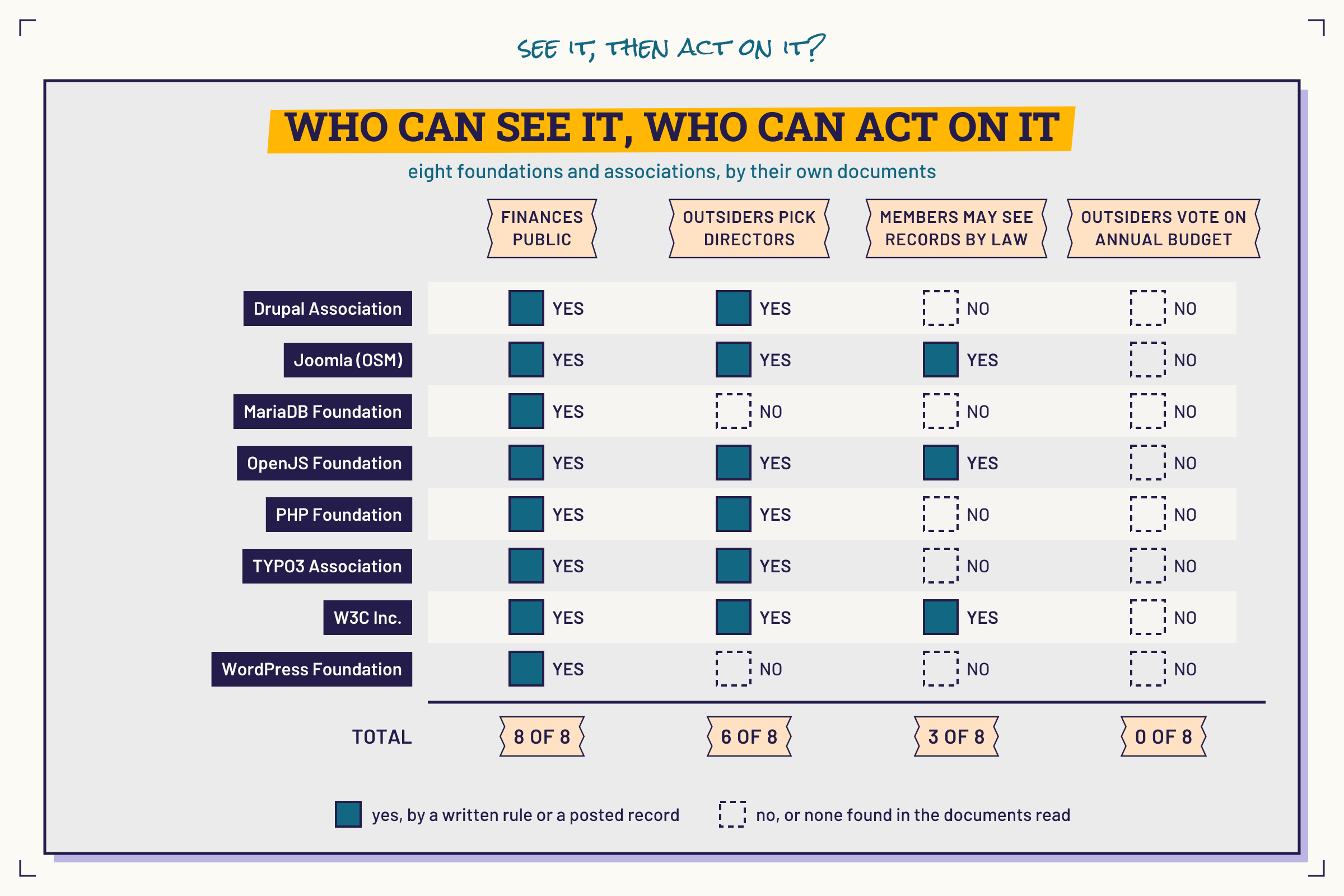
Text description and data for the four checks chart
What this chart shows
- What it shows: A grid with eight organizations in rows, A to Z, and four checks in columns. A filled box with “YES” means a written rule or a posted record says yes. A dashed box with “NO” means no, or none found in the documents read. Each column ends with a total out of 8.
- Finances public, 8 of 8: Drupal Association, Joomla’s Open Source Matters, MariaDB Foundation, OpenJS Foundation, PHP Foundation, TYPO3 Association, W3C and the WordPress Foundation.
- Outsiders pick directors, 6 of 8: every organization except the MariaDB Foundation and the WordPress Foundation.
- Members may see records by law, 3 of 8: W3C and the OpenJS Foundation, through Delaware law; Joomla’s Open Source Matters, through New York law.
- Outsiders vote on the annual budget, 0 of 8: none. TYPO3 members do vote on Community Ideas funding, which isn’t the annual budget.
The pattern is simple. Disclosure and a vote don’t travel together. W3C has both: it posts its returns, and its members elect seven directors.3738 The Drupal Association, by contrast, lists statements for 2011 to 2025, while its bylaws say it “has no members.”3940 Similarly, the WordPress Foundation posts summaries and files a return, but that return lists three directors and no members.41
The WordPress Foundation’s minutes record money decisions, too. In October 2024, its board carried a motion “to approve a $100,000 donation to the Internet Archive.”42 Money coming in gets vetted as well. A 2025 community post says “all sponsorships need to be approved by” two people “from project leadership.”43
Even so, Drupal shows the two can sit side by side. Its “individual members” elect two board seats. In 2026, 307 of 1,274 eligible voters cast ballots.44 Disclosure and a vote sit together there.
In short, open source finances can be fully public and still answer to a small room. That’s a structure, not a scandal, and you can check it for any project. W3C shows the other end: its members also vote on bylaws, mergers and dissolution.45
🏦 Whose published finances are you reading?
Before you trust any total in open source finances, check which organization it belongs to. The money lands in four kinds of places, and each one tells a different story.
- A fiscal host: A fiscal host holds and pays out money for a project. The PHP Foundation’s host is Open Source Collective, and its public ledger sits on the Open Collective platform.46 PHP has two collectives there, one of them in euros.47
- The foundation itself: W3C, the Drupal Association and the MariaDB Foundation each report as one organization.484950
- A parent with a subsidiary: The WordPress Foundation owns all of WordPress Community Support, PBC (WPCS), a taxable company that runs the WordCamp money.51 In 2025, WPCS reported $4,241,714 of operating revenue. The Foundation itself took in $93,131.52 TYPO3 also owns 100% of a company, TYPO3 GmbH.53
- A small volunteer nonprofit: Open Source Matters reported $15,567 of total income for the year ending June 2025. Interest added $2,468.54
Cash isn’t the whole budget either. For example, WPCS booked $2,629,992 of donated salary services in 2025, on both sides of its ledger. The page doesn’t name the donor.55 Also, the Foundation’s return reports zero employees, while it reports sharing paid employees with WPCS.56
So a foundation’s budget measures the foundation, not the project. Owning the subsidiary links the two sets of books, so the split is a legal one. Still, you’ll need both entities’ figures to see the WordPress picture.
🔐 Who can open the books?
Reading a summary isn’t the same as checking it. A summary is someone’s choice of what to show. Inspection, by contrast, lets you check the choice. So I looked for who may inspect the records themselves.
- Directors only: The Drupal Association opens its books “to inspection by the Directors.”57 At MariaDB, the directors are the members, so the right is theirs.58
- Members, by Delaware statute: W3C’s bylaws send member access to Delaware’s Section 220.59 That section covers “a member of a nonstock corporation.”60 OpenJS is a Delaware “non-stock, not for profit membership corporation,” and its members are the paying companies. So Section 220 reaches them too. Its directors also hold an “absolute right” to inspect.61
- Members, by New York statute: Open Source Matters is “a New York Not-For-Profit Corporation.”62 There, a member of six months may inspect minutes and the member list on five days’ written demand. They may also request the yearly balance sheet and profit and loss.63
- No members to ask: The WordPress Foundation’s return reports no members at all.64
TYPO3 sits under Swiss law. I didn’t read the Swiss statute, so its members’ inspection rights are unknown, not absent.
❓ Questions to ask before you read open source finances
These follow the sections above. So bring them to your next grant review or sponsorship renewal. Each answer should point to a page, not a promise.
- Filing: What does the project publish: a ledger, an audit, a tax return or a summary?
- Entity: Which organization’s books are these, and who holds the rest?
- Approval: Who adopts the budget, and where is that written down?
- Vote: Does anyone outside the board vote on the budget, or only on directors?
- Access: Who can inspect the books, and under which rule?
- Grant: Which organization receives your money, and who signs for it?
- Records: Can you see the receipts behind a summary, or only the summary?
If the answers come back “the board,” “the board” and “the board,” you’ve found the pattern this post describes. Then ask whether a written answer duty, like PHP’s, would help.
🙋 Frequently asked questions
Not on the annual budget, in any of the eight organizations here. Publishing gives you something to read. A board adopts the budget wherever a document says who does. TYPO3 members do vote on which community ideas get funded, though.
In my reading, TYPO3. Its members elect the board, accept the annual accounts, approve the board’s year and pick funded community ideas. Their budget poll, however, stays advisory. W3C comes next, since its members elect seven directors.
Not just by donating. Members of W3C and OpenJS can use Delaware’s inspection statute, and Open Source Matters members can use New York’s. Elsewhere here, the right sits with the directors or remains unknown. If you need access, ask for it in your grant agreement. Reading published open source finances is open to anyone, but inspecting the records behind them isn’t.
Next up, 2.7 asks what a proposal is, and what happens when no one writes down the answer.
Every relationship I disclose here
- Pantheon: my employer, a WordPress and Drupal host.
- GoDaddy: I managed its Five for the Future contributors until July 2026. I was asked which foundations and projects I’d fund. I named the obvious ones.
- FAIR Package Manager: an active member of its Technical Steering Committee.
- The WPOCC: a co-founding board member of this community nonprofit.
- Training Team: former faculty member and rep.
Footnotes (66)
- The PHP Foundation. “The PHP Foundation.” The PHP Foundation (home page, sponsor lists). https://thephp.foundation/. Accessed 2026-11-15. ↩︎
- OpenJS Foundation. “Members.” OpenJS Foundation. https://openjsf.org/members. Accessed 2026-11-15. ↩︎
- The PHP Foundation. “The PHP Foundation Impact and Transparency Report 2025.” The PHP Foundation. 2026-05-27. https://thephp.foundation/blog/2026/05/27/impact-and-transparency-report-2025/. Accessed 2026-11-15. ↩︎
- TYPO3 Association. “General Assembly 2026 Protocol.” TYPO3.org. 2026-04-22. https://typo3.org/fileadmin/Association/General_Assembly/2026/GA_2026_Protocol.pdf [PDF]. Accessed 2026-11-15. ↩︎
- TYPO3 Association. “Report of the statutory auditor on the limited statutory examination, 2025.” TYPO3.org. https://typo3.org/fileadmin/Association/financial_statements/2025-Audit-Report.pdf [PDF]. Accessed 2026-11-15. ↩︎
- Drupal Association. “Accountability.” Drupal.org. https://www.drupal.org/association/accountability. Accessed 2026-11-15. ↩︎
- W3C Inc. “Form 990, tax year 2024.” W3C. https://www.w3.org/cms-uploads/990-form-w3c-inc-2024.pdf [PDF]. Accessed 2026-11-15. ↩︎
- WordPress Foundation. “Form 990, tax year 2024.” ProPublica Nonprofit Explorer. 2025-05-01. https://projects.propublica.org/nonprofits/full_text/202511269349302756/IRS990. Accessed 2026-11-15. ↩︎
- WordPress Foundation. “2025 Financials.” WordPress Foundation. 2026-06-04. https://wordpressfoundation.org/2025-financials/. Accessed 2026-11-15. ↩︎
- OpenJS Foundation. “Form 990, tax year 2024.” ProPublica Nonprofit Explorer. https://projects.propublica.org/nonprofits/full_text/202503179349304515/IRS990. Accessed 2026-11-15. ↩︎
- Open Source Matters. “Profit and Loss by Class, fiscal year 2024 to 2025.” Open Source Matters. https://www.opensourcematters.org/images/financials/2025/2024-5_OSM_YE_Profit_and_Loss_by_Class.pdf [PDF]. Accessed 2026-11-15. ↩︎
- MariaDB Foundation. “Board meeting minutes, 27 November 2024.” MariaDB.org. https://mariadb.org/bodminutes/2024-11-27/. Accessed 2026-11-15. ↩︎
- WordPress Foundation. “Form 990, tax year 2024.” ProPublica Nonprofit Explorer. 2025-05-01. https://projects.propublica.org/nonprofits/full_text/202511269349302756/IRS990. Accessed 2026-11-15. ↩︎
- TYPO3 Association. “Third call for community budget ideas in 2026.” TYPO3 News. https://news.typo3.com/article/third-call-for-community-budget-ideas-in-2026. Accessed 2026-11-15. ↩︎
- OpenJS Foundation. “CPC Charter.” GitHub. https://github.com/openjs-foundation/cross-project-council/blob/main/CPC-CHARTER.md. Accessed 2026-11-15. ↩︎
- Drupal Association. “Second Restated Bylaws of DrupalCon, Inc.” Drupal.org. 2017-12-12. https://drupal.org/files/board-bylaws.pdf [PDF]. Accessed 2026-11-15. ↩︎
- Open Source Matters. “Financial Policy.” Open Source Matters. https://www.opensourcematters.org/organisation/finances/financial-policy.html. Accessed 2026-11-15. ↩︎
- Open Source Matters. “By-Laws of Open Source Matters, Inc.” Open Source Matters. 2021-12-13. https://www.opensourcematters.org/images/documents/20211213-OSM-Bylaws.pdf [PDF]. Accessed 2026-11-15. ↩︎
- MariaDB Foundation. “Board meeting minutes, 27 November 2024.” MariaDB.org. https://mariadb.org/bodminutes/2024-11-27/. Accessed 2026-11-15. ↩︎
- MariaDB Foundation. “By-laws.” MariaDB.org. https://mariadb.org/bylaws/. Accessed 2026-11-15. ↩︎
- OpenJS Foundation. “CPC Charter.” GitHub. https://github.com/openjs-foundation/cross-project-council/blob/main/CPC-CHARTER.md. Accessed 2026-11-15. ↩︎
- OpenJS Foundation. “First Amended and Restated By-laws.” OpenJS Foundation. https://bylaws.openjsf.org/. Accessed 2026-11-15. ↩︎
- The PHP Foundation. “Governance.” The PHP Foundation. https://thephp.foundation/governance/. Accessed 2026-11-15. ↩︎
- TYPO3 Association. “Statuten der TYPO3 Association.” TYPO3 Policy Guide. https://docs.typo3.org/m/typo3/guide-policy/main/en-us/Association/BylawsAndProceedingsGermanOriginal.html. Accessed 2026-11-15. ↩︎
- W3C Inc. “Bylaws of World Wide Web Consortium, Inc.” W3C. 2024-09-25. https://www.w3.org/2024/09/25-w3c-bylaws.pdf [PDF]. Accessed 2026-11-15. ↩︎
- WordPress Foundation. “Form 990, tax year 2024.” ProPublica Nonprofit Explorer. 2025-05-01. https://projects.propublica.org/nonprofits/full_text/202511269349302756/IRS990. Accessed 2026-11-15. ↩︎
- Stefan Busemann, TYPO3 Association. “Voting Procedure of the TYPO3 Association.” TYPO3 Policy Guide. 2025-11-13. https://docs.typo3.org/m/typo3/guide-policy/main/en-us/Association/VotingProcedure.html. Accessed 2026-11-15. ↩︎
- Stefan Busemann, TYPO3 Association. “Voting Procedure of the TYPO3 Association.” TYPO3 Policy Guide. 2025-11-13. https://docs.typo3.org/m/typo3/guide-policy/main/en-us/Association/VotingProcedure.html. Accessed 2026-11-15. ↩︎
- TYPO3 Association. “Statuten der TYPO3 Association.” TYPO3 Policy Guide. https://docs.typo3.org/m/typo3/guide-policy/main/en-us/Association/BylawsAndProceedingsGermanOriginal.html. Accessed 2026-11-15. ↩︎
- TYPO3 Association. “General Assembly 2026 Protocol.” TYPO3.org. 2026-04-22. https://typo3.org/fileadmin/Association/General_Assembly/2026/GA_2026_Protocol.pdf [PDF]. Accessed 2026-11-15. ↩︎
- TYPO3 Association. “Third call for community budget ideas in 2026.” TYPO3 News. https://news.typo3.com/article/third-call-for-community-budget-ideas-in-2026. Accessed 2026-11-15. ↩︎
- The PHP Foundation. “Governance.” The PHP Foundation. https://thephp.foundation/governance/. Accessed 2026-11-15. ↩︎
- The PHP Foundation. “Governance.” The PHP Foundation. https://thephp.foundation/governance/. Accessed 2026-11-15. ↩︎
- The PHP Foundation. “Governance.” The PHP Foundation. https://thephp.foundation/governance/. Accessed 2026-11-15. ↩︎
- W3C Inc. “Form 990, tax year 2024.” W3C. https://www.w3.org/cms-uploads/990-form-w3c-inc-2024.pdf [PDF]. Accessed 2026-11-15. ↩︎
- W3C Inc. “Bylaws of World Wide Web Consortium, Inc.” W3C. 2024-09-25. https://www.w3.org/2024/09/25-w3c-bylaws.pdf [PDF]. Accessed 2026-11-15. ↩︎
- Drupal Association. “Accountability.” Drupal.org. https://www.drupal.org/association/accountability. Accessed 2026-11-15. ↩︎
- Drupal Association. “Second Restated Bylaws of DrupalCon, Inc.” Drupal.org. 2017-12-12. https://drupal.org/files/board-bylaws.pdf [PDF]. Accessed 2026-11-15. ↩︎
- WordPress Foundation. “Form 990, tax year 2024.” ProPublica Nonprofit Explorer. 2025-05-01. https://projects.propublica.org/nonprofits/full_text/202511269349302756/IRS990. Accessed 2026-11-15. ↩︎
- WordPress Foundation. “2024 meeting minutes.” WordPress Foundation. https://wordpressfoundation.org/news/2024/meeting-minutes/. Accessed 2026-11-15. ↩︎
- Make WordPress Community. “Announcement: Sponsor review process changes.” WordPress.org. 2025-01-31. https://make.wordpress.org/community/2025/01/31/announcement-sponsor-review-process-changes/. Accessed 2026-11-15. ↩︎
- Drupal Association. “The Drupal Association Announces 2026 Board Election Winner.” Drupal.org. 2026-08-31. https://www.drupal.org/association/blog/the-drupal-association-announces-2026-board-election-winner. Accessed 2026-11-15. ↩︎
- W3C Inc. “Bylaws of World Wide Web Consortium, Inc.” W3C. 2024-09-25. https://www.w3.org/2024/09/25-w3c-bylaws.pdf [PDF]. Accessed 2026-11-15. ↩︎
- The PHP Foundation. “Governance.” The PHP Foundation. https://thephp.foundation/governance/. Accessed 2026-11-15. ↩︎
- Open Collective. “The PHP Foundation (EUR).” Open Collective. https://opencollective.com/php-foundation-eur. Accessed 2026-11-15. ↩︎
- W3C Inc. “Form 990, tax year 2024.” W3C. https://www.w3.org/cms-uploads/990-form-w3c-inc-2024.pdf [PDF]. Accessed 2026-11-15. ↩︎
- Drupal Association. “Accountability.” Drupal.org. https://www.drupal.org/association/accountability. Accessed 2026-11-15. ↩︎
- MariaDB Foundation. “Board meeting minutes, 27 November 2024.” MariaDB.org. https://mariadb.org/bodminutes/2024-11-27/. Accessed 2026-11-15. ↩︎
- WordPress Foundation. “Form 990, tax year 2024.” ProPublica Nonprofit Explorer. 2025-05-01. https://projects.propublica.org/nonprofits/full_text/202511269349302756/IRS990. Accessed 2026-11-15. ↩︎
- WordPress Foundation. “2025 Financials.” WordPress Foundation. 2026-06-04. https://wordpressfoundation.org/2025-financials/. Accessed 2026-11-15. ↩︎
- TYPO3 Association. “Report of the statutory auditor on the limited statutory examination, 2025.” TYPO3.org. https://typo3.org/fileadmin/Association/financial_statements/2025-Audit-Report.pdf [PDF]. Accessed 2026-11-15. ↩︎
- Open Source Matters. “Profit and Loss by Class, fiscal year 2024 to 2025.” Open Source Matters. https://www.opensourcematters.org/images/financials/2025/2024-5_OSM_YE_Profit_and_Loss_by_Class.pdf [PDF]. Accessed 2026-11-15. ↩︎
- WordPress Foundation. “2025 Financials.” WordPress Foundation. 2026-06-04. https://wordpressfoundation.org/2025-financials/. Accessed 2026-11-15. ↩︎
- WordPress Foundation. “Form 990, tax year 2024.” ProPublica Nonprofit Explorer. 2025-05-01. https://projects.propublica.org/nonprofits/full_text/202511269349302756/IRS990. Accessed 2026-11-15. ↩︎
- Drupal Association. “Second Restated Bylaws of DrupalCon, Inc.” Drupal.org. 2017-12-12. https://drupal.org/files/board-bylaws.pdf [PDF]. Accessed 2026-11-15. ↩︎
- MariaDB Foundation. “By-laws.” MariaDB.org. https://mariadb.org/bylaws/. Accessed 2026-11-15. ↩︎
- W3C Inc. “Bylaws of World Wide Web Consortium, Inc.” W3C. 2024-09-25. https://www.w3.org/2024/09/25-w3c-bylaws.pdf [PDF]. Accessed 2026-11-15. ↩︎
- State of Delaware. “Title 8, Chapter 1, Subchapter VII, § 220. Inspection of books and records.” Delaware Code Online. https://delcode.delaware.gov/title8/c001/sc07/index.html. Accessed 2026-11-15. ↩︎
- OpenJS Foundation. “First Amended and Restated By-laws.” OpenJS Foundation. https://bylaws.openjsf.org/. Accessed 2026-11-15. ↩︎
- Open Source Matters. “By-Laws of Open Source Matters, Inc.” Open Source Matters. 2021-12-13. https://www.opensourcematters.org/images/documents/20211213-OSM-Bylaws.pdf [PDF]. Accessed 2026-11-15. ↩︎
- State of New York. “Not-for-Profit Corporation Law § 621.” New York State Senate. https://www.nysenate.gov/legislation/laws/NPC/621. Accessed 2026-11-15. ↩︎
- WordPress Foundation. “Form 990, tax year 2024.” ProPublica Nonprofit Explorer. 2025-05-01. https://projects.propublica.org/nonprofits/full_text/202511269349302756/IRS990. Accessed 2026-11-15. ↩︎
- The PHP Foundation. “The PHP Foundation Impact and Transparency Report 2025.” The PHP Foundation. 2026-05-27. https://thephp.foundation/blog/2026/05/27/impact-and-transparency-report-2025/. Accessed 2026-11-15. ↩︎
- Open Collective. “Expenses FAQ.” Open Collective Documentation. https://docs.opencollective.com/help/expenses-and-getting-paid/expenses. Accessed 2026-11-15. ↩︎
Leave a Reply