

Sponsorship buys open source board seats by written rule at two of nine organizations: the PHP Foundation and OpenJS. In addition, MariaDB sells board pool entries its bylaws never mention. Everywhere else, however, money buys one equal vote or a logo. So here’s the seat math, counted from each project’s own pages.
Key takeaways
- The big picture: Payment reaches board seats at three of nine, either by rule or by page label.
- By the numbers: PHP sponsors can hold up to 7 of 10 seats. Today, they hold 6.
- Why it matters: At PHP and OpenJS, a single seat decides whether a two thirds vote can be blocked.
- Yes, but: Promises and seat rules usually live in different documents. TYPO3 is the one exception.
🪑 How many open source board seats can money reach?
In what each sponsorship tier returns, I listed what a payment buys. This post, by contrast, counts. For every board, I asked four questions. First, how many open source board seats can money reach under the written rules? Second, how many does it fill today? Next, what holds the rest? And finally, where does the “no governance” promise live?
Three models came out of the documents. Under the first, payment buys seats. Under the second, it buys one ballot, with the same weight at every price. A third model sells a logo instead. MySQL, meanwhile, sits outside all three, because Oracle owns it.
Also, every count names its page and its date. Rosters change, so read each number as true on November 15, 2026, and not forever. For more on the labels, the Merge Conflicts methods page explains each one.
📋 Board seats by organization, A to Z
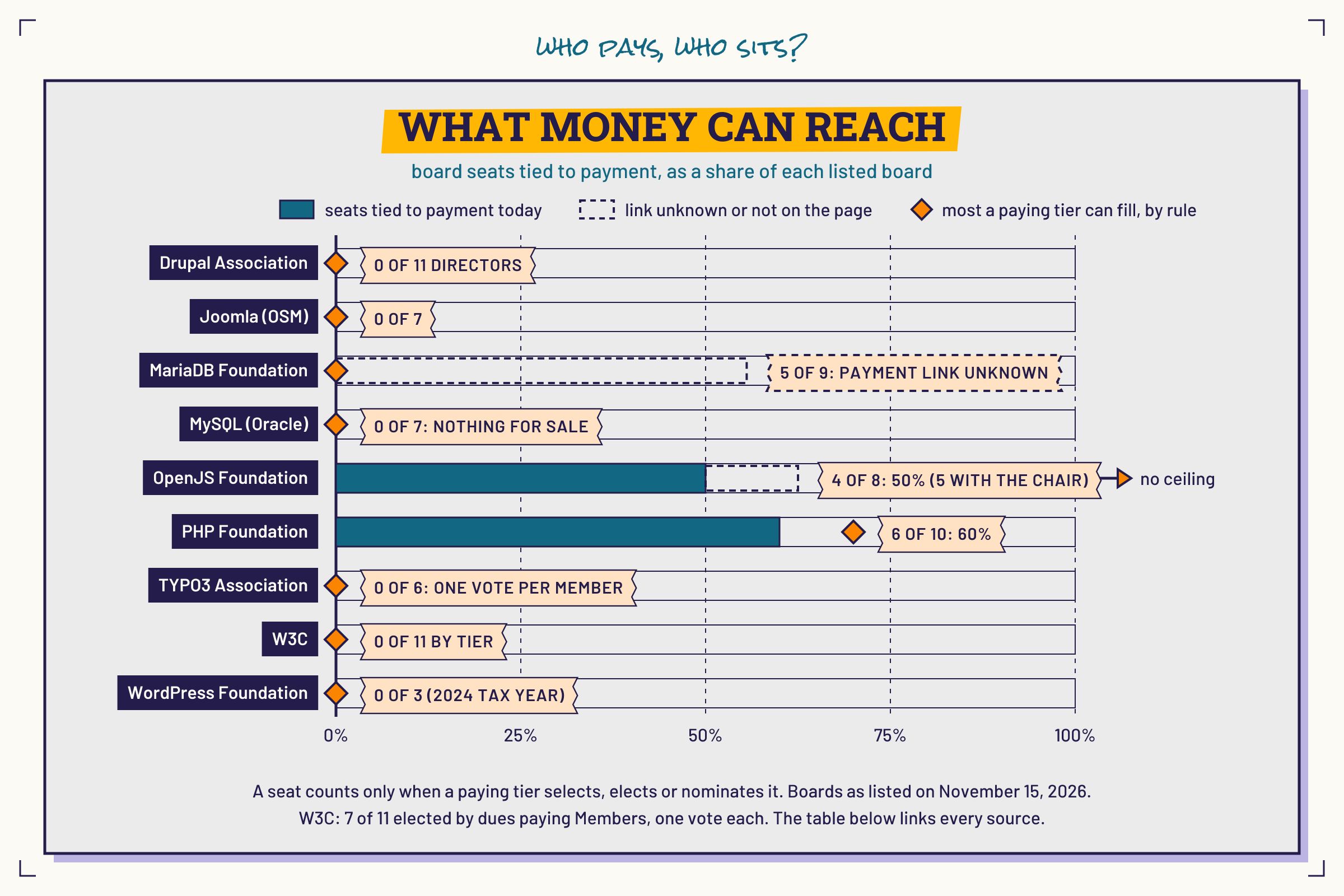
Text description and data for the board seats chart
What this chart shows
- What it shows: One bar per organization on one axis, from 0 to 100 percent of the board as its own page lists it. A solid bar is seats tied to payment today. A dashed bar is seats whose link to payment is unknown or missing from the page’s labels. A diamond marks the most seats a paying tier can fill by written rule, and an arrow means no ceiling.
- Seats tied to payment: PHP Foundation, 6 of 10, and the rules allow 7. OpenJS Foundation, 4 of 8, or 5 counting the Chair’s 2025 Silver seat, with one director per Platinum member and no ceiling. MariaDB Foundation lists 5 of 9 as company representatives, and whether payment placed them is unknown.
- No seats tied to payment: Drupal Association 0 of 11, Joomla 0 of 7, MySQL 0 of 7, TYPO3 Association 0 of 6, W3C 0 of 11 by tier, and WordPress Foundation 0 of 3 as of the 2024 tax year.
| Organization | What money buys | Most seats a paying tier can fill, by written rule | Seats tied to payment today |
|---|---|---|---|
| Drupal Association | A logo | 0 | 0 of 11 directors listed, plus one adviser; the page predates the 2026 election |
| Joomla (Open Source Matters) | A logo | 0 | 0 of 7 |
| MariaDB Foundation | Pool entries | 0 reserved; how an entry becomes a seat is unknown | 5 of 9 listed as company representatives; whether payment placed them is unknown |
| MySQL (Oracle) | Nothing for sale; ownership holds the seats | 0 | 0 of 7 listed |
| OpenJS Foundation | Seats by rule | No ceiling: one director per Platinum member | 4 of 8 by the page’s labels; 5 counting the Chair’s 2025 Silver seat |
| PHP Foundation | Seats by rule | 7 of 10 | 6 of 10 |
| TYPO3 Association | One vote per member | 0 | 0 of 6 |
| W3C | One vote per member | 0 by tier | 0 by tier; 7 of 11 elected by dues paying Members, one vote each |
| WordPress Foundation | A logo | 0 of 3 | 0 of 3, as of the 2024 tax year |
💳 Sponsor seats written into the rules
Two foundations write open source board seats for sponsors into their governance documents. A third, meanwhile, fills seats by company label. So each one gets the same four checks: the rule, the count, what holds the rest, and the promise.
Until July 2026, I managed GoDaddy’s Five for the Future contributors. I was asked which foundations and projects I’d fund. I named the obvious ones, among them the PHP Foundation and OpenJS. Today, GoDaddy.com is listed as a Gold sponsor of the PHP Foundation. GoDaddy is also a Silver member of OpenJS.12
🐘 PHP Foundation: up to 7 of 10 seats
- The rule. First, the PHP Foundation governance page sets a board of 5 to 10 people. Platinum sponsors then get up to 3 seats, “automatically granted to qualified Platinum sponsors.”3 Other sponsors get the remaining seats, “not to exceed 4.” Meanwhile, community representatives get at least 3.
- The count. Today, the board page lists 10 directors.4 According to the Foundation’s own posts, Automattic and JetBrains hold the 2 Platinum seats.56 Four more directors work at companies on the Silver sponsor list.7 So 6 of the 10 open source board seats tie to payment today. The rule, however, allows 7.
- What holds the rest. Strategic matters need a “2/3 majority of total board.” In addition, every director is “Nominated by an existing Board member” and voted in each year.8 On a board of 10, two thirds means 7 votes. So the 4 community directors, voting together, could block. Swap one community seat for a sponsor seat, though, and they couldn’t. Board size has its own exit, too. After 4 failed votes at least 4 weeks apart, a simple majority can decide it.9
- The promise. “Sponsorship does not imply governance rights.” That sentence, however, sits in the Code of Conduct.10 The governance page, which reserves the seats, doesn’t repeat it.
There’s a soft edge here, too. For example, “automatically granted” meets a board vote, and the page never says which one wins. In practice, both 2026 Platinum directors joined by unanimous vote.1112
🟨 OpenJS: one director per Platinum member, no ceiling
- The count. The governance page lists 8 seats.14 Member tiers fill four: Platinum, Gold and Silver directors, plus an End User director those tiers elect together.15 Three more are Cross Project Council (CPC) seats. The page gives the Chair, from GitHub, no class. However, the 2025 board post called the same person a Silver director.16 So member tiers fill 4 of 8 seats by the page’s labels, or 5 counting that seat.
- What holds the rest. First, CPC seats can’t exceed 80 percent of the Platinum, Gold and Silver director seats. Second, CPC participation “shall not be limited to Members.” Finally, a two thirds vote guards listed matters, including removing the Platinum appointment right.17 If all 8 directors vote, that means 6 votes, so the 3 CPC seats could block it together.
- The promise. The Join page says neutrality “ensures that no one company controls an important open source technology.”18 However, that line sits beside the prices, not in the bylaws.
One more wrinkle: the governance page still lists a CPC director that the July 2026 board post thanked for past service.19 Even so, the number of CPC seats doesn’t change.
🦭 MariaDB: pool entries the bylaws don’t mention
- The rule. The sponsor page sells governance access by tier. For example, Gold at EUR 50,000 buys “Representation as an observer at meetings of the MariaDB Foundation Board.” Platinum at EUR 100,000 buys “One entry into the selection pool.” Diamond at EUR 500,000 then buys two entries.20 The bylaws, however, never mention a selection pool. Instead, directors elect directors.21
- The count. Next, the About page lists 9 directors. It files 5 under “Directors representing organisational board members”: Amazon Web Services, DBS, MariaDB, Nextcloud and Virtuozzo.22 So company labels cover 5 of these 9 open source board seats. Still, the pages don’t say whether payment placed any of them.
- What holds the rest. No single election may raise one sponsor’s share of directors above 25 percent. Also, “An Observer may not vote in any meeting of the Board.”23 But no clause caps sponsors as a group.
- The promise. Finally, the sponsor page says sponsorship “does not guarantee the acceptance of code, control over technical decisions or preferential treatment.”24 That covers code and technical processes, though, not seats.
Meanwhile, how a pool entry becomes a seat isn’t written anywhere I found. Of course, unknown isn’t the same as absent.
🗳️ One vote at every price: W3C and TYPO3
Here, dues buy a ballot. However, they never buy a heavier one.
- The rule. First, W3C’s bylaws give each Member in good standing one vote. Good standing, in turn, requires paid dues.25 Members then elect 7 Consortium Directors.
- The count. In the US, dues run from USD 2,250 to USD 77,000 a year, set by a member’s size and type.26 Meanwhile, the board page lists 11 directors, and 7 are Member elected.27 So no seat goes to a tier.
- What holds the rest. The page lists 3 directors chosen by Partner Members. It also marks one director as Board elected, then says there are none right now.28 (One page, two answers.)
- The promise. The Process Document says “no Member receives preferential treatment within W3C.”29 Still, it covers Members, not sponsors, and the seat rules live in the bylaws.
In other words, W3C’s top fee is about 34 times its lowest, for the same single vote.
🧩 TYPO3: one vote, and no seat on the board
TYPO3, likewise, runs the same model with a different menu.
- The rule. The membership page puts it plainly: “While all members have one vote each, higher membership tiers offer additional benefits.”30 Members also elect the board.
- The count. As a result, no board seat is reserved for any tier. The board page lists 6 members.
- What holds the rest. Platinum costs EUR 1,000 once plus EUR 13,750 a year. In return, it buys a “Personal Association Board member contact,” which is access, not a seat.31
- The promise. Here, the one vote rule is the promise. It sits in the statutes, beside the board rules, and on the membership page too.
🎟️ A logo, not a board seat: Drupal and Joomla
In these two, payment buys visibility. Open source board seats, instead, come from elections or volunteer roles.
- The rule. First, the Drupal Association’s bylaws mention no sponsor, fee or donation in any seat clause.32 Certified Partner fees, meanwhile, run from $1,500 to $25,000 a year, set by company size. Partner tiers then rank by contribution credits.33
- The count. The board page lists 11 directors plus an Immediate Past Chair in an advisory role.34 Members elect two At Large seats, which the board ratifies. In addition, only Dries Buytaert is eligible for the Founding Director seat.35 The page also predates the 2026 election, whose winner joins on November 1.36
- What holds the rest. A free membership tier exists “to guarantee voting rights for those who choose not to make a financial donation.”37
- The promise. No line says money doesn’t buy a seat. Still, the free tier comes closest.
There’s one advisory body worth knowing, though. The 2024 Starshot Advisory Council had 12 members, and 3 were Certified Partner representatives. Its job, in its own words, was to “provide strategic input and feedback.”38 The announcement doesn’t say payment earned those places.
I work at Pantheon, a WordPress and Drupal host. Pantheon is a platinum Drupal Certified Partner, and a Pantheon employee sat on the 2024 Starshot Advisory Council.3940
📣 Joomla: no board seat, just advertising
Joomla’s sponsor page, by contrast, is the bluntest of the nine. It says “sponsorship is a form of advertising, not a charitable contribution.”41
- The rule. Bylaw membership comes from team roles, not payment. Also, each member gets one vote.42
- The count. The board has 7 seats: 4 officers and 3 department coordinators.43 So none of them is a sponsor seat.
- What holds the rest. Team leaders and members elect the department coordinators who sit on the board.
- The promise. No line limits what sponsors get. Instead, the advertising line comes nearest. It describes sponsorship, but it doesn’t limit it.
🧾 Where does WordPress sit?
- The rule. The WordPress Foundation’s 2024 tax return reports 3 voting directors, all 3 independent. Those are the numbers at the end of 2024. It also reports no members, and no one outside the board elects directors.44 Donors, meanwhile, get a listing. The 2026 Global Partner tiers cost $60,000 to $180,000. For that, they list visibility and “A dedicated Slack channel” with the Community Support team. The two upper tiers add event tickets.45 However, no tier lists a seat, a vote or an advisory role.
- The count. So payment fills 0 of the 3 Foundation seats.
- What holds the rest. The board elects itself. The same return says directors must disclose possible conflicts every year. Yet it also says there’s no written conflict of interest policy.46
- The promise. Five for the Future invites companies to “Take your seat at the table.”47 Still, it names no body, seat or vote.
🔁 The WordPress rule that runs the other way
WordPress also has the one written rule that runs the other way. A January 2025 Community Team post gives its stated reason first: “The new process strictly enforces WordPress trademark and GPL compliance.” It then says all sponsorships “need to be approved by Matt Mullenweg (@matt) and Mary Hubbard (@4thhubbard) from project leadership.” Meanwhile, Program Managers “hold all invoices until the sponsor complies with guidelines and project leadership approves their sponsorship.” Recently approved sponsors, the post adds, get new invoices “without re-approval.”48 The rule covers WordCamp and event sponsorship.
🏛️ MySQL: ownership holds the seats instead
MySQL sells no open source board seats, because Oracle owns the project. For a start, the governance model says Oracle nominates the first committee “for a term of 2 years.” Its FAQ then describes 5 to 7 people “that represent Oracle (majority).” After two years, “elections will be held for non-Oracle seats.”52
Today, the committee page lists six members. Four come from AWS, Booking.com, Google and JP Morgan Chase, and two from MySQL Engineering. In addition, an Oracle vice president chairs it.53
So, counting the Chair and the two MySQL Engineering members, 3 of 7 tie to Oracle. That’s not the majority the FAQ describes. The page also doesn’t say whether the Chair votes. Yet neither page explains the gap.
🔎 Do “no governance” promises sit beside the seat rules?
Only one of the nine, TYPO3, keeps both in one document. Here’s where each statement lives, so you can check it yourself.
- PHP Foundation: in the Code of Conduct, while the seats live on the governance page.5455
- OpenJS: a neutrality line on the Join page, while the seats live in the bylaws.5657
- MariaDB: on the sponsor page, beside the pool entries, though it covers code, not seats.58
- W3C: in the Process Document, while board seats live in the bylaws.5960
- TYPO3: a one vote rule in the statutes, beside the board rules, and on the membership page.61
- Drupal: a voting guarantee, also on the membership page.62
- Joomla: an advertising line on the sponsor page. It describes sponsorship and limits nothing.63
- MySQL and WordPress: no statement found, so far.
In short, a promise is a sentence, while a seat is a rule. That’s why the clearest promise belongs to the foundation with the most sponsor seats. On the other hand, a missing promise doesn’t prove capture. Only the rules and the roster settle it.
❓ Questions to ask before you fund open source board seats
These match the table’s columns. So bring them to your next sponsorship review, before you fund open source board seats anywhere.
- Seats: Does any tier reserve a director seat, and how many at most?
- Roster: How many of today’s directors hold a sponsor seat?
- Blocking: Which votes need two thirds, and who can block them?
- Selection: Does a seat come automatically, or by a vote?
- Promise: Where does the “no governance” line live, and does it match the seat rules?
🙋 Frequently asked questions
Yes, at two of the nine organizations here, by written rule: the PHP Foundation and OpenJS. MariaDB, meanwhile, fills open source board seats by company label. The other six sell a vote, a logo or nothing.
No. In fact, the PHP Foundation has the clearest promise and the most sponsor seats. So read the seat rules, not the promise.
Not by paying. The 2024 tax return reports no members and no outside electors. As a result, no payment route to a seat appears in the record.
Next up, 2.5 asks who gets a vote when companies pay for the code.
Every relationship I disclose here
- Pantheon: my employer, a WordPress and Drupal host and a WP Engine competitor.
- FAIR Package Manager: an active member of its Technical Steering Committee.
- GoDaddy: I managed its Five for the Future contributors until July 2026.
- The WPOCC: a founding board member.
- Training Team: former faculty member and rep.
Footnotes (63)
- The PHP Foundation. “The PHP Foundation.” The PHP Foundation (home page, sponsor lists). https://thephp.foundation/. Accessed 2026-11-15. ↩︎
- OpenJS Foundation. “Members.” OpenJS Foundation. https://openjsf.org/members. Accessed 2026-11-15. ↩︎
- The PHP Foundation. “Governance.” The PHP Foundation. https://thephp.foundation/governance/. Accessed 2026-11-15. ↩︎
- The PHP Foundation. “Structure.” The PHP Foundation. https://thephp.foundation/structure/. Accessed 2026-11-15. ↩︎
- Elizabeth Barron. “Anne McCarthy Joins The PHP Foundation Board.” The PHP Foundation. 2026-08-04. https://thephp.foundation/blog/2026/08/04/anne-mccarthy-joins-the-board/. Accessed 2026-11-15. ↩︎
- Elizabeth Barron. “Roman Pronskiy Leaves The PHP Foundation Board and Brent Roose Joins.” The PHP Foundation. 2026-09-01. https://thephp.foundation/blog/2026/09/01/welcome-brent-roose/. Accessed 2026-11-15. ↩︎
- The PHP Foundation. “The PHP Foundation.” The PHP Foundation (home page, sponsor lists). https://thephp.foundation/. Accessed 2026-11-15. ↩︎
- The PHP Foundation. “Governance.” The PHP Foundation. https://thephp.foundation/governance/. Accessed 2026-11-15. ↩︎
- The PHP Foundation. “Governance.” The PHP Foundation. https://thephp.foundation/governance/. Accessed 2026-11-15. ↩︎
- The PHP Foundation. “Code of Conduct.” The PHP Foundation. https://thephp.foundation/code-of-conduct/. Accessed 2026-11-15. ↩︎
- Elizabeth Barron. “Anne McCarthy Joins The PHP Foundation Board.” The PHP Foundation. 2026-08-04. https://thephp.foundation/blog/2026/08/04/anne-mccarthy-joins-the-board/. Accessed 2026-11-15. ↩︎
- Elizabeth Barron. “Roman Pronskiy Leaves The PHP Foundation Board and Brent Roose Joins.” The PHP Foundation. 2026-09-01. https://thephp.foundation/blog/2026/09/01/welcome-brent-roose/. Accessed 2026-11-15. ↩︎
- OpenJS Foundation. “Bylaws.” OpenJS Foundation. https://bylaws.openjsf.org. Accessed 2026-11-15. ↩︎
- OpenJS Foundation. “Governance.” OpenJS Foundation. https://openjsf.org/governance. Accessed 2026-11-15. ↩︎
- OpenJS Foundation. “Bylaws.” OpenJS Foundation. https://bylaws.openjsf.org. Accessed 2026-11-15. ↩︎
- OpenJS Foundation. “Meet Our 2025 OpenJS Foundation Board of Directors.” OpenJS Foundation. https://openjsf.org/blog/openjs-board-directors-2025. Accessed 2026-11-15. ↩︎
- OpenJS Foundation. “Bylaws.” OpenJS Foundation. https://bylaws.openjsf.org. Accessed 2026-11-15. ↩︎
- OpenJS Foundation. “Join.” OpenJS Foundation. https://openjsf.org/join. Accessed 2026-11-15. ↩︎
- OpenJS Foundation. “Meet Our 2026 OpenJS Foundation Board of Directors.” OpenJS Foundation. 2026-07-22. https://openjsf.org/blog/meet-our-2026-openjs-foundation-board-of-directors. Accessed 2026-11-15. ↩︎
- MariaDB Foundation. “Sponsor.” MariaDB.org. https://mariadb.org/sponsor/. Accessed 2026-11-15. ↩︎
- MariaDB Foundation. “By-laws.” MariaDB.org. https://mariadb.org/bylaws/. Accessed 2026-11-15. ↩︎
- MariaDB Foundation. “About MariaDB Server.” MariaDB.org. https://mariadb.org/about/. Accessed 2026-11-15. ↩︎
- MariaDB Foundation. “By-laws.” MariaDB.org. https://mariadb.org/bylaws/. Accessed 2026-11-15. ↩︎
- MariaDB Foundation. “Sponsor.” MariaDB.org. https://mariadb.org/sponsor/. Accessed 2026-11-15. ↩︎
- W3C. “Bylaws of World Wide Web Consortium, Inc.” W3C. 2024-09-25. https://www.w3.org/2024/09/25-w3c-bylaws.pdf [PDF]. Accessed 2026-11-15. ↩︎
- W3C. “Membership Fees: Fee Table for United States.” W3C. https://www.w3.org/Consortium/fees?countryCode=US&quarter=10&year=2026. Accessed 2026-11-15. ↩︎
- W3C. “W3C Board of Directors.” W3C. https://www.w3.org/groups/other/board/. Accessed 2026-11-15. ↩︎
- W3C. “W3C Board of Directors.” W3C. https://www.w3.org/groups/other/board/. Accessed 2026-11-15. ↩︎
- W3C. “W3C Process Document.” W3C. https://www.w3.org/policies/process/. Accessed 2026-11-15. ↩︎
- TYPO3 Association. “Membership.” TYPO3. https://typo3.org/association/membership. Accessed 2026-11-15. ↩︎
- TYPO3 Association. “Regular Memberships.” TYPO3. https://typo3.org/association/membership/regular. Accessed 2026-11-15. ↩︎
- Drupal Association. “Bylaws of Drupal Association.” Drupal.org. https://drupal.org/files/board-bylaws.pdf [PDF]. Accessed 2026-11-15. ↩︎
- Drupal Association. “Become a Drupal Certified Partner.” Drupal.org. https://new.drupal.org/association/become-a-drupal-certified-partner. Accessed 2026-11-15. ↩︎
- Drupal Association. “Board of Directors.” Drupal.org. https://www.drupal.org/association/board. Accessed 2026-11-15. ↩︎
- Drupal Association. “Bylaws of Drupal Association.” Drupal.org. https://drupal.org/files/board-bylaws.pdf [PDF]. Accessed 2026-11-15. ↩︎
- The DropTimes. “Janna Malikova Wins 2026 Drupal Association At-Large Board Election.” The DropTimes. 2026-08-31. https://www.thedroptimes.com/node/71997. Accessed 2026-11-15. ↩︎
- Drupal Association. “Membership.” Drupal.org. https://www.drupal.org/membership. Accessed 2026-11-15. ↩︎
- Dries Buytaert. “Announcing the Drupal Starshot Advisory Council.” Drupal.org. 2024-07-12. https://www.drupal.org/about/starshot/blog/announcing-the-drupal-starshot-advisory-council. Accessed 2026-11-15. ↩︎
- Drupal Association. “Drupal Certified Partners.” Drupal.org. https://new.drupal.org/drupal-services. Accessed 2026-11-15. ↩︎
- Dries Buytaert. “Announcing the Drupal Starshot Advisory Council.” Drupal.org. 2024-07-12. https://www.drupal.org/about/starshot/blog/announcing-the-drupal-starshot-advisory-council. Accessed 2026-11-15. ↩︎
- Open Source Matters. “Joomla! Sponsorship Opportunities.” Joomla.org. https://www.joomla.org/sponsor.html. Accessed 2026-11-15. ↩︎
- Open Source Matters. “By-Laws of Open Source Matters, Inc.” Open Source Matters. 2021-12-13. https://www.opensourcematters.org/images/documents/20211213-OSM-Bylaws.pdf [PDF]. Accessed 2026-11-15. ↩︎
- Joomla! Volunteers Portal. “Board of Directors.” Joomla.org. https://volunteers.joomla.org/board-of-directors. Accessed 2026-11-15. ↩︎
- WordPress Foundation. “Form 990, tax year 2024.” ProPublica Nonprofit Explorer. 2025-05-01. https://projects.propublica.org/nonprofits/full_text/202511269349302756/IRS990. Accessed 2026-11-15. ↩︎
- Harmony Romo. “2026 Global Partner Program Announcement.” WordPress.org. 2025-11-12. https://make.wordpress.org/community/2025/11/12/2026-global-partner-program-announcement/. Accessed 2026-11-15. ↩︎
- WordPress Foundation. “Form 990, tax year 2024.” ProPublica Nonprofit Explorer. 2025-05-01. https://projects.propublica.org/nonprofits/full_text/202511269349302756/IRS990. Accessed 2026-11-15. ↩︎
- WordPress.org. “Five for the Future.” WordPress.org. https://wordpress.org/five-for-the-future/. Accessed 2026-11-15. ↩︎
- Timi Wahalahti. “Announcement: Sponsor review process changes.” Make WordPress Community. 2025-01-31. https://make.wordpress.org/community/2025/01/31/announcement-sponsor-review-process-changes/. Accessed 2026-11-15. ↩︎
- Make WordPress Community. “Sponsor Vetting Process.” Community Team Handbook. Last updated 2026-10-15. https://make.wordpress.org/community/handbook/community-deputy/super-deputies/sponsor-vetting-process/. Accessed 2026-11-15. ↩︎
- WordPress.org. “Pantheon.” Five for the Future. https://wordpress.org/five-for-the-future/pledge/pantheon-systems/. Accessed 2026-11-15. ↩︎
- WordPress.org. “GoDaddy.” Five for the Future. https://wordpress.org/five-for-the-future/pledge/godaddy/. Accessed 2026-11-15. ↩︎
- Oracle. “MySQL Community Governance Model.” MySQL. https://dev.mysql.com/community/governance-model/. Accessed 2026-11-15. ↩︎
- Oracle. “MySQL Community Steering Committee.” MySQL. https://dev.mysql.com/community/steering-committee/. Accessed 2026-11-15. ↩︎
- The PHP Foundation. “Code of Conduct.” The PHP Foundation. https://thephp.foundation/code-of-conduct/. Accessed 2026-11-15. ↩︎
- The PHP Foundation. “Governance.” The PHP Foundation. https://thephp.foundation/governance/. Accessed 2026-11-15. ↩︎
- OpenJS Foundation. “Join.” OpenJS Foundation. https://openjsf.org/join. Accessed 2026-11-15. ↩︎
- OpenJS Foundation. “Bylaws.” OpenJS Foundation. https://bylaws.openjsf.org. Accessed 2026-11-15. ↩︎
- MariaDB Foundation. “Sponsor.” MariaDB.org. https://mariadb.org/sponsor/. Accessed 2026-11-15. ↩︎
- W3C. “W3C Process Document.” W3C. https://www.w3.org/policies/process/. Accessed 2026-11-15. ↩︎
- W3C. “Bylaws of World Wide Web Consortium, Inc.” W3C. 2024-09-25. https://www.w3.org/2024/09/25-w3c-bylaws.pdf [PDF]. Accessed 2026-11-15. ↩︎
- TYPO3 Association. “Membership.” TYPO3. https://typo3.org/association/membership. Accessed 2026-11-15. ↩︎
- Drupal Association. “Membership.” Drupal.org. https://www.drupal.org/membership. Accessed 2026-11-15. ↩︎
- Open Source Matters. “Joomla! Sponsorship Opportunities.” Joomla.org. https://www.joomla.org/sponsor.html. Accessed 2026-11-15. ↩︎
Leave a Reply