

Who must explain the ruling on your objection to a web standard? I read both rulebooks for web standards governance. A World Wide Web Consortium (W3C) council must give written reasons. At the Web Hypertext Application Technology Working Group (WHATWG), a Steering Group must decide your appeal but owes no reason.
Guess first: By my count, W3C has finished ten councils on Formal Objections. How many upheld the objection? Pick a number before you read on.
Estimated reading time: 11 minutes
Key takeaways
- The big picture: I count ten finished W3C councils, but only one upheld an objection. That ruling came 278 days after registration.
- Why it matters: Objecting gives you no vote at either body. So if you build WordPress sites, as I do, you live downstream of both.
- Yes, but: The WHATWG ties standards to what ships. A new feature needs two implementers, and editors must respond to substantive issues, so reasons can arrive before any appeal.
- What to do: Search your project’s governance file for “appeal” and “objection.” Then check who must write back, and by when.
W3C’s rule has one gap. A council can hand a case to a delegate, and that clause sets no duty to give reasons.1 In the one delegated case, the CEO gave written reasons anyway.2 HTML’s 2019 agreement also still gives the W3C Director the last W3C word on its endorsement disputes. W3C moved objections to councils in 2023.34
My ties, before any verdict
I work at Pantheon, a WordPress and Drupal host that competes with WP Engine, another WordPress host. It also competes with WordPress VIP, the enterprise service from Automattic, the company behind WordPress.com. At GoDaddy, I started and ran its Five for the Future program, which pledges staff time to WordPress, until July 2026.
Separately, I chose which groups GoDaddy funded:
- The PHP Foundation, which pays developers to work on the PHP language.
- OpenJS, the foundation behind Node.js and other JavaScript projects.
- W3C, one of the two standards bodies in this post. GoDaddy sponsored its 2025 TPAC Inclusion Fund, which helped people attend TPAC, W3C’s annual conference.5
- PHP_CodeSniffer, a tool that checks code style.
- The WPOCC, a WordPress community collective where I’m a co-founding board member.
I’m an active member of the Technical Steering Committee for FAIR, the FAIR Package Manager. It’s a Linux Foundation project, and the Linux Foundation is a nonprofit that hosts open source projects. I picked W3C for GoDaddy’s funding, and this post favors W3C’s process, so weigh my reading with that in mind. Neither GoDaddy nor Pantheon appears on W3C’s member list.6 None of these organizations reviewed this post. I didn’t ask W3C or the WHATWG to comment, because this series doesn’t send drafts out for reply.
What a Formal Objection gets you at W3C
A Formal Objection is a written challenge to a W3C decision. The W3C Process Document, W3C’s rulebook, says “Any individual (regardless of whether they are associated with a Member)” may file one.7
W3C’s staff, the Team, tries to settle it first. If it can’t, the 2025 rules say it must hand a council its report “no later than 90 days after” registration.8 A council is the CEO or a Team delegate, plus the Advisory Board and the elected and appointed Technical Architecture Group (TAG) members. Members elect most seats on both.910 The council’s report “must provide a rationale supporting its conclusion.”11 The council has no deadline. If it hasn’t concluded 45 days after convening, its Chair must report the delay to W3C’s Advisory Committee.12
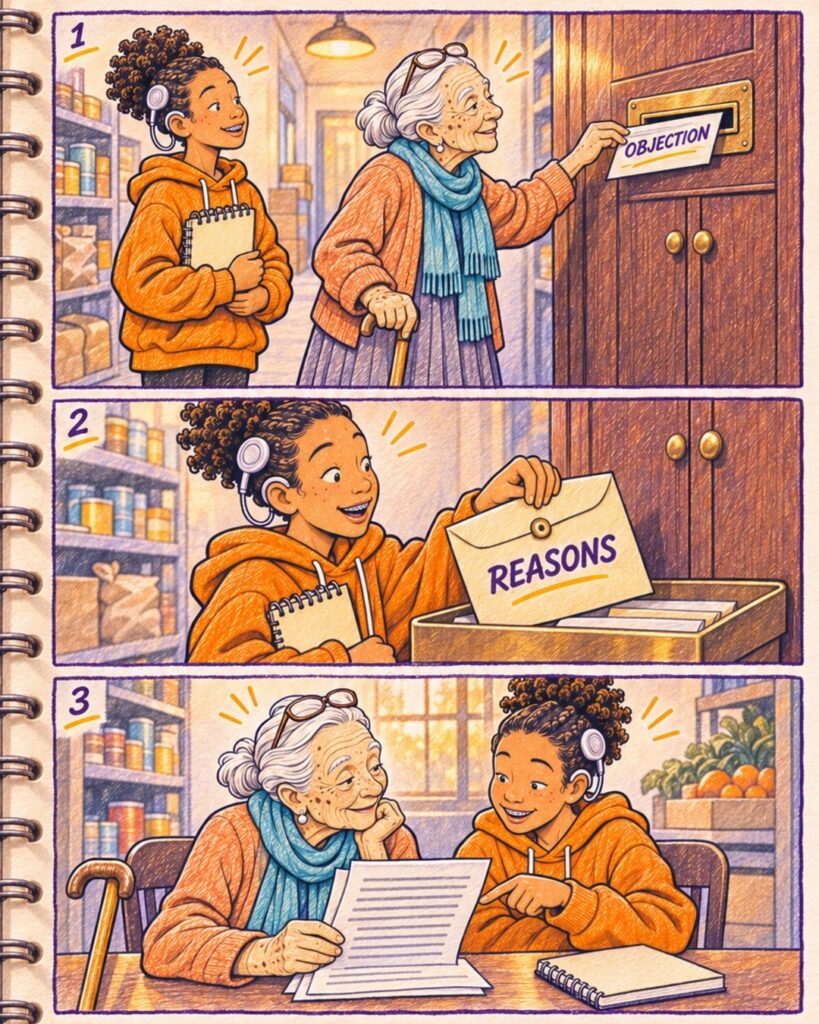
Text description of the reasons envelope illustration
What the reasons envelope illustration shows about W3C governance
- Subject: who has to explain the ruling when someone objects.
- First panel: An older woman with a wooden cane slides a card labeled OBJECTION into a brass slot in a wooden cabinet. A teen with a cochlear implant watches.
- Second panel: Next, the teen lifts a thick envelope labeled REASONS from the tray below the slot.
- Third panel: Then the two sit at the pantry table and read the letter together. The teen points to a paragraph.
- Text in the image: OBJECTION, REASONS and the panel numbers.
- Not shown: any real council, person or standards body. Fictional scene.
In “extraordinary cases,” a two thirds vote can pass the case to a delegate, such as a Team member. That clause, section 5.6.2.2, sets no written duty to give reasons. Section 5.6.2.8’s rationale duty covers a council’s report.1314
I count ten finished councils under the W3C Process.15 Only one upheld an objection. Six ended in a ruling against the objection, one of them the CEO’s. Three ended in a “Short Circuit,” where potential council members voted to adopt the Team’s recommendation. Those three left a Team report but no council report.16 One payments case’s Team report needs a login, though the charter’s approval notice is public.1718
Vibration: upheld on process, 278 days after registration
The Vibration application programming interface (API) lets a web page buzz your phone. An engine is the core code that turns HTML into a page. The Team’s report tells me WebKit, the engine behind Safari, removed the API in 2017. Firefox removed it from its code in June 2024.19
From September to November 2024, W3C asked its Members to mark the API obsolete, and drew two objections. At TPAC 2024 that September, the working group chose to restart the spec as a Candidate Recommendation, a draft stage. That resolved one objection. The other argued for “iterating on API designs rather than marking them obsolete.” The Team cited “the current implementation status” and advised overruling it.20
Registration came when the review closed, on November 5, 2024.21 On August 10, 2025, 278 days later, the council upheld the objection on process: “it is not possible to Obsolete a Candidate Recommendation.”22
A case passed to the CEO
In the other case I traced, objectors challenged the charter, or scope document, of a Private Advertising Technology Working Group. The Team wrote “The CEO should get delegation to address” five issues tagged legal that include antitrust and conflicts of interest. Its report doesn’t say why the CEO should decide instead of a council.23 The council then voted to hand the case over.24 The CEO overruled the objections, writing that concerns about conflicts of interest outside W3C staff “are best handled in open community discussion.”25 Review closed on November 13, 2023. The index dates the case November 5, 2024, 358 days later.2627 So the objectors got written reasons that section 5.6.2.2 didn’t require.28
What WHATWG governance promises an objector
Anyone can file a WHATWG issue.29 To appeal, you or your organization sign its contributor agreement, and participation “is open to all.”30 Editors “must respond to substantive issues raised by Workstream Participants,” meaning signers. If unsatisfied, ask for a revisit, then appeal.31
Under the WHATWG Steering Group Policy, the group “must decide on all such appeals, if not withdrawn.”32 Your appeal also forces a vote, which a two thirds supermajority decides.33 But the duty stops at reasons and dates. Decisions “with a visible public effect must be recorded” in GitHub issues. Recording each company’s rationale is “recommended,” but “not required.” The group “has no obligation to respond to requests in any particular time frame,” unless a policy requires it.34
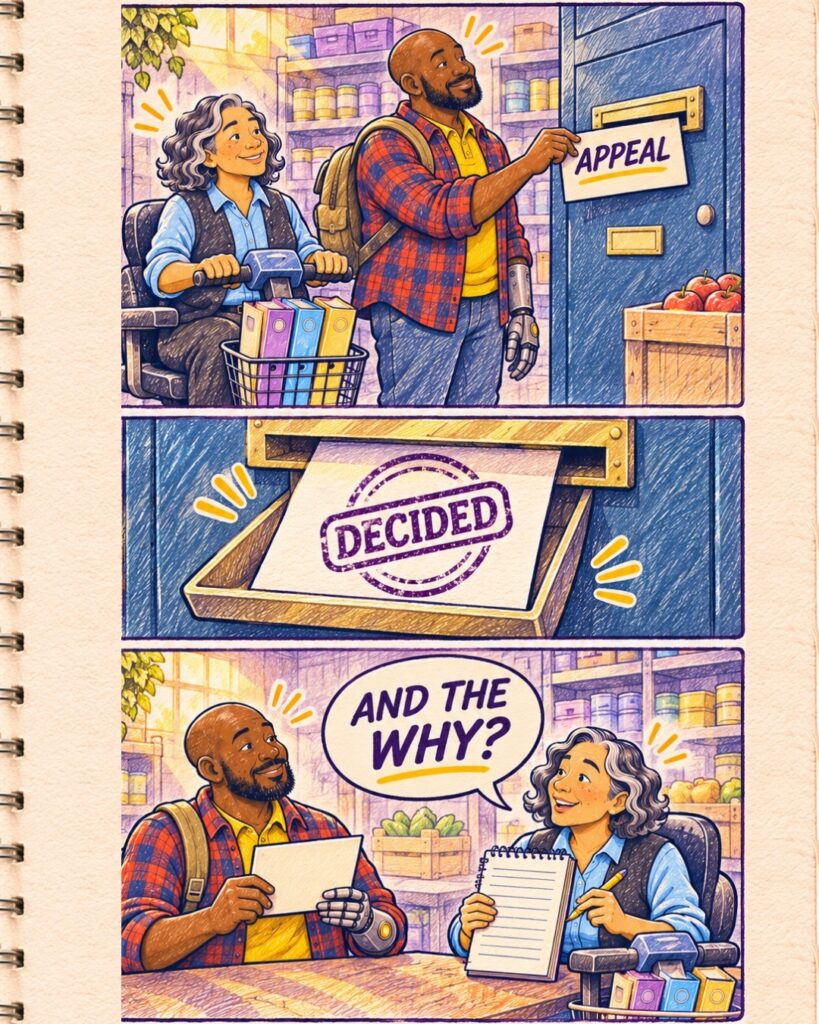
Text description of the decided stamp illustration
What the decided stamp illustration shows about WHATWG governance
- Subject: an appeal that must get a decision, while the reason stays optional.
- First panel: A man with a prosthetic left hand drops a card labeled APPEAL into a blue cabinet’s slot. An adult on a mobility scooter waits beside him.
- Second panel: Then a card slides back out of the tray with one stamp: DECIDED.
- Third panel: However, the back of the card is blank. So the scooter rider holds out an empty notepad and asks, “And the why?”
- Text in the image: APPEAL, DECIDED and “And the why?”
- Not shown: any real browser maker or steering group. Fictional scene.
HTML’s endorsement dispute path still names the W3C Director
In 2019, the two standards bodies wrote down HTML’s governance, agreeing that “the Web community is best served by a single development stream.”35
The agreement also sets a dispute path for objections when W3C is asked to endorse a WHATWG Review Draft of HTML. W3C’s HTML Working Group must “escalate the disagreement to the WHATWG Steering Group,” then “to the W3C Director.” If the Director sustains the objection, W3C can decline to endorse.36 Yet W3C moved Formal Objections from the Director to councils in June 2023.37 W3C’s last step on endorsing HTML is a forwarding address for an office that moved. The Advisory Board’s wiki page, now kept “for historical interest,” notes “a standing resolution to assign this to the Council.”38 But the agreement changes “only in writing” by both sides.39 A 2025 draft would make that change, though it says it “has no standing.”40
On November 21, 2026, I checked W3C’s agreement pages (a 2021 update among them) and searched the Steering Group’s GitHub repository. I found no written change to this step.4142 The HTML Working Group’s charter page says “active but expired.”43 So I can’t tell who would raise a dispute today, or who would hear the last step.
Does web standards governance matter if browsers decide what ships?
The working mode says “Implementations can always override the editor by implementing something else.”44 If code wins anyway, web standards governance can look like a letter browsers can ignore.
What would show me a council changed what ships? A ruling, then a browser bug or release note citing it. I didn’t search bug trackers, so I can’t show one. I can’t use Vibration for this test, since that objection was about the spec’s status at W3C, not what browsers ship.
Still, an objection that reaches a council fixes who must explain. Vibration’s reason is now public.45 Councils do cite each other. In May 2025, one council cited an earlier council’s decision “as precedent.”46 I found nothing in the Process that binds a later council, though.
Deciding is narrower than objecting. Steering Group members are “Qualifying Entities,” which develop “one of the core end-to-end integrated web browser platform engines” and distribute it “widely.” The Steering Group Agreement named Apple, Google, Microsoft and Mozilla as the first four, and others join by “unanimous consent.”47 At W3C, “each Member or group of related Members has one vote.”48 Objecting gives you no vote at either body. If you build WordPress sites, as I do, you live downstream of governance at both web standards bodies.
Would outsiders gain a vote if HTML went back under W3C rules? I don’t think so. They’d gain a council’s written answer, while Members hold W3C’s Advisory Committee votes and browsers decide what ships.49505152
The best case for letting four browser makers decide
WHATWG documents make the strongest case for its brand of web standards governance. The Steering Group’s mission is “to help facilitate cross-engine interoperability.”53 Its working mode says “don’t write fiction”: standards and browsers should match each other. A new feature needs “the support of at least two implementers.”54 Editors’ reasons can also arrive in the thread before any appeal.55
A W3C council, by contrast, can keep an existing spec alive on a point of process, even when only one engine ships it.5657 Its deliberations are “confidential to that W3C Council.”58
So which failure would I rather live with? Here I can only compare rules with rules. I searched the Steering Group’s GitHub repository for “appeal” and “overrule,” and found no appeal decision to time. Its policy lets confidential decisions stay private, so that shows only what’s public.59 On paper, the WHATWG’s failure is a decision with no required reason or deadline. W3C’s is a reasoned answer from closed deliberations, with no deadline for the council and no reasons owed after delegation. I’d still take W3C’s, because a written reason can be cited later. WHATWG representatives may still give reasons, since the policy recommends it.60
How to check your project’s objection path
My post on open source decision making asked who decides. My four checks ask who must explain. They work for governance at any web standards body or project.
- Find the appeal step. Search your governance file for “appeal,” “objection,” “dispute” and “escalate.” If none shows up, your appeal process may not be written down.
- Name who hears an appeal, and check whether that group made the decision.
- Look for a duty to give reasons. A W3C council report “must provide a rationale,” while a WHATWG representative’s rationale is “not required.”6162
- Look for a clock. W3C gives its staff 90 days but sets the council no deadline to rule. The WHATWG names no deadline.636465
If someone objected to your project tomorrow, who would have to write back, and by when?
Footnotes (65)
- World Wide Web Consortium. “W3C Process Document,” section 5.6.2.2, Extraordinary Delegation. 18 August 2025. https://www.w3.org/policies/process/. Accessed 2026-11-21. ↩︎
- W3C President and CEO. “Decision on Formal Objections to the proposed PAT WG Charter.” W3C. Undated; the council index dates the case 5 November 2024. https://www.w3.org/2024/11/pat-wg-decision.html. Accessed 2026-11-21. ↩︎
- W3C and WHATWG. “Memorandum of Understanding Between W3C and WHATWG.” W3C. 2019-05-28. https://www.w3.org/2019/04/WHATWG-W3C-MOU.html. Accessed 2026-11-21. ↩︎
- World Wide Web Consortium. “W3C updates its Process Document.” W3C News. 12 June 2023. https://www.w3.org/news/2023/w3c-updates-its-process-document/. Accessed 2026-11-21. ↩︎
- World Wide Web Consortium. “Diversity,” TPAC Inclusion Fund sponsors (TPAC 2025 entry). W3C. Page undated. https://www.w3.org/about/diversity/. Accessed 2026-11-21. ↩︎
- World Wide Web Consortium. “Current Members & Testimonials.” W3C. Page undated; it read “There are 310 members.” earlier on 2026-11-21 and “There are 309 members.” that night. https://www.w3.org/membership/list/. Accessed 2026-11-21. ↩︎
- World Wide Web Consortium. “W3C Process Document,” section 5.5, Registering Formal Objections. 18 August 2025. https://www.w3.org/policies/process/. Accessed 2026-11-21. ↩︎
- World Wide Web Consortium. “W3C Process Document,” section 5.6.1, Investigation and Mediation by the Team. 18 August 2025. https://www.w3.org/policies/process/. Accessed 2026-11-21. ↩︎
- World Wide Web Consortium. “W3C Process Document,” section 5.6.2.1, on who serves on a council. 18 August 2025. https://www.w3.org/policies/process/. Accessed 2026-11-21. ↩︎
- World Wide Web Consortium. “W3C Process Document,” sections 3.3.1.1 and 3.3.1.2 (Advisory Board) and 3.3.2.1 and 3.3.2.2 (TAG). 18 August 2025. https://www.w3.org/policies/process/. Accessed 2026-11-21. ↩︎
- World Wide Web Consortium. “W3C Process Document,” section 5.6.2.8, Council Decision Report. 18 August 2025. https://www.w3.org/policies/process/. Accessed 2026-11-21. ↩︎
- World Wide Web Consortium. “W3C Process Document,” section 5.6.2.7, Council Deliberations. 18 August 2025. https://www.w3.org/policies/process/. Accessed 2026-11-21. ↩︎
- World Wide Web Consortium. “W3C Process Document,” section 5.6.2.2, Extraordinary Delegation. 18 August 2025. https://www.w3.org/policies/process/. Accessed 2026-11-21. ↩︎
- World Wide Web Consortium. “W3C Process Document,” section 5.6.2.8, Council Decision Report. 18 August 2025. https://www.w3.org/policies/process/. Accessed 2026-11-21. ↩︎
- World Wide Web Consortium. “W3C Council” index of completed council reports, “Formal Councils under the W3C Process.” W3C. Latest entry 22 June 2026. https://www.w3.org/about/council/. Accessed 2026-11-21. ↩︎
- World Wide Web Consortium. “W3C Council” index of completed council reports, “Formal Councils under the W3C Process.” W3C. Latest entry 22 June 2026. https://www.w3.org/about/council/. Accessed 2026-11-21. ↩︎
- World Wide Web Consortium. “W3C Council” index of completed council reports, “Formal Councils under the W3C Process.” W3C. Latest entry 22 June 2026. https://www.w3.org/about/council/. Accessed 2026-11-21. ↩︎
- W3C Marketing and Communications. “Call for Participation: Web Payments Working Group Charter Approved; Join the Web Payments WG.” public-payments-wg mailing list, W3C. 2023-08-03. https://lists.w3.org/Archives/Public/public-payments-wg/2023Aug/0000.html. Accessed 2026-11-21. ↩︎
- W3C Team. “Team report on Vibration API (Second Edition) Specification as Obsolete Recommendation Formal Objection.” W3C. Undated; its latest dated entry is 2025-05-30. https://www.w3.org/2025/05/team-report-vibration-api-council.html. Accessed 2026-11-21. ↩︎
- W3C Team. “Team report on Vibration API (Second Edition) Specification as Obsolete Recommendation Formal Objection.” W3C. Undated; its latest dated entry is 2025-05-30. https://www.w3.org/2025/05/team-report-vibration-api-council.html. Accessed 2026-11-21. ↩︎
- W3C Team. “Team report on Vibration API (Second Edition) Specification as Obsolete Recommendation Formal Objection.” W3C. Undated; its latest dated entry is 2025-05-30. https://www.w3.org/2025/05/team-report-vibration-api-council.html. Accessed 2026-11-21. ↩︎
- W3C Council. “W3C Council Report on the Formal Objection Against Vibration API Obsoletion (Round 2).” W3C. 2025-08-10. https://www.w3.org/2025/08/vibration2-council-report.html. Accessed 2026-11-21. ↩︎
- W3C Team. “Team report on Private Advertising Technology Working Group Charter Formal Objection.” W3C. Undated; AC review ended 2023-11-13. https://www.w3.org/2024/07/team-report-pat-wg-fo.html. Accessed 2026-11-21. ↩︎
- World Wide Web Consortium. “W3C Council” index of completed council reports, “Formal Councils under the W3C Process.” W3C. Latest entry 22 June 2026. https://www.w3.org/about/council/. Accessed 2026-11-21. ↩︎
- W3C President and CEO. “Decision on Formal Objections to the proposed PAT WG Charter.” W3C. Undated; the council index dates the case 5 November 2024. https://www.w3.org/2024/11/pat-wg-decision.html. Accessed 2026-11-21. ↩︎
- W3C Team. “Team report on Private Advertising Technology Working Group Charter Formal Objection.” W3C. Undated; AC review ended 2023-11-13. https://www.w3.org/2024/07/team-report-pat-wg-fo.html. Accessed 2026-11-21. ↩︎
- World Wide Web Consortium. “W3C Council” index of completed council reports, “Formal Councils under the W3C Process.” W3C. Latest entry 22 June 2026. https://www.w3.org/about/council/. Accessed 2026-11-21. ↩︎
- World Wide Web Consortium. “W3C Process Document,” sections 5.5, 5.6.1 and 5.6.2.2. 3 November 2023; superseded by the 18 August 2025 version. https://www.w3.org/policies/process/20231103/. Accessed 2026-11-21. ↩︎
- WHATWG. “Working Mode.” WHATWG. Undated; edited 2026-11-09 by commit f900d0a. https://whatwg.org/working-mode. Accessed 2026-11-21. ↩︎
- WHATWG. “Workstream Policy.” WHATWG. Last changed 2024-06-19 by commit c8579b7. https://whatwg.org/workstream-policy. Accessed 2026-11-21. ↩︎
- WHATWG. “Workstream Policy.” WHATWG. Last changed 2024-06-19 by commit c8579b7. https://whatwg.org/workstream-policy. Accessed 2026-11-21. ↩︎
- WHATWG. “Steering Group Policy.” WHATWG. Last changed 2022-07-06 by commit 9e477ab. https://whatwg.org/sg-policy. Accessed 2026-11-21. ↩︎
- Apple, Google, Microsoft and Mozilla. “WHATWG Steering Group Agreement.” WHATWG. Commencing 2017-11-30; last changed 2025-03-06 by commit 6119ef8. Sections 2, 3.1, 3.2 and 5. https://whatwg.org/sg-agreement. Accessed 2026-11-21. ↩︎
- WHATWG. “Steering Group Policy.” WHATWG. Last changed 2022-07-06 by commit 9e477ab. https://whatwg.org/sg-policy. Accessed 2026-11-21. ↩︎
- W3C and WHATWG. “Memorandum of Understanding Between W3C and WHATWG.” W3C. 2019-05-28. https://www.w3.org/2019/04/WHATWG-W3C-MOU.html. Accessed 2026-11-21. ↩︎
- W3C and WHATWG. “Memorandum of Understanding Between W3C and WHATWG.” W3C. 2019-05-28. https://www.w3.org/2019/04/WHATWG-W3C-MOU.html. Accessed 2026-11-21. ↩︎
- World Wide Web Consortium. “W3C updates its Process Document.” W3C News. 12 June 2023. https://www.w3.org/news/2023/w3c-updates-its-process-document/. Accessed 2026-11-21. ↩︎
- W3C Advisory Board. “AB/Director-free Plan,” item I. W3C Wiki. Last edited 2023-08-18; the page says it “is kept for historical interest, but is no longer current or maintained.” https://www.w3.org/wiki/AB/Director-free_Plan. Accessed 2026-11-21. ↩︎
- W3C and WHATWG. “Memorandum of Understanding Between W3C and WHATWG.” W3C. 2019-05-28. https://www.w3.org/2019/04/WHATWG-W3C-MOU.html. Accessed 2026-11-21. ↩︎
- World Wide Web Consortium. “W3C/WHATWG Relationship update” (draft). W3C. Last updated 2025-08-07. https://www.w3.org/2025/08/WHATWG-W3C-MOU_2025_update.html. Accessed 2026-11-21. Its author, a W3C staff member, opened w3c/whatwg-coord issue 22 on 2025-08-06 with “I wrote a draft of what an update to the MoU would look like.” https://github.com/w3c/whatwg-coord/issues/22. Accessed 2026-11-21. ↩︎
- W3C and WHATWG. “W3C/WHATWG Relationship update.” W3C. Last updated 2021-06-28. https://www.w3.org/2021/06/WHATWG-W3C-MOU_2021_update.html. Accessed 2026-11-21. ↩︎
- World Wide Web Consortium. “W3C/WHATWG Relationship update” (draft). W3C. Last updated 2025-08-07. https://www.w3.org/2025/08/WHATWG-W3C-MOU_2025_update.html. Accessed 2026-11-21. Its author, a W3C staff member, opened w3c/whatwg-coord issue 22 on 2025-08-06 with “I wrote a draft of what an update to the MoU would look like.” https://github.com/w3c/whatwg-coord/issues/22. Accessed 2026-11-21. ↩︎
- World Wide Web Consortium. “HTML Working Group,” Charters history. W3C. Charter of 2022-06-06, extended until 2024-12-06. https://www.w3.org/groups/wg/htmlwg/charters/. Accessed 2026-11-21. ↩︎
- WHATWG. “Working Mode.” WHATWG. Undated; edited 2026-11-09 by commit f900d0a. https://whatwg.org/working-mode. Accessed 2026-11-21. ↩︎
- W3C Council. “W3C Council Report on the Formal Objection Against Vibration API Obsoletion (Round 2).” W3C. 2025-08-10. https://www.w3.org/2025/08/vibration2-council-report.html. Accessed 2026-11-21. ↩︎
- W3C Council. “W3C Council Report on the Formal Objections Against the Privacy Principles as a Statement,” section 3.2.3. W3C. 2025-05-09. https://www.w3.org/2025/05/council-privacy-principles-report.html. Accessed 2026-11-21. ↩︎
- Apple, Google, Microsoft and Mozilla. “WHATWG Steering Group Agreement.” WHATWG. Commencing 2017-11-30; last changed 2025-03-06 by commit 6119ef8. Sections 2, 3.1, 3.2 and 5. https://whatwg.org/sg-agreement. Accessed 2026-11-21. ↩︎
- World Wide Web Consortium. “W3C Process Document,” section 5.8, Advisory Committee Votes. 18 August 2025. https://www.w3.org/policies/process/. Accessed 2026-11-21. ↩︎
- World Wide Web Consortium. “W3C Process Document,” section 5.6.2.8, Council Decision Report. 18 August 2025. https://www.w3.org/policies/process/. Accessed 2026-11-21. ↩︎
- World Wide Web Consortium. “Current Members & Testimonials.” W3C. Page undated; it read “There are 310 members.” earlier on 2026-11-21 and “There are 309 members.” that night. https://www.w3.org/membership/list/. Accessed 2026-11-21. ↩︎
- World Wide Web Consortium. “W3C Process Document,” section 5.8, Advisory Committee Votes. 18 August 2025. https://www.w3.org/policies/process/. Accessed 2026-11-21. ↩︎
- WHATWG. “Working Mode.” WHATWG. Undated; edited 2026-11-09 by commit f900d0a. https://whatwg.org/working-mode. Accessed 2026-11-21. ↩︎
- Apple, Google, Microsoft and Mozilla. “WHATWG Steering Group Agreement.” WHATWG. Commencing 2017-11-30; last changed 2025-03-06 by commit 6119ef8. Sections 2, 3.1, 3.2 and 5. https://whatwg.org/sg-agreement. Accessed 2026-11-21. ↩︎
- WHATWG. “Working Mode.” WHATWG. Undated; edited 2026-11-09 by commit f900d0a. https://whatwg.org/working-mode. Accessed 2026-11-21. ↩︎
- WHATWG. “Workstream Policy.” WHATWG. Last changed 2024-06-19 by commit c8579b7. https://whatwg.org/workstream-policy. Accessed 2026-11-21. ↩︎
- W3C Team. “Team report on Vibration API (Second Edition) Specification as Obsolete Recommendation Formal Objection.” W3C. Undated; its latest dated entry is 2025-05-30. https://www.w3.org/2025/05/team-report-vibration-api-council.html. Accessed 2026-11-21. ↩︎
- W3C Council. “W3C Council Report on the Formal Objection Against Vibration API Obsoletion (Round 2).” W3C. 2025-08-10. https://www.w3.org/2025/08/vibration2-council-report.html. Accessed 2026-11-21. ↩︎
- World Wide Web Consortium. “W3C Process Document,” section 5.6.2.7, Council Deliberations. 18 August 2025. https://www.w3.org/policies/process/. Accessed 2026-11-21. ↩︎
- WHATWG. “Steering Group Policy.” WHATWG. Last changed 2022-07-06 by commit 9e477ab. https://whatwg.org/sg-policy. Accessed 2026-11-21. ↩︎
- WHATWG. “Steering Group Policy.” WHATWG. Last changed 2022-07-06 by commit 9e477ab. https://whatwg.org/sg-policy. Accessed 2026-11-21. ↩︎
- World Wide Web Consortium. “W3C Process Document,” section 5.6.2.8, Council Decision Report. 18 August 2025. https://www.w3.org/policies/process/. Accessed 2026-11-21. ↩︎
- WHATWG. “Steering Group Policy.” WHATWG. Last changed 2022-07-06 by commit 9e477ab. https://whatwg.org/sg-policy. Accessed 2026-11-21. ↩︎
- World Wide Web Consortium. “W3C Process Document,” section 5.6.1, Investigation and Mediation by the Team. 18 August 2025. https://www.w3.org/policies/process/. Accessed 2026-11-21. ↩︎
- World Wide Web Consortium. “W3C Process Document,” section 5.6.2.7, Council Deliberations. 18 August 2025. https://www.w3.org/policies/process/. Accessed 2026-11-21. ↩︎
- WHATWG. “Steering Group Policy.” WHATWG. Last changed 2022-07-06 by commit 9e477ab. https://whatwg.org/sg-policy. Accessed 2026-11-21. ↩︎
Leave a Reply