

Years ago, before WordPress had a project-wide open source code of conduct, I had a complaint about a project leader. The only person I could have taken it to was that same leader.
“Account” means my own experience, not a documented finding.
Guess first: Of 13 projects, how many say who hears a report about the people who enforce their code? Pick a number.
So I counted. I read the conduct rules of 13 open source projects. Eight say who hears a report about the people who enforce the code. Five say who hears one about the people at the top, or name a process that does.
A code that doesn’t say who hears a complaint about the people at the top fails the reporter who may need it most. The count is fact. That cost is my read.
Estimated reading time: 13 minutes
Key takeaways
- The big picture: The Contributor Covenant, a template WordPress adapts, hands enforcement to “community leaders.” But I found no appeal or conflict of interest clause in version 2.1 or 3.0.
- Why it matters: In seven projects that name a top, I found no written route for a complaint about it. A report nobody files also never shows up in a count.
- Yes, but: Rust and TYPO3 make the case for insiders who are “known and trusted” and understand the project’s people. Still, my read is that this fits a report about the top only when someone the top doesn’t pick hears the case.
- What to do: Before you report, find your project’s row, or check its pages for the four answers my table tracks. A “not found” means no written route, not that nobody will listen.
By conduct rules, I mean each open source code of conduct plus the charters and policies around it. By the people at the top, I mean a project’s lead or its top governing body.
If you need help now
If anyone is in danger, contact local emergency services first. At a Linux Foundation event, its code asks you to “notify a conference organizer at once.”1 A host foundation, the nonprofit some projects sit under, may have a conduct team apart from the project’s top. The Cloud Native Computing Foundation (CNCF) lets you send a report “directly to any individual member” of its committee.2
My ties, before any verdict
I work at Pantheon, a WordPress and Drupal host that competes with WP Engine, another WordPress host. It also competes with WordPress VIP, the enterprise service from Automattic, the company behind WordPress.com. At GoDaddy, I started and ran its Five for the Future program, which pledges staff time to WordPress, until July 2026.
Separately, I chose which groups GoDaddy funded:
- The PHP Foundation, which pays developers to work on the PHP language.
- OpenJS, the foundation behind Node.js and other JavaScript projects.
- W3C, the World Wide Web Consortium, a web standards body.
- PHP_CodeSniffer, a tool that checks code style.
- The WPOCC, a WordPress community collective where I’m a co-founding board member.
I’m an active member of the Technical Steering Committee for FAIR, the FAIR Package Manager, which distributes WordPress plugins and themes. It’s a Linux Foundation project, and the Linux Foundation is a nonprofit that hosts open source projects.
WordPress and Drupal are two of my 13 rows, and my employer hosts both. Pantheon is a platinum Drupal Certified Partner.3 Of the groups GoDaddy funded, OpenJS hears Node.js conduct appeals, and the PHP Foundation’s code covers its own spaces. Kubernetes appeals go to CNCF,4 which “is part of the nonprofit Linux Foundation.”5 My FAIR role sits under that foundation. So does the kernel’s TAB, which its docs call the “Linux Foundation Technical Advisory Board.”6 I’ve volunteered in WordPress since 2009, including as a former Training Team faculty member and rep. None of these groups reviewed this post.
13 projects, one row each
What counts in each column
I chose open source projects whose code of conduct pages are public, so I could read them in full. That leans my sample toward projects that write things down, and away from solo maintainers. PHP is in because its project pages are public, and it has no adopted code.
A route counts only when a page names who receives or decides a report and ties it to that case. Conflict rules count when they name who takes over. A power to remove, like Drupal’s review panel holds, doesn’t count.7
The kernel lets you contact one committee member, but ties that to a reporter’s wish, not to a report about a member.8 WordPress’s case teams “should not have a direct connection to the case,” but no page names who takes over.9 Neither counts. One sentence can count in both columns when its people enforce the code and sit at the top, as at Node.js and MariaDB. A host foundation counts as a top or a route only where a project’s own pages point to it.
An appeal counts when a page names the reviewer for more than events. So Mozilla’s appeal email and WordPress’s event appeal stay out.1011
Which rows name a top
The top is whoever a project’s own governance pages put in charge of the whole project, or give the last word on its decisions. I don’t pick it by its place in the conduct process. That rule would force any route about the top outside the process.
So Django’s top is its steering council, with “a tie-breaking vote when other decision-making processes fail,”12 like Python’s Steering Council.13 WordPress’s Core handbook says a “core leadership team” “governs all aspects of the project.”14
Joomla’s nonprofit, Open Source Matters, has a board that decides conduct cases.15 Joomla’s project page says that board governs the project.16 That leaves 12 rows with a top, and five name who hears a report about it.
PHP’s index of proposals files the 2016 plan to adopt a code under “Inactive,” though the plan’s own page still says “Reopened.”1718 Leave out PHP and it’s eight of 12 and five of 12.
Seven projects name who reviews an appeal beyond events: Django, Drupal, Joomla, Kubernetes, Node.js, Rust and TYPO3.
Where I go past the documents, I say “my read.” “Not found” means not found in the documents I searched on November 21, 2026.19
The 13 rows
| Project | The top, per its pages | Report about an enforcer | Report about the top | Appeal |
|---|---|---|---|---|
| Django | Steering council20 | Chairs, then the Django Software Foundation (DSF) board21 | Not found | DSF board “reconsideration”22 |
| Drupal | Project lead23 | Conduct team, then its “chartered authority”24 | Not found | Review panel25 |
| Joomla | Open Source Matters board26 | Not found | Not found | Ombudsman, then Open Source Matters board27 |
| Kubernetes | Steering Committee28 | Recusal, then a mediator29 | Separate committee the Steering Committee elects3031 | CNCF, on listed grounds32 |
| Linux kernel | Sole merger into the main kernel repository33 | Not found; one member, at the reporter’s choice34 | Not found | Not found |
| MariaDB | Maintainer Council35 | A Council member a report names “takes no part”36 | Same rule; Foundation handles it37 | Not found |
| Mozilla | The “ultimate decision-maker”38 | Not found | Not found; hotline covers employees39 | Not found; email only40 |
| Node.js | Technical Steering Committee (TSC)41 | Other TSC members; involved ones recuse42 | Other TSC members43 | OpenJS, on listed grounds44 |
| PHP | No top named | No adopted code found45 | No top named | Not found |
| Python | Steering Council46 | Recusal; a Python Software Foundation (PSF) board member fills in47 | Not found | Not found |
| Rust | Leadership Council48 | Remaining and contingent (backup) moderators49 | Moderation team, same process as members50 | Any moderator, in private51; Council may order audits52 |
| TYPO3 | TYPO3 Association board53 | Inmedio (outside mediators) for ombudsperson conflicts54 | Inmedio, “independent of the Board”55 | TYPO3 Association board, “final”56 |
| WordPress | Core leadership team57 | Not found; Incident Response Team (IRT) case teams avoid “direct connection”58 | Not found | Events only; team rep or Executive Director59 |
Where the template stops
WordPress and the PHP Foundation adapt version 2.1 of the Contributor Covenant, an open source code of conduct template. Django adapts version 3.0.606162
Version 2.1 doesn’t say who hears a complaint about the people at the top. It says, “Community leaders are responsible for clarifying and enforcing our standards of acceptable behavior.”63 Each project then decides who its “community leaders” are.
I found no appeal or conflict of interest clause in version 2.1.64 Version 3.0 came out in July 2025, and I found none there either.6566
Who hears a conduct complaint about the people at the top
The Kubernetes incident process says its committee is “separate from the Steering Committee.” Its reason is so “anyone can report, regardless of roles and organizational power dynamics which often lead to systemic underreporting.”67 Rust’s Council members follow “the same process as conflicts involving Project members.”68 TYPO3 offers Inmedio, “an external team” of mediators, “especially if the situation involves a person in a leadership role.”69
Not all five go around the top. TYPO3’s mediators work “independent of the Board.” Yet anyone can appeal an ombudsperson’s decision to the TYPO3 Association board, whose “decisions are final.”70 Rust’s moderation team hears the case, and that team also holds one of the Council’s seats.71 Node.js keeps the case among peers. MariaDB’s Foundation handles reports “in consultation with the Maintainer Council,” minus any member a report names.72 Kubernetes’s committee stands apart, but only Steering Committee members vote in its elections.73 My read is that a route helps most when it goes around the person in the complaint.
Who hears a code of conduct report about an enforcer
Eight projects name who hears a report about an enforcer. Six use recusal, where a conflicted member steps aside. TYPO3 points reporters to Inmedio instead.74
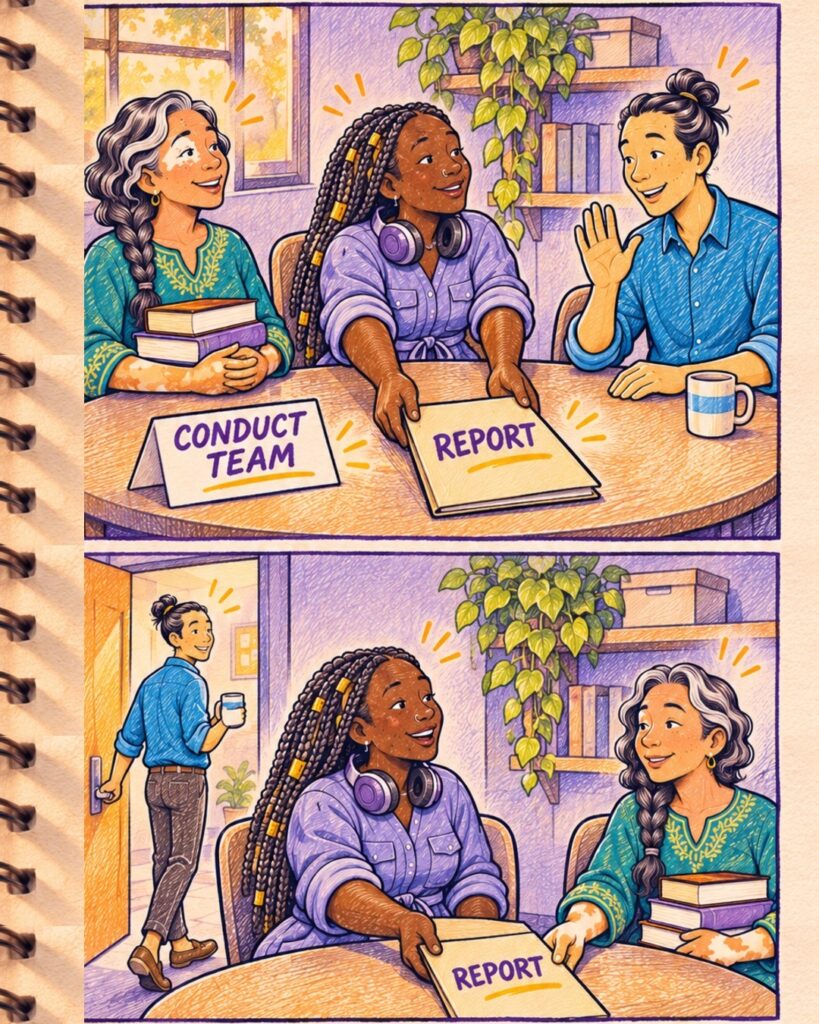
Text description of the stepping aside illustration
What the stepping aside illustration shows about conduct enforcement
- Subject: recusal, where a conflicted member of an open source conduct team steps aside, as its code allows.
- First panel: Three people sit at a round table behind a tent card reading CONDUCT TEAM. A woman with box braids sets down a folder labeled REPORT. A man with a top knot raises his hand.
- Second panel: Then he walks out the door with his mug. After that, the woman with box braids slides the folder to a woman with vitiligo and a long braid.
- Text in the image: CONDUCT TEAM and REPORT.
- Not shown: what the report says or whom it names. Fictional scene.
Seven also name someone who takes or joins the case. Django sends a report about every chair to the Django Software Foundation (DSF) board.75 A Python Software Foundation (PSF) board member steps in when more than two lead incident responders recuse.76 If every Kubernetes member recuses, “our third party mediator” takes the case.77 Node.js sends a dispute about a moderator to “the other TSC members.”78 Rust brings in its contingent moderators.79 Drupal lets outsiders report a conduct team member to the team, then escalate.80 MariaDB relies on recusal alone. That makes eight, since five do both.
The cost of a missing route
In seven projects that name a top, I found no written route for a complaint about it. PHP names no top at all. The reporter pays first, if the Kubernetes committee’s claim about “systemic underreporting” holds. A report nobody files never shows up in a count.
My read is that the person at the top pays, too. With no named route, a leader facing a complaint has no named place to answer it or be cleared.
Before announcing Inmedio in August 2026, TYPO3 already had a written inside route: its Ombudsperson Committee and a public mediation process. Its announcement says that system “has rarely been used in the past two years.” It “may not be well suited to complaints involving people in important or leadership roles,” and possible reasons include “a lack of perceived independence.”81 That’s TYPO3’s read, not a count.
The conduct team also pays. Its members may have to rule on people who appoint them. At the kernel, the TAB appoints the conduct committee.82
The best case for keeping conduct enforcement inside
Rust keeps a complaint about a Council member inside, with its moderation team. Its rules expect contingent moderators will often be “already part of the Project.” Its reason: “Choosing people known and trusted by the rest of the Project helps lower tensions in that situation.”83
TYPO3 makes a similar case for its inside committee, even as it adds an outside route. Its ombudspersons “understand its people, teams, and internal structures.” They can also “help resolve the issue informally.”84
My read is that these reasons fit a report about a member. For a report about the top, inside enforcers fit only when someone the top doesn’t pick hears the case. Kubernetes doesn’t clear that bar, since its top elects its conduct team.85 Rust’s moderators bring in their own members, but its Council must approve the contingent ones.86 An outside panel might draw more reports from people who fear the top, but no count I found tests that.
Drupal’s outside seat
In November 2018, Drupal’s conduct team, the Community Working Group, proposed a new charter.87 Under the old one, the Project Lead “appoints (or approves) its members” and “reviews any appeals.” The team called that setup “no longer tenable or scalable in the long term.”88
Drupal’s current charter has the three person review panel the proposal described. That panel seats two community elected Drupal Association board members plus “an independent representative from a different open source project.”89 (Pantheon is a Drupal partner; see my ties.)

Text description of the outside seat illustration
What the outside seat illustration shows about a conduct complaint
- Subject: an appeal panel with one seat for someone from a different project.
- First panel: An older man with hearing aids and a woman in a violet suit sit at a table. A third man with tabbed pages sits behind a tent card reading OUTSIDE SEAT.
- Second panel: Then a man with a forearm crutch and a headset hands the three a folder labeled APPEAL. They listen.
- Text in the image: OUTSIDE SEAT and APPEAL. However, in the second panel the tent card is blank.
- Not shown: any real project, board or foundation. Fictional scene.
An outside seat has costs too, and here I have reasons, not data. Insiders may trust an outsider less, because an outsider may lack the history. So might anyone who distrusts the picker. Drupal’s outside seat is “appointed by the Drupal Association board.”90
What the report counts can and can’t show
Showing how often routes get used would take a count of reports naming someone at the top, with outcomes. None of the counts I found splits reports that way. Their periods and units also differ. Django’s working group logged four reports in 2025.91 The PSF logged 20 in 2024, covering 16 issues.92 Kubernetes counted 69 incidents in the first half of 2022, its newest report I found.93 Mozilla had triaged 282 reports by September 2020, but its post gives no start date.94
Check your open source code of conduct before you report
If you’re about to report, find your project’s row. If your open source project isn’t there, check its code of conduct pages for the four answers my table tracks. A “not found” doesn’t mean nobody will listen. It means I found no written route.
Before you report in yours, who will read it first?
Footnotes (94)
- The Linux Foundation. “Code of Conduct” for Linux Foundation events. events.linuxfoundation.org. https://events.linuxfoundation.org/about/code-of-conduct/. Accessed 2026-11-21. ↩︎
- Cloud Native Computing Foundation. “CNCF Code of Conduct: Incident Resolution Procedures,” section How to submit a report. GitHub, cncf/foundation. https://github.com/cncf/foundation/blob/main/code-of-conduct/coc-incident-resolution-procedures.md. Accessed 2026-11-21. ↩︎
- Drupal.org. “Pantheon.” Drupal.org. https://new.drupal.org/pantheon. Accessed 2026-11-21. ↩︎
- Cloud Native Computing Foundation. “Code of Conduct Committee jurisdiction policy.” GitHub, cncf/foundation. https://github.com/cncf/foundation/blob/main/code-of-conduct/coc-committee-jurisdiction-policy.md. Accessed 2026-11-21. ↩︎
- Cloud Native Computing Foundation. “Who We Are.” cncf.io. https://www.cncf.io/about/who-we-are/. Accessed 2026-11-21. ↩︎
- The Linux kernel. “Linux Kernel Contribution Maturity Model.” docs.kernel.org. https://docs.kernel.org/process/contribution-maturity-model.html. Accessed 2026-11-21. ↩︎
- Drupal. “Community Working Group charter.” drupal.org. Updated 2024-05-16. https://www.drupal.org/community/cwg/charter. Accessed 2026-11-21. The charter links the group’s “Code of Ethics” (modified 2020-11-24), whose section on violations says “People outside the group may also report suspected violations of this policy to the CWG” and, without “a satisfactory response,” may “escalate the matter to the CWG’s chartered authority.” https://www.drupal.org/community/cwg/code-of-ethics. Accessed 2026-11-21. ↩︎
- The Linux kernel. “Linux Kernel Contributor Covenant Code of Conduct Interpretation.” docs.kernel.org. https://docs.kernel.org/process/code-of-conduct-interpretation.html. Accessed 2026-11-21. ↩︎
- WordPress Community team. “Incident Response Process.” Community Handbook. Updated 2024-10-04. https://make.wordpress.org/community/handbook/irt/process/. Accessed 2026-11-21. ↩︎
- Mozilla. “Community Participation Guidelines” v3.1. mozilla.org. 2020-01-16. https://www.mozilla.org/en-US/about/governance/policies/participation/. Accessed 2026-11-21. ↩︎
- WordPress Community team. “Incident report response procedure.” Community Handbook. First published 2019-10-22, updated 2023-08-10. https://make.wordpress.org/community/handbook/community-deputy/the-community-supporter-program/when-things-happen/incident-report-response-procedure/. Accessed 2026-11-21. ↩︎
- Django Software Foundation. “Organization of the Django Project,” section Steering council. Django documentation, docs.djangoproject.com. https://docs.djangoproject.com/en/dev/internals/organization/. Accessed 2026-11-21. ↩︎
- Python core team. “PEP 13: Python Language Governance.” peps.python.org. Created 2018-12-16. https://peps.python.org/pep-0013/. Accessed 2026-11-21. ↩︎
- WordPress Core team. “Project Organization.” Core Contributor Handbook, make.wordpress.org. First published 2011-12-13, updated 2026-09-07. https://make.wordpress.org/core/handbook/about/organization/. Accessed 2026-11-21. ↩︎
- Open Source Matters. “Policy regarding Code of Conduct breaches.” opensourcematters.org. 2019-04-17, updated 2020-03-07. https://www.opensourcematters.org/organisation/directors/policies/278-policy-regarding-coc-breaches.html. Accessed 2026-11-21. ↩︎
- Joomla. “The Joomla! Project.” joomla.org. https://www.joomla.org/about-joomla/the-project.html. Accessed 2026-11-21. It says, “The Joomla! Project is governed by the Board of Directors of Open Source Matters, Inc.” ↩︎
- PHP. “Request for Comments,” section Inactive. PHP Wiki. https://wiki.php.net/rfc. Accessed 2026-11-21. ↩︎
- PHP. “PHP RFC: Adopt Code Of Conduct.” PHP Wiki. Version 0.5, 2016-01-20, status Reopened. https://wiki.php.net/rfc/adopt-code-of-conduct. Accessed 2026-11-21. ↩︎
- Courtney Robertson. “Documents searched for each row,” author’s note for this post, all read 2026-11-21, to be posted on the Merge Conflicts methods page. https://courtneyr.dev/merge-conflicts-methods/. Django: the project organization page, code of conduct, reporting guide, conduct working group charter and its 2025 transparency report. Drupal: core MAINTAINERS.txt, Community Working Group charter and its 2018 proposal. Joomla: the Open Source Matters breach policy, its organisation page and Joomla’s leadership team page. Kubernetes: the Steering Committee charter, incident process, committee charter, election process, the transparency reports folder, the committee’s kubernetes.dev page and CNCF’s jurisdiction policy and transparency page. Linux kernel: code of conduct, its interpretation and the development process guide. MariaDB: code of conduct, governance overview and governance framework. Mozilla: Community Participation Guidelines, its reporting page, its governance page, its roles and leadership page and its module ownership policy. Node.js: moderation policy, project governance and the OpenJS code of conduct policy. PHP: the RFC index, the 2016 RFC, the voting RFC, the credits page and the PHP Foundation’s code. Python: PEP 13, the PSF reporting procedures and its code of conduct page’s report list. Rust: code of conduct, RFC 3392 and the Rust Forge pages on the Council and moderation. TYPO3: code of conduct, the association’s who we are page and the 2026 news post. WordPress: the Core handbook’s project organization page, community code of conduct, IRT handbook, IRT process, incident report response procedure, the 2023 IRT report and a search of the Make WordPress Project blog for later reports. ↩︎
- Django Software Foundation. “Organization of the Django Project,” section Steering council. Django documentation, docs.djangoproject.com. https://docs.djangoproject.com/en/dev/internals/organization/. Accessed 2026-11-21. ↩︎
- Django Software Foundation. “Reporting guide.” djangoproject.com. https://www.djangoproject.com/conduct/reporting/. Accessed 2026-11-21. ↩︎
- Django Software Foundation. “Reporting guide.” djangoproject.com. https://www.djangoproject.com/conduct/reporting/. Accessed 2026-11-21. ↩︎
- Drupal. “MAINTAINERS.txt,” section Drupal Core Leadership team. Drupal GitLab, project/drupal, branch 11.x. https://git.drupalcode.org/project/drupal/-/raw/11.x/core/MAINTAINERS.txt [TXT]. Accessed 2026-11-21. ↩︎
- Drupal. “Community Working Group charter.” drupal.org. Updated 2024-05-16. https://www.drupal.org/community/cwg/charter. Accessed 2026-11-21. The charter links the group’s “Code of Ethics” (modified 2020-11-24), whose section on violations says “People outside the group may also report suspected violations of this policy to the CWG” and, without “a satisfactory response,” may “escalate the matter to the CWG’s chartered authority.” https://www.drupal.org/community/cwg/code-of-ethics. Accessed 2026-11-21. ↩︎
- Drupal. “Community Working Group charter.” drupal.org. Updated 2024-05-16. https://www.drupal.org/community/cwg/charter. Accessed 2026-11-21. The charter links the group’s “Code of Ethics” (modified 2020-11-24), whose section on violations says “People outside the group may also report suspected violations of this policy to the CWG” and, without “a satisfactory response,” may “escalate the matter to the CWG’s chartered authority.” https://www.drupal.org/community/cwg/code-of-ethics. Accessed 2026-11-21. ↩︎
- Joomla. “The Joomla! Project.” joomla.org. https://www.joomla.org/about-joomla/the-project.html. Accessed 2026-11-21. It says, “The Joomla! Project is governed by the Board of Directors of Open Source Matters, Inc.” ↩︎
- Open Source Matters. “Policy regarding Code of Conduct breaches.” opensourcematters.org. 2019-04-17, updated 2020-03-07. https://www.opensourcematters.org/organisation/directors/policies/278-policy-regarding-coc-breaches.html. Accessed 2026-11-21. ↩︎
- Kubernetes. “Kubernetes Steering Committee Charter.” GitHub, kubernetes/steering. https://github.com/kubernetes/steering/blob/main/charter.md. Accessed 2026-11-21. ↩︎
- Kubernetes. “Incident process.” GitHub, kubernetes/community. https://github.com/kubernetes/community/blob/main/committee-code-of-conduct/incident-process.md. Accessed 2026-11-21. ↩︎
- Kubernetes. “Incident process.” GitHub, kubernetes/community. https://github.com/kubernetes/community/blob/main/committee-code-of-conduct/incident-process.md. Accessed 2026-11-21. ↩︎
- Kubernetes. “Code of Conduct Committee election process” (election.md). GitHub, kubernetes/community. https://github.com/kubernetes/community/blob/main/committee-code-of-conduct/election.md. Accessed 2026-11-21. ↩︎
- Cloud Native Computing Foundation. “Code of Conduct Committee jurisdiction policy.” GitHub, cncf/foundation. https://github.com/cncf/foundation/blob/main/code-of-conduct/coc-committee-jurisdiction-policy.md. Accessed 2026-11-21. ↩︎
- The Linux kernel. “How the development process works.” docs.kernel.org. https://docs.kernel.org/process/2.Process.html. Accessed 2026-11-21. ↩︎
- The Linux kernel. “Linux Kernel Contributor Covenant Code of Conduct Interpretation.” docs.kernel.org. https://docs.kernel.org/process/code-of-conduct-interpretation.html. Accessed 2026-11-21. ↩︎
- MariaDB Foundation. “Governance Framework,” section Decision making. mariadb.org. https://mariadb.org/governance/governance-framework/. Accessed 2026-11-21. ↩︎
- MariaDB Foundation. “Code of Conduct.” mariadb.org. https://mariadb.org/governance/governance-code-of-conduct/. Accessed 2026-11-21. ↩︎
- MariaDB Foundation. “Code of Conduct.” mariadb.org. https://mariadb.org/governance/governance-code-of-conduct/. Accessed 2026-11-21. ↩︎
- Mozilla. “Mozilla Roles and Leadership,” section Ultimate Decision-Makers. mozilla.org. https://www.mozilla.org/en-US/about/governance/roles/. Accessed 2026-11-21. ↩︎
- Mozilla. “Community Participation Guidelines: How to Report.” mozilla.org. https://www.mozilla.org/en-US/about/governance/policies/participation/reporting/. Accessed 2026-11-21. ↩︎
- Mozilla. “Community Participation Guidelines” v3.1. mozilla.org. 2020-01-16. https://www.mozilla.org/en-US/about/governance/policies/participation/. Accessed 2026-11-21. ↩︎
- Node.js. “Node.js Project Governance,” section Technical Steering Committee. GitHub, nodejs/node. https://github.com/nodejs/node/blob/main/GOVERNANCE.md. Accessed 2026-11-21. ↩︎
- Node.js. “Moderation Policy,” section Reports regarding TSC and Moderation Team members. GitHub, nodejs/admin. https://github.com/nodejs/admin/blob/main/Moderation-Policy.md. Accessed 2026-11-21. ↩︎
- Node.js. “Moderation Policy,” section Reports regarding TSC and Moderation Team members. GitHub, nodejs/admin. https://github.com/nodejs/admin/blob/main/Moderation-Policy.md. Accessed 2026-11-21. ↩︎
- OpenJS Foundation. “Code of Conduct Policy,” section Appeals. GitHub, openjs-foundation/cross-project-council. https://github.com/openjs-foundation/cross-project-council/blob/main/conduct/COC_POLICY.md. Accessed 2026-11-21. ↩︎
- PHP. “Request for Comments,” section Inactive. PHP Wiki. https://wiki.php.net/rfc. Accessed 2026-11-21. ↩︎
- Python core team. “PEP 13: Python Language Governance.” peps.python.org. Created 2018-12-16. https://peps.python.org/pep-0013/. Accessed 2026-11-21. ↩︎
- Python Software Foundation. “Procedures for Reporting Incidents.” policies.python.org. https://policies.python.org/python.org/code-of-conduct/Procedures-for-Reporting-Incidents/. Accessed 2026-11-21. ↩︎
- The Rust Project. “Leadership Council.” Rust Forge. https://forge.rust-lang.org/governance/council.html. Accessed 2026-11-21. ↩︎
- The Rust Project. “Moderation.” Rust Forge. https://forge.rust-lang.org/governance/moderation.html. Accessed 2026-11-21. ↩︎
- The Rust Project. “Moderation.” Rust Forge. https://forge.rust-lang.org/governance/moderation.html. Accessed 2026-11-21. ↩︎
- The Rust Project. “Code of conduct,” section Moderation. rust-lang.org. https://rust-lang.org/policies/code-of-conduct/. Accessed 2026-11-21. ↩︎
- The Rust Project. “Moderation.” Rust Forge. https://forge.rust-lang.org/governance/moderation.html. Accessed 2026-11-21. ↩︎
- TYPO3 Association. “The TYPO3 Association: Who We Are.” typo3.org. https://typo3.org/project/association. Accessed 2026-11-21. ↩︎
- TYPO3. “New Community Support Contact for Code of Conduct Incidents.” TYPO3 News. 2026-08-10. https://news.typo3.com/article/new-community-support-contact-for-code-of-conduct-incidents. Accessed 2026-11-21. ↩︎
- TYPO3. “New Community Support Contact for Code of Conduct Incidents.” TYPO3 News. 2026-08-10. https://news.typo3.com/article/new-community-support-contact-for-code-of-conduct-incidents. Accessed 2026-11-21. ↩︎
- TYPO3 Association. “Code of Conduct.” TYPO3 Community infrastructure guide, docs.typo3.org. https://docs.typo3.org/m/typo3/guide-policy/main/en-us/Community/CodeOfConduct.html. Accessed 2026-11-21. ↩︎
- WordPress Core team. “Project Organization.” Core Contributor Handbook, make.wordpress.org. First published 2011-12-13, updated 2026-09-07. https://make.wordpress.org/core/handbook/about/organization/. Accessed 2026-11-21. ↩︎
- WordPress Community team. “Incident Response Process.” Community Handbook. Updated 2024-10-04. https://make.wordpress.org/community/handbook/irt/process/. Accessed 2026-11-21. ↩︎
- WordPress Community team. “Incident report response procedure.” Community Handbook. First published 2019-10-22, updated 2023-08-10. https://make.wordpress.org/community/handbook/community-deputy/the-community-supporter-program/when-things-happen/incident-report-response-procedure/. Accessed 2026-11-21. ↩︎
- WordPress. “Community Code of Conduct.” Make WordPress Handbook. First published 2022-05-26, updated 2024-11-19. https://make.wordpress.org/handbook/community-code-of-conduct/. Accessed 2026-11-21. ↩︎
- The PHP Foundation. “Code of Conduct.” thephp.foundation. https://thephp.foundation/code-of-conduct/. Accessed 2026-11-21. ↩︎
- Django Software Foundation. “Django Code of Conduct,” section Attribution. djangoproject.com. https://www.djangoproject.com/conduct/. Accessed 2026-11-21. ↩︎
- Organization for Ethical Source. “Contributor Covenant 2.1.” contributor-covenant.org. https://www.contributor-covenant.org/version/2/1/code_of_conduct/. Accessed 2026-11-21. ↩︎
- Organization for Ethical Source. “Contributor Covenant 2.1.” contributor-covenant.org. https://www.contributor-covenant.org/version/2/1/code_of_conduct/. Accessed 2026-11-21. ↩︎
- Organization for Ethical Source. “Contributor Covenant 3.0.” contributor-covenant.org. https://www.contributor-covenant.org/version/3/0/code_of_conduct/. Accessed 2026-11-21. ↩︎
- Organization for Ethical Source. “Announcing Contributor Covenant 3.0.” Ethical Source blog. 2025-07-28. https://ethicalsource.dev/blog/contributor-covenant-3/. Accessed 2026-11-21. ↩︎
- Kubernetes. “Incident process.” GitHub, kubernetes/community. https://github.com/kubernetes/community/blob/main/committee-code-of-conduct/incident-process.md. Accessed 2026-11-21. ↩︎
- The Rust Project. “Moderation.” Rust Forge. https://forge.rust-lang.org/governance/moderation.html. Accessed 2026-11-21. ↩︎
- TYPO3. “New Community Support Contact for Code of Conduct Incidents.” TYPO3 News. 2026-08-10. https://news.typo3.com/article/new-community-support-contact-for-code-of-conduct-incidents. Accessed 2026-11-21. ↩︎
- TYPO3 Association. “Code of Conduct.” TYPO3 Community infrastructure guide, docs.typo3.org. https://docs.typo3.org/m/typo3/guide-policy/main/en-us/Community/CodeOfConduct.html. Accessed 2026-11-21. ↩︎
- The Rust Project. “Leadership Council.” Rust Forge. https://forge.rust-lang.org/governance/council.html. Accessed 2026-11-21. ↩︎
- MariaDB Foundation. “Code of Conduct.” mariadb.org. https://mariadb.org/governance/governance-code-of-conduct/. Accessed 2026-11-21. ↩︎
- Kubernetes. “Code of Conduct Committee election process” (election.md). GitHub, kubernetes/community. https://github.com/kubernetes/community/blob/main/committee-code-of-conduct/election.md. Accessed 2026-11-21. ↩︎
- TYPO3. “New Community Support Contact for Code of Conduct Incidents.” TYPO3 News. 2026-08-10. https://news.typo3.com/article/new-community-support-contact-for-code-of-conduct-incidents. Accessed 2026-11-21. ↩︎
- Django Software Foundation. “Reporting guide.” djangoproject.com. https://www.djangoproject.com/conduct/reporting/. Accessed 2026-11-21. ↩︎
- Python Software Foundation. “Procedures for Reporting Incidents.” policies.python.org. https://policies.python.org/python.org/code-of-conduct/Procedures-for-Reporting-Incidents/. Accessed 2026-11-21. ↩︎
- Kubernetes. “Incident process.” GitHub, kubernetes/community. https://github.com/kubernetes/community/blob/main/committee-code-of-conduct/incident-process.md. Accessed 2026-11-21. ↩︎
- Node.js. “Moderation Policy,” section Reports regarding TSC and Moderation Team members. GitHub, nodejs/admin. https://github.com/nodejs/admin/blob/main/Moderation-Policy.md. Accessed 2026-11-21. ↩︎
- The Rust Project. “Moderation.” Rust Forge. https://forge.rust-lang.org/governance/moderation.html. Accessed 2026-11-21. ↩︎
- Drupal. “Community Working Group charter.” drupal.org. Updated 2024-05-16. https://www.drupal.org/community/cwg/charter. Accessed 2026-11-21. The charter links the group’s “Code of Ethics” (modified 2020-11-24), whose section on violations says “People outside the group may also report suspected violations of this policy to the CWG” and, without “a satisfactory response,” may “escalate the matter to the CWG’s chartered authority.” https://www.drupal.org/community/cwg/code-of-ethics. Accessed 2026-11-21. ↩︎
- TYPO3. “New Community Support Contact for Code of Conduct Incidents.” TYPO3 News. 2026-08-10. https://news.typo3.com/article/new-community-support-contact-for-code-of-conduct-incidents. Accessed 2026-11-21. ↩︎
- The Linux kernel. “Linux Kernel Contributor Covenant Code of Conduct Interpretation.” docs.kernel.org. https://docs.kernel.org/process/code-of-conduct-interpretation.html. Accessed 2026-11-21. ↩︎
- The Rust Project. “Moderation.” Rust Forge. https://forge.rust-lang.org/governance/moderation.html. Accessed 2026-11-21. ↩︎
- TYPO3. “New Community Support Contact for Code of Conduct Incidents.” TYPO3 News. 2026-08-10. https://news.typo3.com/article/new-community-support-contact-for-code-of-conduct-incidents. Accessed 2026-11-21. ↩︎
- Kubernetes. “Code of Conduct Committee election process” (election.md). GitHub, kubernetes/community. https://github.com/kubernetes/community/blob/main/committee-code-of-conduct/election.md. Accessed 2026-11-21. ↩︎
- The Rust Project. “Moderation.” Rust Forge. https://forge.rust-lang.org/governance/moderation.html. Accessed 2026-11-21. ↩︎
- Drupal Community Working Group. “Proposed Changes to the Community Working Group Charter.” Drupal GitLab, project/drupal_cwg, issue 3011215, migrated from Drupal.org. 2018-11-03. https://git.drupalcode.org/project/drupal_cwg/-/work_items/3011215. Accessed 2026-11-21. ↩︎
- Drupal Community Working Group. “Proposed Changes to the Community Working Group Charter.” Drupal GitLab, project/drupal_cwg, issue 3011215, migrated from Drupal.org. 2018-11-03. https://git.drupalcode.org/project/drupal_cwg/-/work_items/3011215. Accessed 2026-11-21. ↩︎
- Drupal. “Community Working Group charter.” drupal.org. Updated 2024-05-16. https://www.drupal.org/community/cwg/charter. Accessed 2026-11-21. The charter links the group’s “Code of Ethics” (modified 2020-11-24), whose section on violations says “People outside the group may also report suspected violations of this policy to the CWG” and, without “a satisfactory response,” may “escalate the matter to the CWG’s chartered authority.” https://www.drupal.org/community/cwg/code-of-ethics. Accessed 2026-11-21. ↩︎
- Drupal. “Community Working Group charter.” drupal.org. Updated 2024-05-16. https://www.drupal.org/community/cwg/charter. Accessed 2026-11-21. The charter links the group’s “Code of Ethics” (modified 2020-11-24), whose section on violations says “People outside the group may also report suspected violations of this policy to the CWG” and, without “a satisfactory response,” may “escalate the matter to the CWG’s chartered authority.” https://www.drupal.org/community/cwg/code-of-ethics. Accessed 2026-11-21. ↩︎
- Dan Ryan. “Django Code of Conduct Transparency Report 2025.” Django Weblog, Django Software Foundation. 2025-12-11. https://www.djangoproject.com/weblog/2025/dec/11/django-code-of-conduct-transparency-report-2025/. Accessed 2026-11-21. ↩︎
- Python Software Foundation. “PSF Transparency Report 2024.” policies.python.org. https://policies.python.org/python.org/code-of-conduct/reports/PSF-Transparency-Report-2024.pdf [PDF]. Accessed 2026-11-21. ↩︎
- Kubernetes. “H1 2022 – Transparency Report.” GitHub, kubernetes/community. https://github.com/kubernetes/community/blob/main/committee-code-of-conduct/transparency-reports/2022-h1.md. Accessed 2026-11-21. ↩︎
- Mozilla. “Weaving Safety into the Fabric of Open Source Collaboration.” Mozilla Community blog. 2020-09-10. https://blog.mozilla.org/community/2020/09/10/weaving-safety-into-the-fabric-of-open-source/. Accessed 2026-11-21. ↩︎
Leave a Reply