By Courtney Robertson. Last updated November 20, 2026.
This page holds the open source governance data behind Merge Conflicts, my series on who decides in open source. Each post now argues one point. The counts, rosters, comparison tables and evidence labels behind those points live here instead.
No count here is new. Every table, list and label comes from one of the 16 published posts, copied as that post printed it. Sections follow the series order, and each one opens with a link to its post and that post’s date. Tables keep their captions, read dates and footnotes. Each count keeps the post’s own words on what it measures, such as seats listed, members eligible or votes cast. Where a post printed a table without a caption or footnotes, it stays that way here.
Disclosures travel with the posts. I work at Pantheon, a WordPress and Drupal host. At GoDaddy, I started and ran its Five for the Future program until July 2026. I’m an active member of the FAIR Package Manager’s Technical Steering Committee. Each post lists every relationship in full.
Found a wrong number? Reply from your own site or in a post’s public discussion thread, or use the contact form. The last section explains what happens next.
Governance procedures: which projects the series compares
This roster backs the opening post on governance procedures nobody wrote down, published November 2, 2026.
Season 2 asks 12 projects the same questions about their open source governance procedures. In alphabetical order: Backdrop, the CSS and HTML standards bodies, Drupal, Ghost, Joomla, MariaDB, MySQL, Node.js, OpenJS, PHP, TYPO3 and WordPress. Three supplemental cases sit beside them: xz-utils, ClassicPress, and Ruby Central with RubyGems.1 WordPress is one row in every table, sorted like the others, with no special color.
Season 3 reads WordPress’s record through dated documents, the way the room section did: a recap, a post, a capture, each dated.
Seasons 4 to 8 turn to how projects work, grow, license, fund and measure themselves.2
What the series doesn’t compare: Python, Apache and Kubernetes were in an older plan and stay out until someone researches them from primary documents.3 If you came for Kubernetes governance, I’m sorry. The research didn’t go there.
Four freedoms: the dates, the product questions and four forks
These dates and tables back the post on the four freedoms and where WordPress uses them, published November 3, 2026.
Ideas, licenses and projects: the dates behind the freedoms
The institutions and licenses behind the four freedoms of open source followed soon after, and then the projects that became WordPress:
- October 4, 1985: the Free Software Foundation incorporated.4
- 1986: its first bulletin carried an early definition of free software, by the FSF’s own history page.5
- February 1989: the GNU General Public License, version 1.6
- June 1991: version 2.7 WordPress still ships under version 2 or later.8
- June 2001: b2 began. That August its author wrote that “b2 isn’t released under the GPL yet.”9
- November 2002: a b2 readme dated that month says it was.10
- May 27, 2003: WordPress’s first release.11
“Open source” is younger still:
- It dates to a strategy session on February 3, 1998 in Palo Alto, “shortly after the announcement of the release of the Netscape source code.”12
- The Open Source Initiative formed that month.13
- The OSI’s definition likewise lists ten criteria and opens with a warning: “Open source doesn’t just mean access to the source code.”14
Do SaaS, proprietary software and AI built tools give you the four freedoms?
| Question | What to ask | Who answers it |
|---|---|---|
| How was it made? | Written by hand, with AI help, or both? How was it reviewed? | The maker’s process. The four freedoms don’t ask |
| How is it delivered? | A copy I run, or access to someone else’s service? | The delivery model |
| What permissions do I hold? | May I run, study, change and redistribute it? Where does it say so? | The license. This is the four freedoms’ question |
| Who controls the project around it? | Who changes the rules, runs the update server, hears complaints? | Governance, which the rest of this series covers |
How four forks used freedom 3
| Parent project | Fork | What the fork kept | What stayed behind | Label and claim |
|---|---|---|---|---|
| b2/cafelog | WordPress, 2003 | The code, as “the official successor of b2/cafelog” | The b2 name | verified; WordPress.org version history15 |
| Drupal | Backdrop, 2013 | The code, as “a fork of Drupal” and “Drupal 7 — modernized” | A new name and domain | verified; Backdrop’s about page and its GitHub repository record, created 2013-08-2216 |
| MySQL | MariaDB | The GPLv2 code and the people | The MySQL name; the MariaDB name sits with a company, and the Foundation uses it under license | analysis; C-MDB-20117 |
| RubyGems | gem.coop, 2025 | A gem server and mirror run by former maintainers | The rubygems.org registry and its namespace | source-derived; C-SUP-08018 |
Free as in freedom: two definitions side by side
This table backs the post on which free open source promises, published November 4, 2026.
How do free software and open source differ if the programs are the same?
| Question | Free software, per the FSF | Open source, per the OSI |
|---|---|---|
| Same programs? | The terms “stand for almost the same range of programs”19 | “two terms for the same thing”20 |
| What the term stresses | “a movement for freedom and justice”21 | “the superiority of an open development process”22 |
| Why this word | Think of “free” as in “free speech”23 | “the ambiguity of the English word ‘free’” was given as “a reason”24 |
| How it describes the other | “the open source idea values mainly practical advantage”25 | “the philosophically- and politically-focused label ‘free software’”26 |
| What it says about price | “a matter of liberty, not price”27 | “You can even sell Open Source software.”28 |
Open source history: where WordPress code and tickets live
These records back the post on what open source history says about who decides, published November 5, 2026.
Where does WordPress sit in the history of open source?
WordPress lives in two eras at once. Here’s the record, one document at a time:
- When it starts: WordPress.org says the project has “come a long way since 2003.” Its release list begins with version 0.7 on May 27, 2003.29
- Where core code lives: “The canonical WordPress repository is managed using Subversion,” the core handbook says.30 Subversion, or SVN, is another version control system.
- What the GitHub copy is: “This repository is just a mirror of the WordPress subversion repository,” the wordpress-develop README says.31 The handbook adds that “pull requests submitted to GitHub will not be merged there.”32
- How a GitHub patch counts: patches can be reviewed in pull requests, the handbook says, “but they must be associated with a Trac ticket.”33 Trac is WordPress’s ticket tracker for core.
- Where the block editor lives: Gutenberg, the block editor project, calls its GitHub repository “the development hub for the WordPress Gutenberg project.”34
Why are there several Trac sites?
- Core Trac: tickets and patches for WordPress itself, the route the core handbook describes above.35
- Meta Trac: bug reports for the WordPress.org sites. Its home page explains: “We used to manage the WordPress.org site on the same Trac as WordPress core is developed.”36
- Themes Trac: the review queue. “A ticket is automatically created when a new theme is uploaded,” the Themes Team handbook says.37
Licenses: the criteria, the two families and who can relicense
These tables back the post on how open source licenses work and what they leave out, published November 6, 2026.
What makes a license count as open source?
The OSI keeps the Open Source Definition, version 1.9.38 It lists ten criteria a license must meet. To get on the OSI’s list, “a license must go through the Open Source Initiative’s license review process.”39
Five of the ten criteria do most of the work for a site builder.
| Criterion | What the definition says | What it means for you |
|---|---|---|
| 1. Free Redistribution | “The license shall not restrict any party from selling or giving away the software” | You can share it, or sell it |
| 2. Source Code | “The program must include source code” | You get the readable version, not only the compiled one |
| 3. Derived Works | “The license must allow modifications and derived works” | Your fork is allowed |
| 5. No Discrimination Against Persons or Groups | “The license must not discriminate against any person or group of persons.” | Nobody gets left off the list |
| 6. No Discrimination Against Fields of Endeavor | “The license must not restrict anyone from making use of the program in a specific field of endeavor.” | A business can use it, and so can a lab |
What’s the difference between permissive and copyleft licenses?
| When you share a changed copy | Permissive, such as MIT | Copyleft, such as GPLv2 |
|---|---|---|
| Keep the copyright notice | Yes | Yes |
| Share your changes under the same license | Not required | Required |
| Ship a closed version | Allowed | Not allowed |
Who can change an open source license?
How do six projects compare on who can relicense?
Other projects answer the same question differently. Here are six from the series’ comparison, sorted alphabetically, with WordPress as one row. I work at Pantheon, a WordPress and Drupal host, so two of these rows touch my employer’s business.
| Project | Code license | Contributor terms | Who could relicense (analysis) |
|---|---|---|---|
| Drupal | GPL-2.0-or-later | Contributors keep copyright; no CLA or DCO mentioned | The project lead decides distribution; a legal change needs contributor consent |
| Ghost | MIT | CLA lets the Ghost Foundation license contributions “on any licensing terms” | The Ghost Foundation, for contributed code |
| MySQL | GPLv2 plus a commercial license | Contributor agreement assigns joint ownership to Oracle | Oracle, for its code and its joint share |
| Node.js | MIT | DCO sign-off; no CLA | All contributors, which is impractical |
| PHP | BSD-3-Clause, since the RFC above | Contributors certify their rights; no CLA | The PHP Group and Perforce, after a vote |
| WordPress | GPLv2 or later | No CLA or DCO found | Every copyright holder; no single holder found |
The license and contributor columns come from each project’s own files.42 The last column is analysis.
WordPress /random/: the record, the rulebooks and the next task
These tables back the post on who pays when a random redirect becomes the default, published November 7, 2026.
How did random redirects go from optional to default?
| Record | What it says or changes |
|---|---|
| Ticket #64498‘s opening proposal | Proposes discussing whether a minimal, opt-in core implementation should exist. |
| Comment 12 | Anne McCarthy attributes core inclusion to Matt’s repeated requests. |
| Changeset r63906 | Reverts the first implementation for further work. |
| Changeset r64402 | Reintroduces the feature using the existing rewrite and query systems. |
| November 5 dev note | Describes the feature as enabled by default. |
The ticket supplies the development history; the dev note supplies the announced default.4344
What would /random/ need in the projects we compare?
Disclosure: I work at Pantheon, which hosts Drupal and WordPress sites.
Same feature, six rulebooks. Each row comes from the project’s own governance page, and WordPress is one row. PHP’s rule covers language changes, so treat it as the strict end. These six were chosen for this post. The other projects in the comparison weren’t checked.
| Project | What the written rules ask for | Who can stop it |
|---|---|---|
| Backdrop CMS | Its Project Management Committee approves “proposed new features for each minor release”45 | The committee, by consensus or a majority vote |
| ClassicPress (extra case) | Anyone suggests it in GitHub issues; volunteers build it46 | Its rule: “No single person within ClassicPress has the power to force through a valid change” |
| Drupal | Product managers approve “a significant new feature”; someone besides the author signs off47 | Product managers; the Project Lead breaks ties |
| Node.js | Two collaborators who didn’t write it approve, or one after seven days48 | Any collaborator: “If a collaborator opposes a proposed change, then the change cannot land.” But “The exception is if the TSC votes to approve the change despite the opposition”49 |
| PHP | An RFC (Request for Comments), two weeks of discussion, then a vote of at least two weeks50 | Voters: Yes must be at least twice No |
| WordPress | Features as Plugins and a merge proposal, as the usual route51 | “The Core team”; lead developers have “final authority on technical decisions”52 |
In four of the six rows, someone besides the proposer can stop a feature in writing. It might be a committee, a product manager, one collaborator or a vote. In WordPress, the written stop is the core team’s judgment. None of these rules says whether /random/ is a good idea. They decide who has to be convinced.
Who gets the next task after the merge?
| Who | What they may need to decide or maintain |
|---|---|
| Core contributors | Query and routing behavior, compatibility, documentation and regression tests. |
| Hosts | Cache policy, database capacity, protection rules and upgrade procedures. |
| Plugin and theme developers | Eligibility rules, existing URLs, query changes and understandable controls. |
| Site owners and agencies | Whether the feature fits, which content qualifies and who can disable it. |
| Authors and editors | Whether older material makes sense outside its original sequence, sometimes without access to site settings. |
| Visitors | Whether the link’s label and destination give enough context to use it. |
Projects compared: names, licenses and who decides
These tables and rosters back the post on which open source projects the series compares, and why, published November 9, 2026.
The research brief named 13 items. CSS and HTML share one profile, so the research has 12 profiles. The table below has 13 rows, because the two web standards come from two separate bodies: W3C for CSS and WHATWG for HTML.
| Project | What kind of unit | Who holds the name | License | Label |
|---|---|---|---|---|
| Backdrop CMS | Software project in Software Freedom Conservancy | Software Freedom Conservancy53 | GPL v2 or later | verified |
| Drupal | Software project, with the Drupal Association | The project’s founder, as an individual54 | GPL 2.0 or later | verified |
| Ghost | Software project; the hosted service funds the Ghost Foundation, which calls itself “a non-profit organisation” whose “legal constitution ensures that the company can never be bought or sold”55 | Ghost Foundation56 | MIT57 | verified |
| Joomla | Software project, with Open Source Matters | Open Source Matters | GPL 2.0 or later | verified |
| MariaDB | Software project, with a foundation and a company | MariaDB Corporation Ab, per the published agreement58 | GPLv259 | verified |
| MySQL | A company’s product | Oracle | GPLv2, plus a commercial license60 | verified |
| Node.js | Software project at OpenJS | OpenJS Foundation | MIT | verified |
| OpenJS Foundation | Foundation (a membership corporation) | OpenJS Foundation | Its projects pick from five approved licenses | verified |
| PHP | Software project; the PHP Foundation runs through a fiscal host | No trademark found | BSD 3 Clause, as PHP License 461 | verified; name unknown |
| TYPO3 | Software project, with the TYPO3 Association | TYPO3 Association, which decides how the trademark is used62 | GPL 2.0 or later | verified |
| W3C (CSS) | Standards body (a nonprofit) | W3C63 | W3C Software and Document License | verified |
| WHATWG (HTML) | A contract among four browser makers | Not found | CC BY 4.064 | verified; name unknown |
| WordPress | Software project, with the WordPress Foundation | WordPress Foundation65 | GPLv2 or later | verified |
“Unknown” means I searched and didn’t find it. It doesn’t mean the thing doesn’t exist.
Who decides in each of these open source projects, and where is it written down?
Same rows, two new columns. The last column is the one document I’d open first if it were my project. The rows answer different kinds of decision: license changes at Drupal, committee membership at Backdrop, board elections at Joomla and TYPO3, and technical decisions at WordPress.
| Project | Who decides, and how they’re chosen | Written down at | Label |
|---|---|---|---|
| Backdrop CMS | A Project Management Committee; new members need a unanimous committee vote67 | backdropcms.org/about/leadership | verified |
| Drupal | The project lead decides license changes; the Licensing Working Group can only recommend68 | Licensing Working Group charter | verified |
| Ghost | Ghost lists its founders as CEO and CTO; no board page found69 | ghost.org/about | verified; board unknown |
| Joomla | A board of three department coordinators and four officers, elected through its official teams7071 | volunteers.joomla.org; Open Source Matters election policy | verified |
| MariaDB | The Foundation’s board, which “does not make technical decisions”72 | mariadb.org/about | verified |
| MySQL | Oracle, “the project lead for MySQL community edition”; its steering committee FAQ lists “Oracle (majority),” and there’s no foundation73 | MySQL Community Governance Model | verified |
| Node.js | A Technical Steering Committee, “a subset of the collaborators”74 | GOVERNANCE.md on GitHub | verified |
| OpenJS Foundation | A board with one director per Platinum member, plus seats elected by Gold and Silver members and by the Cross Project Council75 | OpenJS 2026 board announcement | verified |
| PHP | Proposals called RFCs, passed by a two thirds vote76 | wiki.php.net/rfc/voting | verified |
| TYPO3 | About 1,100 members elect the board at a yearly general assembly77 | typo3.org/project/association | verified |
| W3C (CSS) | A Board of Directors with “ultimate authority”; members elect part of it78 | W3C Groups page | verified |
| WHATWG (HTML) | A Steering Group of browser engine makers, with “final say in all matters”79 | whatwg.org/sg-agreement | verified |
| WordPress | A core leadership team “led by co-founder and lead developer”; lead developers hold “final authority on technical decisions”80 | Core Handbook, “Project Organization” | verified |
The WordPress row quotes WordPress’s own handbook, the same way the others quote theirs. Season 2 goes question by question; this table is only the map.
Why these open source projects?
The stack WordPress runs on
- Projects: PHP, MySQL and MariaDB.
- Why they’re here: WordPress’s requirements page asks for PHP 8.3 or greater, and for MariaDB 10.11 or MySQL 8.4 or greater, as reread on November 20, 2026.81 Without them, your site doesn’t run.
- What they add: two ways to run a database project. MariaDB pairs a foundation with a company. MySQL is one company’s product.
The standards WordPress renders
- Projects: CSS through W3C, and HTML through WHATWG.
- Why they’re here: every WordPress page is HTML and CSS. WordPress’s own coding standards say pages “should be verified against the W3C validator.”82
- What they add: standards bodies decide differently from software projects. One is a nonprofit with members. The other is a contract among four companies.
The JavaScript side
- Projects: OpenJS and Node.js, as two rows.
- Why they’re here: the Block Editor Handbook calls Node.js “essential” for block development.83
- What they add: a foundation and a project it holds the name for. Keeping them apart shows which body decides what.
Other content management systems
- Projects: Drupal, TYPO3, Joomla, Backdrop and Ghost.
- Why they’re here: they do the same job WordPress does. If you build sites, you may have met one of them in a client’s old stack.
- What they add: five different answers to “who’s in charge of a CMS?” Drupal and Backdrop also share a history, which the fork section covers.
xz-utils: one maintainer holds every key
- 2024-02-24 and 2024-03-09: releases 5.6.0 and 5.6.1 shipped from a second maintainer account.84
- 2024-03-29: a downstream engineer posted “backdoor in upstream xz/liblzma” to the oss-security list.85 The US Cybersecurity and Infrastructure Security Agency (CISA) told users to downgrade the same day.86
ClassicPress: a small fork votes on its own future
What happened after the RubyGems access change?
- 2025-10-17: the Ruby core team took ownership of the repositories, with “no changes to licensing terms.”90 Ruby Central would keep managing the projects, now jointly with the Ruby core team.
- 2026-03-31: Ruby Central published an incident report by a member of its Open Source Committee. It said Ruby Central “lacked the structural ability to make this change directly.”91
Forks already in the comparison set
You don’t need extra cases for forks. Four of them sit inside the main rows:
- Databases: MySQL to MariaDB.92
- JavaScript: io.js and Node.js.9394
- Content management: Mambo to Joomla,95 and Drupal to Backdrop.96
How big is the record behind the comparison?
| Item | Count |
|---|---|
| Distinct incidents (WordPress history only) | 86 |
| Claims | 2,417 (2,406 public) |
| Sources | 2,840 |
Every claim carries one of six evidence labels, which the methods page explains. Counts are floors, not totals. The incidents cover WordPress’s own history; the claims and sources cover every project. The methods page publishes these counts and dates them.97
The open source stack: who approves a change at each layer
This table backs the post on who decides the open source stack under WordPress, published November 10, 2026.
| Layer | Project | Who approves a change | Contributor agreement |
|---|---|---|---|
| Browser | Chromium | An owner of each directory a change touches | Not checked |
| Browser | Firefox | The module owner | Not checked |
| Browser | WebKit | Reviewers; reviewers also pick new reviewers | Not checked |
| Standards | W3C | Working Groups; a Council hears formal objections | Not checked |
| Application | WordPress | Core leadership team; lead developers on technical calls | Not checked |
| Language | PHP | RFC voters, two thirds majority | Not checked |
| Database | MySQL | Oracle, as project lead; a steering committee reviews changes to the governance rules98 | Not checked |
| Database | MariaDB | Not named on the pages read; most developers work for MariaDB plc, and the board doesn’t decide technical questions | Not checked |
| Web server | Apache httpd | A project committee; committers vote, and any binding veto stops a consensus change | ASF individual agreement, for maintainers and large contributions99 |
| Web server | NGINX | A technical committee | F5’s agreement, for every contributor100 |
| Operating system | Linux | Subsystem maintainers, then the top maintainer | Not checked |
| Build tools | Node.js | OpenJS hosts it; members elect or appoint the board | Not checked |
| Build tools | PHP_CodeSniffer | Not stated in its README; label: unknown | Not checked |
Then pick one layer and read one page:
- Linux: the kernel development process guide.
- Apache or NGINX: Apache’s voting guidelines or NGINX’s governance page.
- MySQL or MariaDB: MySQL’s Community Governance Model or the MariaDB Foundation’s about page.
- PHP: the PHP RFC voting rules.
- WordPress: the Core Handbook’s Project Organization page.
- Your browser: Chromium’s code review guide, Mozilla’s module ownership policy or WebKit’s commit and review policy.
Sponsorship: what a payment returns
These tables and lists back the post on what open source sponsorship buys, published November 11, 2026.
What open source sponsorship returns, project by project
Here’s open source sponsorship as a table, sorted A to Z. WordPress is one row. Each row names what you pay for and what comes back.
| Organization | You pay for | What comes back | Does it include a say? |
|---|---|---|---|
| Drupal Association | Ripple Makers membership, from free to $50 or more a month | Recognition, newsletters and webinars at paid levels | The free level carries the voting rights101 |
| MariaDB Foundation | Sponsorship, EUR 5,000 to EUR 500,000 a year | An observer at board meetings, or entries in the board selection pool | No guaranteed seat102 |
| OpenJS Foundation | Membership at Platinum, Gold or Silver | Platinum members appoint directors; Gold and Silver members elect theirs | Yes, by class103 |
| PHP Foundation | Sponsorship at Silver, Gold or Platinum | An Advisory Board seat, and up to three board seats at Platinum | At Platinum only104 |
| TYPO3 Association | Membership at five levels, EUR 10 to EUR 13,750 a year plus a one time fee | One vote at the General Assembly. Discounts of 10 to 45 percent from Bronze up. The word mark in paid ads at Gold and Platinum105 | Yes, the same for every member106 |
| W3C | Member dues, set by size and revenue | One vote per Member, whatever the fee | Yes, the same for every Member107 |
| WordPress | Donations, event sponsorship, hosted services | A name on a list, event benefits, a thank you | None stated on the pages I read |
I haven’t read sponsor pages for Backdrop, Ghost, Joomla, MySQL or the WHATWG yet. So they aren’t in the table. Unknown isn’t the same as absent.
Sponsor tiers that come with a seat or a class vote
Some open source sponsorship comes with a formal say. Here are three examples.
- PHP Foundation. Its governance page sets a board of 5 to 10 people. It also grants up to three of those seats to qualified Platinum sponsors.108 Meanwhile, the home page lists four Platinum sponsors today.109
- OpenJS Foundation. Each Platinum member appoints a director. Gold and Silver members, in contrast, elect directors as a class.110
- MariaDB Foundation. Platinum buys one entry in the board selection pool, and Diamond buys two. However, the sponsor page says sponsorship doesn’t guarantee control over technical decisions.111
Advisory access and observer seats
Other open source sponsorship buys a voice, not a vote.
- PHP Foundation. Sponsors at Silver and above sit on an Advisory Board. Its members “do not hold decision-making authority.”112 Still, when the board declines a formal recommendation, it owes a written reason within 30 days.
- MariaDB Foundation. Gold sponsors get an observer at board meetings.113
- W3C. Each Member gets one vote, whatever fee it pays.114 In other words, a bigger invoice doesn’t buy a bigger vote.
Sponsorship that returns benefits only
The third kind of open source sponsorship returns benefits only.
- Drupal Association. The free membership level carries the voting rights. Paid Ripple Makers levels, on the other hand, add recognition, newsletters and webinars.115
- TYPO3 Association. Every member has one vote at the General Assembly, under Article 15.116 Higher levels don’t add votes. They add discounts of 10 to 45 percent from Bronze up, on events, certifications and TYPO3 partnership.117 Gold and Platinum also get the TYPO3 word mark in paid advertising. On October 29, 2026, members adopted rules for six Units.118 A Unit Member votes in the Unit Council, and that role requires an active personal Association membership.119
- WordPress. It has five channels and no vote. That row gets its own section below.
Beyond money: users, paid contributors and leaders
- Paid contributors. MariaDB’s governance repository lists ten Stewards and maintainers. Nine of them give MariaDB plc as an affiliation.120 Meanwhile, the PHP Foundation says its contractors wrote about 42 percent of 2025 commits to PHP core.121 A share of the work isn’t a share of the votes, though. Season 2 comes back to that.
- WordPress leaders. The Core Handbook says the project is “led by co-founder and lead developer Matt Mullenweg.”122 However, the same page gives five lead developers the final word on technical decisions.
- Drupal’s Project Lead. Its core governance page says the Project Lead, Dries Buytaert, sets direction and breaks ties. Meanwhile, core committers decide by consensus.123
- MySQL. Oracle nominates the first committers and project leads. It also keeps authority over licensing and trademarks.124
Donating to the WordPress Foundation
- What you pay for: education programs, trademark protection and free access to the software.125
- What comes back: your name on the Donors page, if you pick an annual plan. Plans run from $10 to $5,000 or more a year.126 The donate page mentions no seat and no vote.
- Who decides the spend: three directors. The Foundation’s 2024 tax return lists no members, so nobody outside the board elects them.127
- How big it is: $93,131 in revenue for 2025. Of that, $47,131 was general donations.128
- Where it went in 2024: $100,000 of $121,957 in expenses went to the Internet Archive. That year, do_action events got $1,066.129
- The stated reason: the Foundation’s post says it has long supported the Archive’s work to preserve the web. The board’s vote was unanimous.130
- What the donate page tells you: it names education programs, the trademark and free access.131 However, it doesn’t mention the Internet Archive or gifts to other nonprofits.
Sponsoring events: the Global Partner Program
- What you pay for: WordCamps and meetups. The 2026 tiers cost $180,000, $110,000 and $60,000.132
- What comes back: sponsor tables at local WordCamps, a landing page, event tickets and recognition posts. However, no tier lists a vote, a seat or a role in decisions.
- Who holds the money: WordPress Community Support PBC, the Foundation’s subsidiary. In 2025 it took in $3,794,359 in sponsorship, about 89 percent of its operating revenue.133
- Who approves a sponsor: project leadership. A January 2025 Community Team post says sponsorships need its approval, and it names the project lead and Mary Hubbard as project leadership.134
Sponsoring infrastructure
Open source funding proposals inside WordPress
Contributors have proposed changes on the money side too.
- 2018. A proposal described a public pledge list for companies that pay contributors.136 A pledge list now runs on WordPress.org.137
- 2024. A proposal recommended sponsorships tied to one task, project or release.138
- 2024. WordPress Community Support reported $665,000 in 2023 global sponsorship and a loss of about $148,718.139
- 2026. A proposal asks for a $30,000 education sponsor fund with two published selection criteria. Every sponsor would get the same recognition.140
Neither the 2024 nor the 2026 proposal records a decision on its own page.
Open Collective and the security fund
What the hosting page says about itself
- Who’s listed: Pressable, Bluehost and Hostinger, as read on November 10, 2026.143
- How hosts are chosen: the page calls its own listing “completely arbitrary.” Still, it names factors, among them contributions to WordPress.org and current system software.
- Where the money goes: the page says some hosts donate part of your fee to support WordPress.org.
- Who decides: a Meta ticket once asked to remove or rework the page. It was closed, and the closing note put the listing at the project lead’s discretion.144
The page doesn’t say who receives that donated money, or how much it is.
What contributors proposed: a matrix, Project Bedrock and a rubric
Contributors have drafted written criteria for this page since 2019.
- 2019, the Requirement Matrix. A working draft says the criteria should filter hosts and “should not result in a rank.”145
- 2020, a rubric. A chat recap says the project lead was “+1.” Next, people who don’t work for hosts would evaluate hosts, then recheck yearly.146
- By 2023, Project Bedrock. Javier Casares proposes a directory that any host can join by meeting minimum requirements. A review team would check each entry.147
- 2023, the Hosting Application Rubric. It scores hosts from 0 to 10 on contributions, company criteria and values. Trademark adherence is one criterion.148
- 2024, a directory proposal. Hosts would publish their own data for volunteers to review.149
Disclosure: I drafted the 2023 rubric. A Make post credits me by name.150 I worked at GoDaddy then.
What has been said about payment, 2005 to 2026
Here are the statements in date order. I’ve left out a 2016 comment and a 2014 interview that I couldn’t verify.
- 2005. The page told visitors that some hosts would donate part of the fee back.151
- 2021. The project lead wrote, “No one can pay to be on the page, and there are no affiliate payments made for customers sent from that page.”152 The stated reason for one decider came with it. The page drives so much business that a larger group would raise the risk of bribery or conflict. In the same report, the Executive Director at the time said she knew of nobody who had paid.
- 2025. In a sworn declaration, the project lead said companies seek endorsement on WordPress.org for their hosting. When a deal succeeds, a partnership follows, and its terms stay confidential.153 A sworn statement is an account, not a finding.
- 2026. WP Engine’s complaint alleges that an internal document says money sent from the hosting page went directly to the project lead.154 However, the company’s name and the amount are redacted. The defendants deny the complaint’s characterizations, and no court has ruled on this allegation.155
Who appears on which public list
You can check one thing yourself: which names repeat across public lists. This is a matching table, not a cause.
| Organization | Hosting page156 | Foundation Donors page157 | 2026 Global Partner158 | Named as compliant in the trademark policy, November 2024 to February 2025159 |
|---|---|---|---|---|
| Automattic | Not by that name | Yes | Yes | Yes |
| Bluehost | Yes | Yes | Yes | Yes |
| GoDaddy | No | No | No | Yes |
| Hostinger | Yes | Yes | Yes | Yes |
| InMotion Hosting | No | Yes | No | No |
| Pressable | Yes | Yes | Not by that name | No |
Two rows cut against a simple reading. First, GoDaddy was named as compliant and appears on none of the other three lists. Second, InMotion Hosting donates and isn’t a listed host. Also, the Donors page shows current annual plans and 97 anonymous donors. So it can’t tell you who gave in earlier years.
Who holds what in WooCommerce
- Name: Woo’s guidelines say “Automattic Inc. owns and oversees the Woo trademark.”160
- Code: WooCommerce is open source, and anyone can fork it. However, the same guidelines say open source licenses cover copyright only, not the marks.
- Security reports: they go to Automattic’s bug bounty program, according to the repository README.161
- Who decides: the README names no governance document.162
Who holds what in WordPress
- Code: contributors hold the copyright. The license file reads “Copyright 2011-2026 by the contributors.”163
- Name: the WordPress Foundation holds the marks. Automattic gave them to the Foundation in a 2010 agreement.164
- Commercial license: that agreement licensed the marks back to Automattic for hosting on WordPress.com. The license is exclusive, perpetual and royalty free.
- Fallback: if a court ever voids that license, the agreement treats the donation as if it never happened.
One offer, two sets of marks: what the court has ruled so far
Then WP Engine sued and called the demand extortion. Here’s where the rulings stand, in pairs.
| Order | Went toward Automattic | Went toward WP Engine |
|---|---|---|
| Dkt. 169, September 12, 2025166 | Attempted extortion claim dismissed: the statute gives no private right to sue. Computer fraud extortion claim dismissed, with leave to amend | Interference and unfair competition claims survive |
| Dkt. 410, September 24, 2026167 | Computer fraud extortion claim dismissed for good | Antitrust counts 11 to 14 survive. Trademark counterclaims dismissed as Automattic and its chief executive brought them in their own right |
A pleading stage ruling tests whether a complaint states a claim. It isn’t a finding of fact. Also, the second order treats Automattic and its chief executive as neither owners nor registrants of the marks. Meanwhile, the Foundation’s and WooCommerce’s counterclaims continue. Trial is set for October 19, 2027.168
First contributions: doors, waits, credit and cohorts
These tables and counts back the post on where to make a first open source contribution, published November 12, 2026.
Which was my first open source contribution, 2009 or 2014?
| Time | Who | Message |
|---|---|---|
| 18:36 | courtneydawn | so that leaves Template Hierarchy which seems to be abandoned, Post Formats which needs someone who is good at them to go over it and make some tweaks for first draft, and Web Fonts |
| 18:38 | Courtney | I’m making progress on Post Formats now on my own sites, and will finish the area I started at NYC contributor day |
| 18:39 | Courtney | Should have more written this week on the tutorial |
| 18:39 | courtneydawn | great Courtney – tracy had thought youhad done as much as you felt comfortable |
| 18:39 | courtneydawn | We prefer you continuing on it 🙂 And tell us if you need any help!! |
| 18:39 | courtneydawn | I will update the status |
A first contribution without code, project by project
Disclosure: I work at Pantheon, a WordPress and Drupal host.
These twelve rows come from the post that explains which projects this series compares. That post also lists the OpenJS Foundation. It sits outside these tables, because a first contribution goes to a project, and Node.js has its own row. Each project’s own pages name where a first open source contribution can start without code. Each also sets a gate before your work can count. Some gates in the third column apply only once you send code. Here they are, A to Z.
| Project | First step without code | What you need, or sign if you send code |
|---|---|---|
| Backdrop CMS | Test a pull request in its sandbox site169 | GitHub account; an issue for every pull request170 |
| Drupal | Triage one issue report171 | Drupal.org account; accept terms before Git access172 |
| Ghost | Answer questions on the forum173 | License grant takes effect when you contribute code174 |
| Joomla | Ask the volunteer team to place you175 | GitHub account to test patches; no agreement named176 |
| MariaDB | Try a development release and report back177 | Its contributor agreement, or a BSD license178 |
| MySQL | Report a bug179 | Oracle Contribution Agreement, signed before Oracle takes your code180 |
| Node.js | Triage issues or answer questions181 | A sign-off line on every commit182 |
| PHP | Run the test suite on a release candidate183 | Nothing signed; a pull request certifies your rights184 |
| TYPO3 | Help a team with its work185 | A my.typo3.org account; no agreement named186 |
| W3C | Review a draft and send comments187 | Patent commitment for substantive changes from outsiders188 |
| WHATWG | Review a standard and file an issue189 | Participant agreement; some employers must sign190 |
| WordPress | Pick a starter guide by skill191 | WordPress.org account; no separate agreement found192 |
What stands out in the first table
- WordPress sorts by skill. Its Contribution Pathways index groups starter guides by skill, and it first appeared in March 2026.193
- Five WordPress steps need only an account. For example, you can answer a forum question, suggest a translation, submit photos, caption a video, or test a ticket in the browser.194
- A first open source contribution can be tiny. In WordPress, one translated string earns a badge.195
- Ghost and MySQL list narrow paths. Besides donating, Ghost’s only path without Git is its forum. Meanwhile, MySQL’s documentation path isn’t open yet.
- Several pages are old. Drupal’s list of contribution areas, for instance, dates from February 2021.196
- Some lists don’t say what’s open. On November 11, 2026, Joomla showed 99 help wanted roles across 25 teams, with no posting dates.197
What you sign, and who else has to
- Nothing found: WordPress, PHP and Backdrop. WordPress’s licensing page says contributing licenses your work.198 However, no page I read says “no agreement” in those words, so this one is my reading.
- One line per commit: Node.js asks for a sign-off line and doesn’t require a legal name.199
- A choice of two: MariaDB takes its own agreement or a BSD license.200
- Signed agreement: MySQL needs Oracle’s agreement signed before it merges your code.201
- Your employer’s signature: WHATWG asks people who work in web technology to have their employer sign.202
- A patent promise: W3C asks outsiders for a patent commitment on substantive changes.203 Typo fixes pass without one.
- Unknown: I found no current agreement page for Joomla or TYPO3. That’s unknown, which isn’t the same as none.
How long a first contribution waits
Only one project I read publishes both a target and its own numbers. MariaDB’s target is a first response within “7 calendar days.”204 Its statistics for January to June 2026 count 777 new pull requests: 246 answered and 174 not. The rest were drafts, or merged or closed by their authors.205 However, one caveat applies: the count covers every pull request, not only a newcomer’s.
WordPress publishes its waits too. For example, on November 11, 2026, its Core components page showed tickets with no replies: 115 in Editor, 91 in General and 50 in Taxonomy.206 In April 2026, a project post gave the stated reason for new onboarding work: “Teams want help, but we’re losing people at the door.”207 It also named scattered onboarding and unanswered Slack messages. (Every project has a door. Fewer have a doorbell.)
Meanwhile, the same project credited more than 800 contributors in WordPress 7.1. Over 170 of them were first timers.208
One study helps here, at its own size. Researchers looked at 111,094 pull requests in ten projects. Newcomers who got a human reply within a day were more likely to open another pull request.209 Still, that’s an association, and it’s about code. It doesn’t prove a fast reply keeps a translator.
Some projects write the wait into their rules instead. For example, Node.js lets a change land with two approvals after 48 hours, or one after seven days.210
Who says your open source contribution counts?
| Project | Who credits the work | Route to a say |
|---|---|---|
| Backdrop CMS | Release posts thank contributors as a group211 | Committee nomination, then a unanimous committee vote212 |
| Drupal | A project maintainer grants issue credit213 | Free membership votes in the yearly board election214 |
| Ghost | Release notes name the author of each listed change215 | No contributor vote documented216 |
| Joomla | Release posts and volunteer portal profiles217 | Membership in an official team, not a subteam, makes you a voter218 |
| MariaDB | Statistics posts and a patch log219 | Nomination by maintainers and stewards220 |
| MySQL | Release notes thank contributors by name221; release posts give counts222 | Nomination; Oracle names the first committers223 |
| Node.js | Commit authorship and README role lists224 | Collaborator nomination, with one week for objections225 |
| PHP | A credits page names contributors by role226 | A php.net account and code contributions earn a vote on proposals227 |
| TYPO3 | A monthly post names contributors228 | Membership: EUR 10 once, then EUR 10 a year229; Units since October 2026230 |
| W3C | Acknowledgments sections; translators are named231 | Members hold committee seats; Invited Experts join groups232 |
| WHATWG | You add your own name to the acknowledgments233 | No vote; editors decide, four companies rule on appeal234235 |
| WordPress | Props and profile badges236 | Teams elect reps; committers need the lead’s approval237238 |
Where WordPress credit is automatic
Disclosure: Training badges are assigned by hand, and I held roles on that team.
- By count: one translated string or one published photo earns a badge.239 Similarly, 50 forum replies earn the support badge.240 The Support Team’s own handbook, last updated in July 2025, still lists 400 replies and awards by hand.241
- Hand assigned: Docs, Training, Design, Accessibility, Test and Community badges come from a person.242 A team rep can now grant them from the team’s own Make site, with no network admin needed.243
- Through props: Core’s handbook says design, writing, user testing and good bug reports deserve props. However, a maintainer has to add them.244
- Not gathered: the same page says work done in Slack isn’t compiled automatically.
- Yes, but: for WordPress 7.1, the Test Team thanked 84 testers by username, and 50 of them had no Test Contributor badge yet.245 The tracker behind that count already finds those testers by scanning Trac. Still, the badge waits for a request, and a Test Team Rep reviews requests weekly.246 The tracker also misses testing done on GitHub.
Check it yourself: open your WordPress.org profile and count the badges. Then ask which ones a person had to hand you.
What could count without a person
Some of that recognition already runs on software. The rest waits on a person, or on code nobody has shipped yet.
- Built: core props, translations, photos, patterns and forum replies award badges with no request.247
- Found, not awarded: the Test Team’s tracker finds new testers on Trac, but a rep still grants the badge.248249
- Faster by hand: after a recent Meta change, team reps grant badges themselves from their Make site’s Tools menu.250
- Proposed: a Meta ticket from 2022 asks for the Performance badge to arrive with each GitHub contribution. It’s still open.251
- Piloted: a contributor dashboard tracks support, translation and event activity across teams. It doesn’t award badges.252
From a first contribution to a say
- Membership: Drupal Association membership is free on request and votes in the yearly board election.253 Likewise, TYPO3 membership comes with one vote.254 In October 2026, its members also approved Units, contributor groups that will hold their own elections.255
- Team listing: Joomla’s voters are the members of its official teams. Subteam members don’t vote. That meant 84 and 94 people in two 2026 elections.256
- Code: PHP gives a vote on proposals to people with a php.net account and code contributions.257
- Nomination: WordPress teams elect their reps.258 Commit access, however, takes a public nomination and the project lead’s approval.259
- Organizations first: at W3C, each member organization has one Advisory Committee representative. Individuals can join working groups as Invited Experts.260
- Nothing documented: Ghost and WHATWG describe no contributor vote.
- Yes, but: a vote isn’t turnout. For instance, Drupal’s ballots fell from 707 to 528 to 307 in three years.261
Mentoring programs count heads, not who stays
Disclosure: I helped write the 2023 pilot proposal, and its closing post lists me as a facilitator.
A mentoring program is one answer to a first open source contribution that stalls. So what do the programs publish?
The proposal named two marks of success. First, at least 80% of the first cohort would graduate.265 In addition, at least half would keep contributing three months later. The closing post reported the first: 11 of 13 completed.
The fourth quarter recap adds a limit of its own. More than 30 mentees had no assigned mentor.266 It also planned another cohort alongside WordPress 6.8.
A post at the end of 2023 came close to the second mark. It said at least 7 of the 13 kept contributing.267
I found no post that measures that at three months. It may sit in Slack or in a document I can’t see.
What other projects publish
- Joomla: its January 2026 sprint reported more than 150 people in 14 countries.268
- TYPO3: one documented cohort ran from September 2020 to February 2021, with six mentees and four mentors.269
- Node.js: its mentorship repository has been archived since February 26, 2022.270
- PHP: its foundation started an onboarding group in August 2026. So far, its scope is new PHP users.271
- One study: of 367 Google Summer of Code students, about 15% were still committing a year later.272
Work that isn’t code: what the credit systems see
The evidence is mixed, so here it is in pairs.
- Drupal’s project lead wrote in 2021 about what its credit data misses. The list included event organizers, speakers and translators.273
- A 2021 study compared All Contributors lists, which credit work beyond code, with GitHub’s own panel in 2,855 projects. The All Contributors list named more people in 29.5% of them. However, it named fewer people than GitHub’s event data in over 90%.274
- The PHP Foundation says it hires only for the core language. As a result, documentation, websites and translations sit outside its hiring.275
- Drupal’s written policy credits triage, testing, design and mentoring. Even so, a maintainer still ticks each name.276
- WordPress hands out some badges automatically for translation, photos and support.277
Who measures work beyond core
Several projects compared here count more than core code. Each counts a different slice.
- Drupal moved credit into a separate Contribution Records system in 2025. Its stated reason: many contributions need no code, so credit can’t rely on commits.278 Its credit page also gives an event’s organizer credits, from 220 for a DrupalCon to 25 for a meetup.279
- TYPO3’s monthly numbers sit documentation and translation next to core patches. July 2026 listed 16 documentation improvers and 6,384 words translated on Crowdin.280
- PHP’s credits page names documentation, quality assurance, websites, infrastructure and event maintainers.281
- Joomla’s developer site charts who tests fixes and who manages issues, plus documentation wiki activity.282
Limits: what changed for a first contribution, 2024 to 2026
Disclosure: I was a Training faculty member. I worked with the Sustainability Team on a dashboards project, and a news report quotes me objecting to its closure. I also started and ran GoDaddy’s Five for the Future program until July 2026.
The tables above are a snapshot, and some doors moved. This list comes from a record built around big decisions. Because of that, it leans toward the role that made them.
- April 2024, Marketing. A post by the Executive Director proposed a Media Corps to get dependable project news to users. It said the Marketing Team would be “temporarily archived.”283 Then, in May 2025, a post ended the Media Corps experiment.284 The Marketing blog still reads inactive, though it still lists work that’s open to contributors.285
- Summer 2024, Training. The team retired its Faculty Program to “free up people’s time to focus on higher-impact areas.” The same post said many faculty were no longer active, and some contributors could see the program as a barrier.286
- January 2025, sponsored hours. Automattic cited an “imbalance in how contributions to WordPress are distributed” and WP Engine’s lawsuits. It said it would cut its sponsored time to about 45 hours a week, matching other companies’ pledges.287 In May 2025, it announced a full return.288
One closure, and its stated reason
January 2025, Sustainability. On January 8, 2025,289 the project’s cofounder posted in the team’s Slack channel. The message cited “results of the team so far, and the ROI of time invested.”290 The same message said it was time to dissolve the team.291 In June 2025, the cofounder added that it “was not a solo decision.”292 Today’s team lists omit it, and its blog carries no closure notice.293
What opened in 2026
What a license decides: licenses, names, domains and roles
These tables and rosters back the post on what an open source license decides, and what it leaves out, published November 13, 2026.
What an open source license decides
| Project | License, as its own file or page states it |
|---|---|
| Backdrop | GPL version 2 or later |
| ClassicPress | GPL version 2 “or (at your option) any later version” |
| Drupal | GPL version 2 or later |
| Ghost | MIT |
| Joomla | GPL version 2 or later |
| MariaDB | GPL version 2; libraries under the new BSD license |
| MySQL | GPL version 2 plus a commercial license, with an open source exception for client libraries |
| Node.js | MIT |
| OpenJS Foundation projects | Apache 2.0, Blue Oak 1.0.0, MIT, or BSD with 2 or 3 clauses; anything else needs Board permission |
| PHP | BSD style with 3 clauses, “The PHP Group and Contributors” |
| RubyGems | MIT, or RubyGems’ own conditions |
| TYPO3 | GPL version 2 or later |
| W3C (CSS) | W3C Software and Document License, 2023 version |
| WHATWG (HTML) | Creative Commons Attribution 4.0; code under BSD with 3 clauses |
| WordPress | GPL version 2 or any later version, “Copyright 2011-2026 by the contributors” |
| xz-utils | 0BSD for the library and tools; GPL version 2 or later for some scripts; GNU Lesser General Public License 2.1 or later for one bundled part |
What the license leaves to open governance
Here are the six WordPress records.
- 2014: a Training Team call on workshop slides
- 2022: WebP images by default, reverted before Beta 1
- 2024: an @WordPress post about the Bay Lights
- 2024: WP Engine’s access to WordPress.org
- 2025: a post that said it was deactivating five accounts
- 2026: a committer told he holds no WordPress.org positions
The name: the first job of project governance
A license lets anyone copy the code. But a trademark decides who can call that copy by the project’s name, or speak as the project. So the first open governance question is who holds the name. Each project’s answer comes from the series’ legal and intellectual property (IP) matrix.297
- Backdrop: the Software Freedom Conservancy, which allows “based on” uses.
- Drupal: an individual, who grants licenses at “sole discretion.” Plain references get an automatic license.
- Ghost: the Ghost Foundation.
- Joomla: Open Source Matters.
- MariaDB: MariaDB plc owns it, while the MariaDB Foundation holds a license.
- MySQL: Oracle, which can revoke its logo license “in its sole discretion.”
- OpenJS Foundation: its policy keeps its marks out of product names.
- TYPO3: the TYPO3 Association, registered in 7 jurisdictions.
- WordPress: the WordPress Foundation. Automattic holds “the exclusive license” for commercial use.
- ClassicPress, PHP and xz-utils: no mark holder found.
Access: governance outside the license
The GPL lets anyone run WordPress on any server. However, it doesn’t promise anyone the project’s plugin directory, update service or forums. Those live on WordPress.org, and no license clause says who controls a domain. That’s open governance territory. Here’s who each project’s own site pages name, and in what role: domain owner, site operator, copyright holder or website access. Most of these pages say who runs the site, not who registered the domain.298
- ClassicPress (site operator or copyright holder): The ClassicPress Initiative, a US nonprofit.
- Drupal (domain owner): Dries Buytaert “owns and retains full rights to the domain names,” the Drupal Association’s copyright page says. The Association runs Drupal.org with his permission.
- Ghost (site operator or copyright holder): Ghost Foundation Ltd.
- Joomla (site operator or copyright holder): Open Source Matters, Inc.
- MariaDB (site operator or copyright holder): the MariaDB Foundation.
- MySQL (site operator or copyright holder): Oracle, whose terms of use cover mysql.com.
- Node.js (site operator or copyright holder): the OpenJS Foundation.
- PHP (copyright notice): The PHP Group holds the site’s copyright.
- RubyGems (site operator or copyright holder): Ruby Central, Inc.
- TYPO3 (site operator or copyright holder): the TYPO3 Association.
- Backdrop and WHATWG: no holder named on the pages I checked.
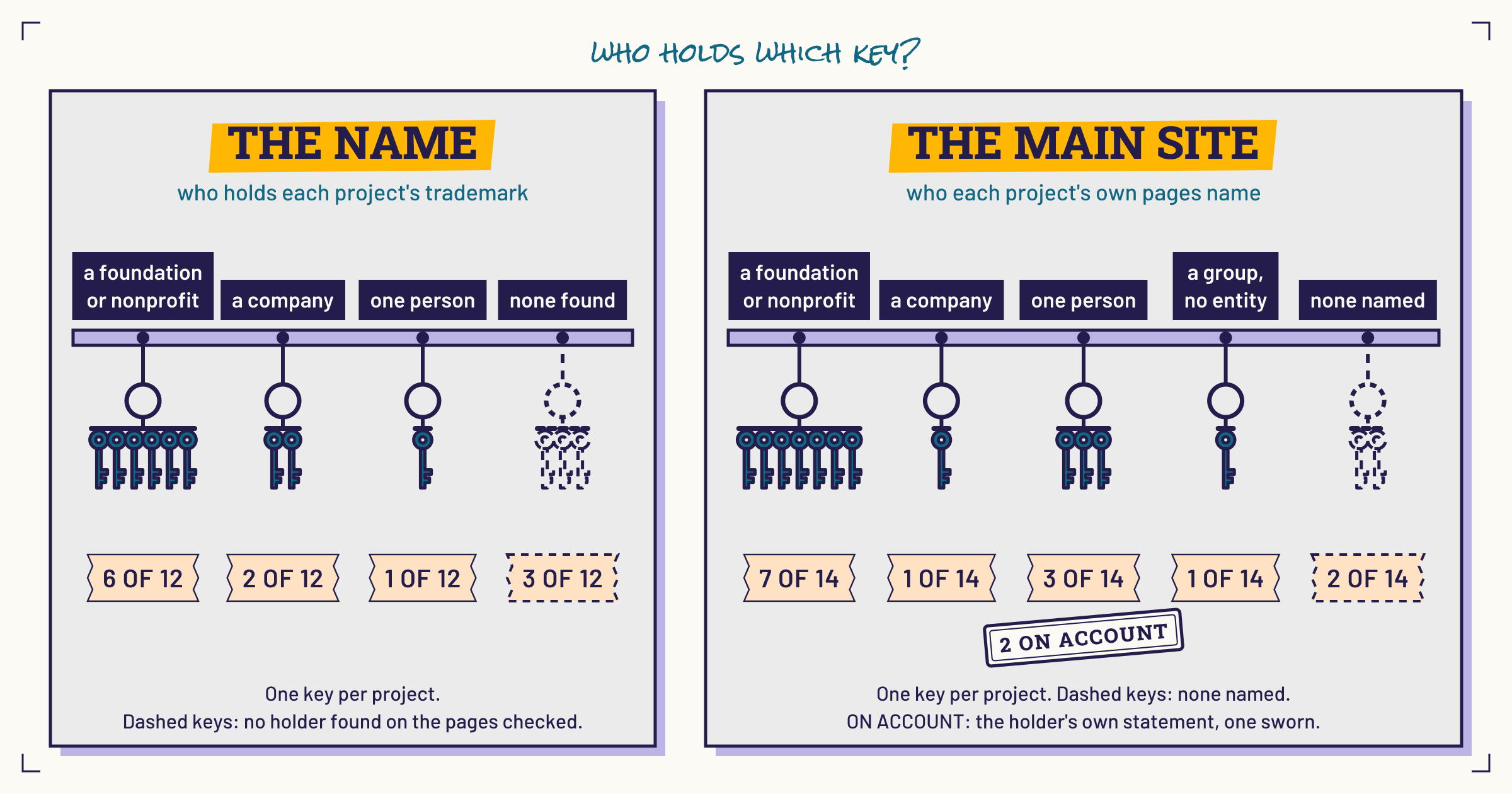
Text description and data for the key board chart
What this chart shows
- What it shows: Two key boards side by side. Each hook is a kind of holder, and each small key on its ring stands for one project. Dashed keys mean no holder was found or named on the pages checked. The “2 on account” stamp marks two holders whose line rests on their own statement, one of them sworn.
- The name, 12 projects: a foundation or nonprofit, 6 (Backdrop, Ghost, Joomla, OpenJS Foundation, TYPO3, WordPress). A company, 2 (MariaDB, MySQL). One person, 1 (Drupal). None found, 3 (ClassicPress, PHP, xz-utils).
- Who the site’s own pages name, 14 projects: the 13 projects in the domain footnote plus WordPress. A foundation or nonprofit as site operator or copyright holder, 7 (ClassicPress, Ghost, Joomla, MariaDB, Node.js, RubyGems, TYPO3). A company as site operator or copyright holder, 1 (MySQL). One person, 3: Drupal and WordPress by a domain statement (WordPress’s is sworn), and xz-utils by its maintainer’s access statement. A group with no legal entity, by a copyright notice, 1 (PHP). None named, 2 (Backdrop, WHATWG).
Teams and roles: project governance for people
How each project adds people to trusted roles:301
- Backdrop: a unanimous vote of its Project Management Committee.
- Drupal: committers usually need “at least a year” of broad work on core issues.
- MySQL: Oracle nominates the first committers. Later, existing committers nominate and approve new ones.
- Node.js: a nomination passes when no one objects.
- PHP: voting rights (“vote karma”) with no written grant process.
- W3C: the W3C Team appoints chairs.
- WHATWG: the Steering Group appoints editors.
- WordPress: the committer page lists onboarding tasks, but no selection criteria and no removal procedure.
Appeals: who can say no, and who reviews it
- OpenJS Foundation: people involved can appeal within 30 days, but only if the documented process wasn’t followed or the decision didn’t meet the policy. If the Code of Conduct team handled the report, different members of that team hear the appeal.302
- TYPO3: members can also call a vote by petition.303
- WHATWG: participants may appeal an Editor’s final response to the Steering Group. Removal, however, is “final and non-appealable.”304
- WordPress: the Code of Conduct lists four steps: Correction, Warning, Temporary Ban and Permanent Ban. It describes no appeal.305 At events, though, either party can appeal an incident decision within 7 days, to a community team rep or to the Executive Director the page names.306 Five named lead developers hold final technical authority.307
Decision making: votes, blocks and final says
These tables back the post on how open source projects make decisions, published November 16, 2026.
[!note] Disclosure I work at Pantheon, a WordPress and Drupal host. At GoDaddy, I started and ran its Five for the Future program until July 2026. Separately, I chose which groups GoDaddy funded: the PHP Foundation, OpenJS, W3C, PHP_CodeSniffer and The WPOCC. Some appear in this table.
Project decision rules: 16 rule sets from 15 projects and standards bodies (Drupal has two)
| Project | Decision covered | What settles it | Who settles it |
|---|---|---|---|
| Backdrop CMS | Committee business, members and philosophy | A committee vote | A six member committee; an elected member breaks ties308 |
| ClassicPress | Project direction | A final say | Three directors, who “make decisions as allowed”309 |
| Drupal Association | At-Large board seats | A vote, then board ratification | Members elect At-Large seats |
| Drupal core | Code and core policy | Consensus | Committers; the Project Lead breaks ties |
| Ghost | The product roadmap | A final say | The staff core team |
| Joomla (Open Source Matters) | Board elections and bylaws | A vote | Members in three classes: officers and coordinators, team leaders, team members |
| MariaDB Server | Code and governance changes | A council vote with a rationed veto | The Maintainer Council; the Foundation CEO breaks ties |
| MySQL | Code changes and strategy | A final say | Oracle as project lead; the core project lead “makes the final decision” |
| Node.js | Landing a pull request | Consensus | Any collaborator can block; the Technical Steering Committee overrides by vote |
| OpenJS Cross Project Council | Council business | Lazy consensus | Two thirds of all voting members can overrule an objection |
| PHP | Language changes by RFC | A vote | Code contributors with php.net accounts, plus chosen community representatives |
| TYPO3 Association | General Assembly business | A vote | Members, one vote each |
| W3C | Specifications and Formal Objections | Consensus, then a council | Anyone may object; a council decides |
| WHATWG | Standards changes and editors | Implementer support, then a final say | Two browser makers must support a change; a steering group decides |
| WordPress | Code, WordPress.org and community | A final say by named roles | A core leadership team; five lead developers on technical decisions |
| xz-utils | Code and releases | A final say | One lead maintainer, with no governance file |
Open source voting: who counts, and what counts as a yes
| Project | Who votes | What passes | Minimum turnout |
|---|---|---|---|
| Drupal Association | Members, including a free membership | Most approvals wins the At-Large seat; the board ratifies | None written |
| Joomla (Open Source Matters) | Members: officers, coordinators, team leaders and team members | A majority of votes cast; bylaw changes need two thirds of all members | A majority of members present |
| PHP | Code contributors with php.net accounts, plus chosen community representatives | Yes at least twice No; abstentions don’t count | None written |
| TYPO3 Association | Members, with three proxies at most | A simple majority; bylaw changes need two thirds | None written; any properly called assembly decides |
| WordPress | Team reps are elected by poll, open about two weeks | No product or technical decision goes to a count | None written |
For example, PHP’s voting rules set a two thirds bar, and recent results show it working.310
- PHP: the Pipe Assignment Operator drew 14 yes, 12 no and 7 abstain in August 2026. It failed, because 14 isn’t twice 12.311 Somewhere, a math teacher smiles.
- Joomla: 63 of 84 eligible members voted for president in 2026.312
- Drupal Association: 307 of 1,274 eligible voters cast ballots in 2026, down from 528 of 1,459 in 2025.313
Who shows up to vote
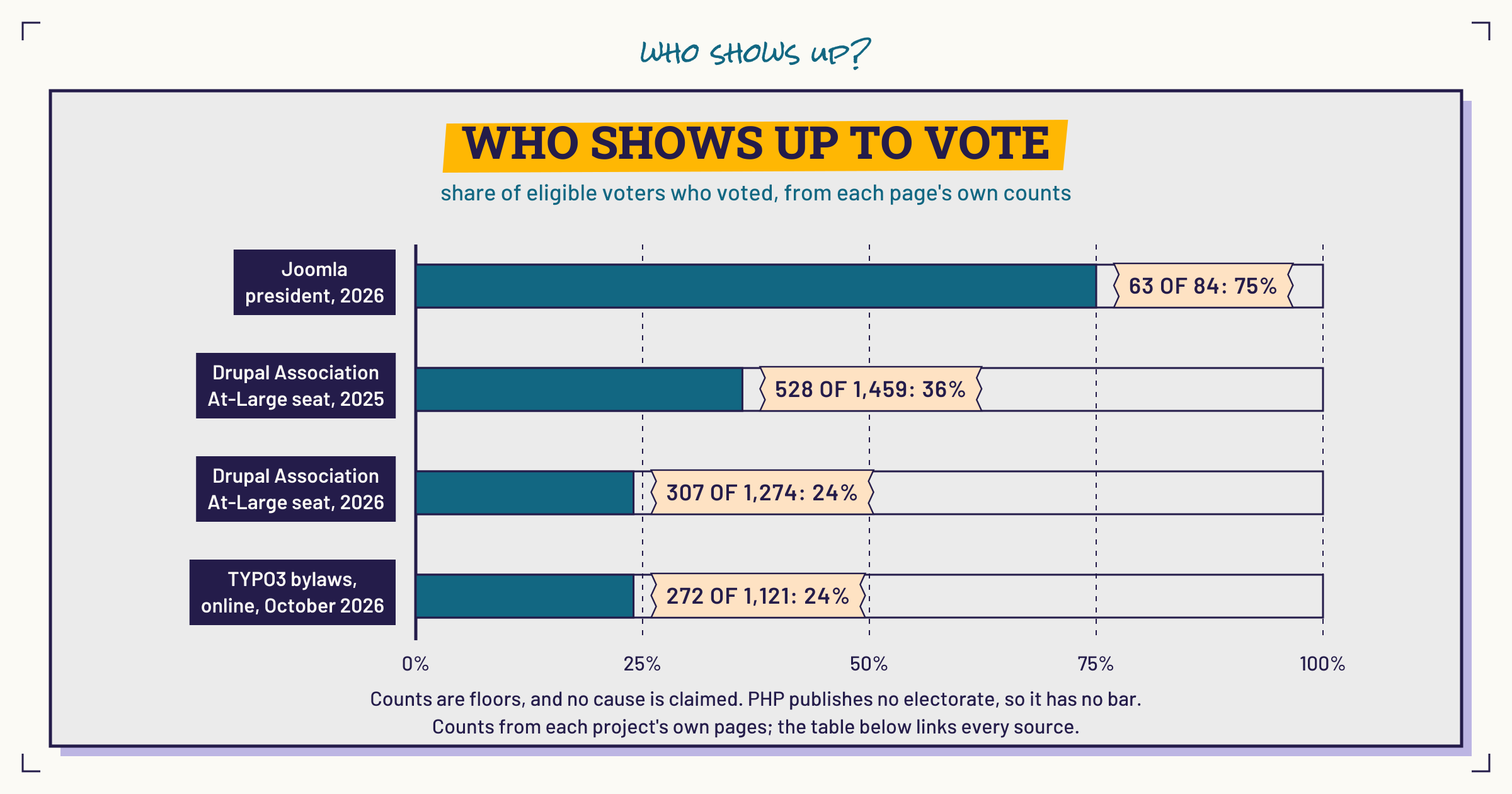
| Vote | Eligible | Voted | Share |
|---|---|---|---|
| Joomla president, 2026 | 84 | 63 | 75% |
| Drupal Association At-Large, 2025 | 1,459 | 528 | 36% |
| Drupal Association At-Large, 2026 | 1,274 | 307 | 24% |
| TYPO3 bylaws, online, October 2026 | 1,121 | 272 | 24% |
TYPO3 note: 204 yes, 66 no, 2 blank; 849 eligible votes uncast.
TYPO3: one term limit failed in April, another passed in October
- What happened: in April 2026, a member petition asked for a limit of two terms on the Board. It got 22 votes for and 44 against, so it failed.314 Then, in October, members voted online on a broader bylaw package. This time it passed 204 to 66, while 849 members didn’t vote.315
- Stated reasons: the petitioner wrote that the board “needs to be more diverse and also needs fresh faces.” However, the Board recommended rejection, citing “incomplete text, unresolved retroactivity” and more. Instead, it offered milder options, including “a cap of three instead of two consecutive terms.”316 Later, its September protocol proposed nine year limits and gave no reason there.317
- What decided it: members, by vote, both times. The new bylaws let Board members be reelected twice, then require a break of at least a year.318 In fact, that’s close to the Board’s April alternative.
- What cuts the other way: the October Assembly took note of the online result. The Association says a legal opinion made the online vote binding, but I found no link to the full opinion.319
Also, the 204 yes votes are 18 percent of 1,121 eligible members. So a rule can change with most members silent.
Consensus: how open source projects decide when nobody counts
- Node.js: a change needs two approvals, or one after seven days. One collaborator’s objection blocks it until consensus or a committee vote.320
- OpenJS Cross Project Council: “silence indicates consent,” but objections must be resolved.321
- W3C: consensus means wide support with “no sustained objection from anybody in the set.”322
- WHATWG: a change needs support from “at least two implementers.” Since an edit on 2026-11-09, a positive standards position counts as support.323
- Drupal core: committers “use consensus decision-making,” and unresolved questions then go to the Project Lead.324
- WordPress: release candidates need “a double signoff by two different committers,” and “Every decision needs to be clearly made in public.”325
Who can block a change in open source decision making
| Project | Who can block | How the block ends |
|---|---|---|
| Apache (reference) | A binding no on a code change, which needs a technical justification: “A veto without a justification is invalid and has no weight”326 | With a justification, it “cannot be overruled nor overridden by anyone” and stands until the voter withdraws it |
| Backdrop CMS | Any committee member, on decisions that need unanimity | No written way out |
| Drupal core | No individual veto is written | The Project Lead “may proactively make or override these decisions” |
| MariaDB Server | Each council member, once every three years | A two thirds vote overrides |
| Node.js | Any collaborator, with a reason | Consensus, a committee vote, or dismissal after seven silent days |
| OpenJS Cross Project Council | Any objector | Two thirds of all voting members |
| PHP | No veto | A no from more than a third of yes and no votes defeats a proposal |
| W3C | No single block; anyone may file a Formal Objection | A council decides |
| WHATWG | Implementers, by declining to implement | The steering group can overrule an editor |
| WordPress | No written objection right | The release lead makes “big final decisions on feature readiness” |
Who decides the open source stack under WordPress also walks through Apache’s veto. Meanwhile, W3C publishes how its objection councils end.327
How W3C objection councils end
- Count: the index lists ten completed formal cases from August 2023 to June 2026.
- Outcomes: five overruled the objection, one upheld it, three ended by a unanimous short circuit among council members, and one went to the CEO.
- Newest: a Digital Credentials council overruled its objection in June 2026.
A final say: one person, one company or one small group
- Drupal core: the Project Lead “acts as a tie-breaker when needed” and approves changes to governance. However, a footnote on the same page adds that the Project Lead “may proactively make or override these decisions.”328
- Ghost: staff decide, while feature votes are “not a democratic system.” Ghost keeps its roadmap private, because sharing it “turned out to be more distracting than helpful.”329
- MySQL: Oracle nominated the first committers and project leads, and “Oracle is the project lead.”330
- WHATWG: a steering group of browser makers has “final say in all matters.”331
- WordPress: the Core Handbook says a core leadership team “governs all aspects of the project,” led by Matt Mullenweg. Five lead developers also “have final authority on technical decisions.” But the page sets no term, election or removal rule.332
- xz-utils: one lead maintainer, but no governance file.333
Open source decision making inside teams
Of 26 team sites I checked, three publish a clear way to settle a contested decision: Core, CLI and Openverse. Sustainability, though, covers only minor changes. The rest describe approvals, elections or venues instead, with no tiebreaker.334 Two offer appeals for single rulings: theme suspensions go to the executive director or project lead, and conduct cases to a community team rep.335336 No page I read sets an appeal, or any procedure, for a change made from above.
Nine times a team’s decision didn’t stand
From 2018 to 2026, the project lead or the executive director set aside a team’s decision or process nine times. The count uses one definition: “a decision or process a team had adopted, set aside by the project lead or the executive director.” Recent cases are easier to find, so this isn’t a trend line. Seven came in 2024 or later. Six rest on public pages, while three rest on Slack messages, which need a WordPress.org account to read.337
[!note] Disclosure I’m a former Training Team rep and Faculty member. In 2024 I wrote Sustainability Team posts, and I objected to its closure. My work sits alongside the Accessibility Team.
| When and team | Stated reason | What changed |
|---|---|---|
| Dec 2018, Core committers | “I would not recreate the old deliberation process”338 | Project lead alone approves commit access |
| Sep 2022, Performance | The default was “a lot for right now”339 | WebP by default came out of 6.1 |
| Mar 2024, Marketing | “not requests that I am able to fulfill”340 | Scope changed; then an archive plan in April |
| Jan 2025, Sustainability | “a good time to officially dissolve the team entirely”341 | Team dissolved and delisted |
| Apr to May 2026, Core committers | “have changed my mind and we’re doing this”342 | Akismet restored, although committers backed a revert |
| Apr 2026, Themes and Accessibility | “Somehow the #accessibility team put this requirement in?”343 | Link underline rule dropped |
| Apr 2026, Meta | “move quickly, embrace experimentation”344 | Janitors change WordPress.org without team approval |
| May 2026, Core | “a stable and reliable WordPress 7.0 release”345 | Real-time collaboration pulled from 7.0 |
| Aug 2026, Accessibility | “The team has overstepped its authority, usefulness, and charter.”346 A 2026-08-17 reply added “missing your own set goals and deadlines”347 | “Permanently delayed.” In October, the team made its accessibility-ready tag conditional; its post doesn’t mention Matt’s comment348 |
Each was announced by post, ticket comment, handbook edit or Slack message. However, no page I read sets a procedure for these changes.
Where other projects write the undo button
Other projects, however, write down the lever above a team.
| Project: who sits above the team | The written lever |
|---|---|
| Python: Steering Council | Recall a delegate, which “will overrule any prior acceptance or rejection”349; the proposal goes back to draft |
| Node.js: Technical Steering Committee (TSC) | “The only recourse” is to “revoke the entire charter”350 |
| Apache (reference): Board | End a project committee “by resolution”351 |
| Drupal: Review panel (conduct); Project Lead (core) | Panel overrides on appeal352; Lead may override core decisions353 |
| W3C: A council per case | Affirm or overturn on appeal354 |
| WordPress: Project lead; executive director | Final say written, but no override procedure |
Ties and deadlocks in open source decision making
- A named person or office: Drupal’s Project Lead, and MySQL’s core project lead, who “makes the final decision.” Also, TYPO3’s chair on business items, with lots drawn in tied elections, and the W3C council chair.355356357358
- Someone outside the deciding body: MariaDB’s Foundation CEO, “who must not be a member of the Council.”359
- Another vote: the Node.js committee votes, a tied PHP vote fails, and OpenJS overrules by two thirds.360361362
- Nothing written: Ghost and xz-utils. In WordPress, meanwhile, Core Tech Lead cases “are usually escalated to project leadership,” a term the page doesn’t define.363
Who changes the project decision rules
- The voters: PHP voters set their own rules by the same two thirds vote. TYPO3 and Joomla members also amend their bylaws by two thirds.367368369
- A board or council: the Drupal Association board, by two thirds of directors present, and MariaDB’s council, by two thirds.370371
- A second body: Node.js changes its committee charter only with approval from the OpenJS council. W3C’s Advisory Board drafts process changes for a member review of at least 28 days.372373
- No written path: Backdrop’s leadership rules, ClassicPress, Ghost, xz-utils and WordPress, whose organization and release team pages state no amendment step.374375
Records you can check: how open source projects decide in public
Check it yourself: for example, open any PHP RFC page. The vote table then lists each voter’s username next to yes, no or abstain. For example, End PEAR Endorsement passed 40 to 0.376
- Named votes: PHP’s completed RFC votes list each voter’s username and choice.
- Named approvals: Node.js pull requests and their reviewer lines.377
- Positions in public issues: WHATWG steering group decisions.378
- Names without positions: W3C council reports name who took part but “must not attribute any position to any individual.”379
- Counts without names: TYPO3 protocols, Joomla’s motions registry and Drupal Association totals.
- Who asked: a 2026-11-13 Make WordPress Core post says a new theme became the flagship “at @matt’s request.”380
Forks: what seven forks kept and rebuilt
This table and its lists back the post on what an open source fork can keep, published November 17, 2026.
Seven forks, one packing list
Here’s what each open source fork packed, at the split and by its first release. Read across a row for one fork, or down a column for one asset.
| Fork | Split | Code and history at the split | Name and domain at the split | Updates by first release | Who could relicense later |
|---|---|---|---|---|---|
| Backdrop | 2013 | Kept, with history | New | Pre-release code pointed at Drupal’s server; switched to updates.backdropcms.org on 2014-12-21, a month before 1.0, while the new server still reported “not implemented”382 | No single holder; authors keep copyright |
| ClassicPress | 2018 | Kept, with history | New | Committee decided on 2018-09-07 that “WordPress endpoints will be used for plugin checks”; the minutes call an initial permission review “positive” and record no final result. Plugin and theme checks still go to api.wordpress.org (update.php, lines 381 and 657)383384 | No single holder; authors keep copyright |
| io.js | 2014 | Kept, with history | New | Own downloads at 1.0 (2015) | No single holder; MIT notices kept |
| Joomla | 2005 | Code kept; public history starts at the split (2005-09-15) | New | Own downloads and project forge at 1.0 (2005) | Miro, then the Mambo Foundation, for Mambo’s code |
| MariaDB | 2009 | Kept, with history | New | Own releases from the first beta (2009) | Oracle, for MySQL, as copyright owner and through its contributor agreement |
| OpenTofu | 2023 | Kept, with history | New | Own registry at 1.6.0 (2024); HashiCorp provider names kept | HashiCorp, for Terraform, through contributor permission |
| Valkey | 2024 | Kept, with history | New | Own releases and images at 7.2.5 (2024) | Redis Inc, for Redis; older code stays BSD |
What every open source fork took: code and history
Every fork started from the original’s code. Six of them carry the original’s history, so the authors’ names travel with the code. Only Joomla’s public repository starts at the split.
- Backdrop: more than 19,000 commits from before the fork, with Drupal history back to 2000.385
- ClassicPress: WordPress history back to the repository’s start on 2003-04-01.386
- io.js: its 1.0.0 README said it “began as a GitHub fork of joyent/node.”387
- Joomla: version 1.0 was Mambo 4.5.2.3, “given it a spring clean and named it Joomla! 1.0.”388 Its public repository starts at the split. The oldest commit, “Initial import into SCM,” is dated 2005-09-15.389
- MariaDB: its first beta, on 2009-10-29, was “based on MySQL 5.1.38”.390
- OpenTofu: its repository’s oldest commit is dated 2014-05-21. It holds 31,551 commits across all branches from before 2023-08-25.391
- Valkey: its repository’s oldest commit is dated 2009-03-22. It holds 18,643 commits across all branches from before 2024-03-28.392
What no fork took: the name, the mark and the domain
- Drupal: its policy names a Drupal fork called “ImprovedDrupal” as a use that doesn’t qualify for its automatic license.393
- MySQL: Oracle’s guidelines bar its marks from the name of an open source distribution without permission.394
- Redis: its current policy lets a fork say it’s “based on a fork of Redis® Open Source version XX.”395 However, calling some products “Redis compatible” needs a commercial agreement, under conditions the policy lists.
- WordPress: the Foundation’s policy aims to stop anyone who would “unfairly profit from, trick or confuse people.”396 It also asks people not to put WordPress in a domain name.
Forks build their names early
So forks build their names early. MariaDB registered mariadb.org on 2009-03-04, about eight months before its first beta.397 Backdrop’s trademark claims first use on 2013-08-15, a month before the announcement.398 At first, the registration went to one founder. Software Freedom Conservancy holds it today, through an assignment signed in 2021.
A new name doesn’t guarantee a new kind of holder, though. A company owns the MariaDB mark, and the MariaDB Foundation uses its own name and listed marks under a license from that company.399
The update channel a fork can’t pack
Disclosure: I’m an active member of the Technical Steering Committee of the FAIR Package Manager, which also distributes packages.
- Backdrop: on the day of the announcement, its code still asked
updates.drupal.org.400 A commit on 2014-12-21 switched it toupdates.backdropcms.org, a month before 1.0.401 That’sgit blameat its purest: one line, two commits, about 15 months apart. - ClassicPress: in 2018, its committee decided to use WordPress endpoints for plugin checks. The minutes call an initial permission review “positive” and record no final result.402 Version 1.0 then sent update notices from its own servers, with downloads hosted on GitHub.403 Today its code still sends plugin and theme checks to
api.wordpress.org.404 - io.js: it shipped the npm client and promised releases “compatible with the npm ecosystem.”405
- OpenTofu: it built
registry.opentofu.organd kept short provider names likehashicorp/aws.406 Its FAQ also says plainly: “OpenTofu will not have its own providers.” Its stated reason: “Terraform providers have not altered their licenses, and the potential for such a change is virtually zero.”407 - RubyGems: former maintainers launched gem.coop, a gem server and mirror. But the rubygems.org registry stayed with Ruby Central.408
Who can change the license after the fork
- MySQL: Oracle’s rule reads “Without a submitted and approved OCA, Oracle cannot integrate your contribution”.409 (OCA is the Oracle Contributor Agreement.) Earlier, its 2010 version gave Oracle joint ownership of each contribution.410
- Terraform: HashiCorp’s agreement takes a broad license, and contributors keep ownership: “You reserve all right, title, and interest in and to Your Contributions”.411 In 2023, HashiCorp moved future product releases to the Business Source License. However, APIs, SDKs and most libraries stayed on the Mozilla license.412
- Redis: Redis Inc moved Redis 7.4 to two source available licenses in 2024.413 Later, in May 2025, it added the AGPLv3, starting with Redis 8.414 Its contributions file says code from before 7.4 stays available under the BSD license.415
- Backdrop: an early README says the code is “Copyright 2001 – 2013 by the original authors”.416
- ClassicPress: GPL version 2 or later, with the WordPress contributors’ notice kept.417
- WordPress:
license.txtreads “Copyright 2011-2026 by the contributors”.418
Board seats: what payment can reach
This chart, table and set of rosters back the post on how many open source board seats sponsorship can buy, published November 18, 2026.
Board seats by organization, A to Z
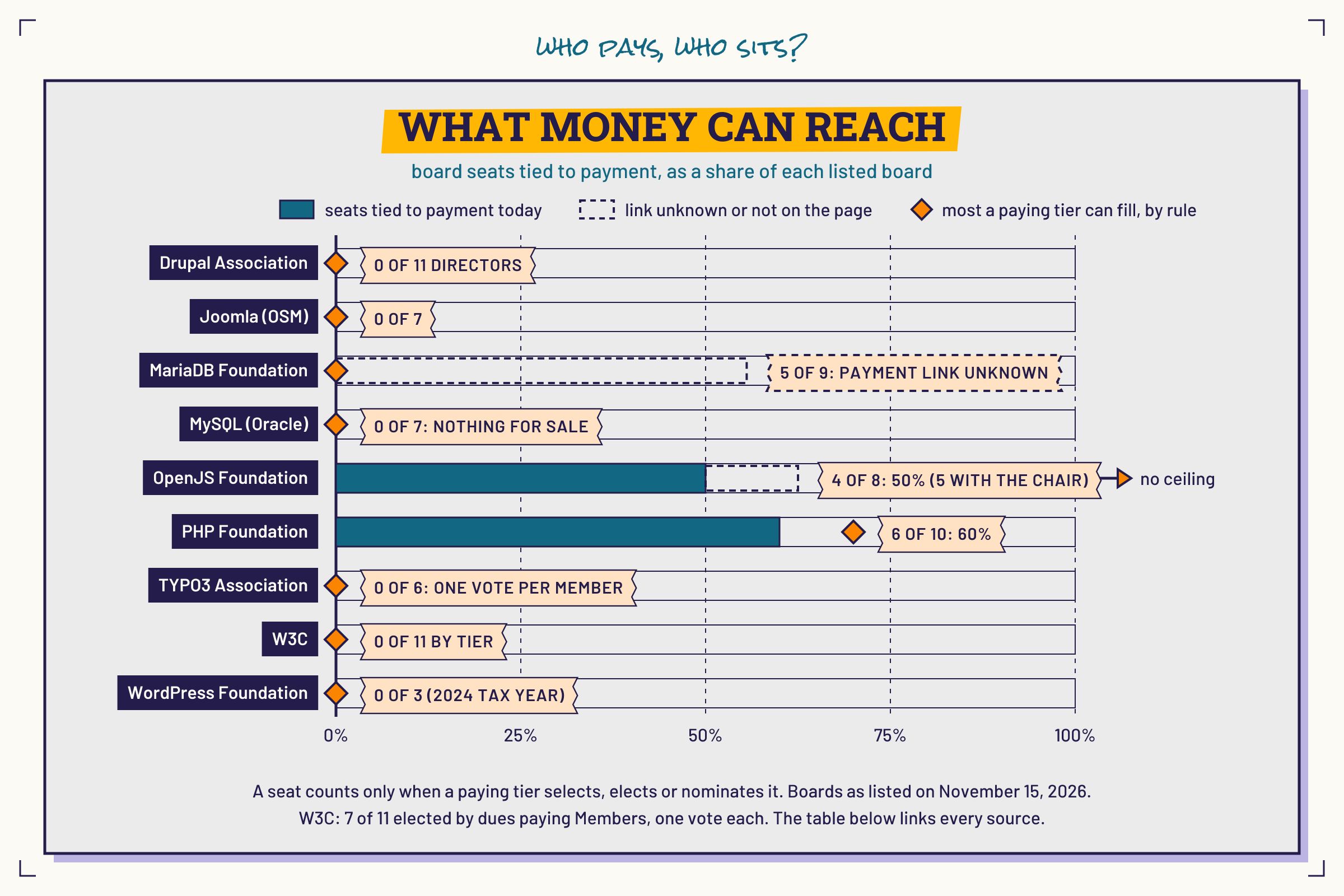
Text description and data for the board seats chart
What this chart shows
- What it shows: One bar per organization on one axis, from 0 to 100 percent of the board as its own page lists it. A solid bar is seats tied to payment today. A dashed bar is seats whose link to payment is unknown or missing from the page’s labels. A diamond marks the most seats a paying tier can fill by written rule, and an arrow means no ceiling.
- Seats tied to payment: PHP Foundation, 6 of 10, and the rules allow 7. OpenJS Foundation, 4 of 8, or 5 counting the Chair’s 2025 Silver seat, with one director per Platinum member and no ceiling. MariaDB Foundation lists 5 of 9 as company representatives, and whether payment placed them is unknown.
- No seats tied to payment: Drupal Association 0 of 11, Joomla 0 of 7, MySQL 0 of 7, TYPO3 Association 0 of 6, W3C 0 of 11 by tier, and WordPress Foundation 0 of 3 as of the 2024 tax year.
| Organization | What money buys | Most seats a paying tier can fill, by written rule | Seats tied to payment today |
|---|---|---|---|
| Drupal Association | A logo | 0 | 0 of 11 directors listed, plus one adviser; the page predates the 2026 election |
| Joomla (Open Source Matters) | A logo | 0 | 0 of 7 |
| MariaDB Foundation | Pool entries | 0 reserved; how an entry becomes a seat is unknown | 5 of 9 listed as company representatives; whether payment placed them is unknown |
| MySQL (Oracle) | Nothing for sale; ownership holds the seats | 0 | 0 of 7 listed |
| OpenJS Foundation | Seats by rule | No ceiling: one director per Platinum member | 4 of 8 by the page’s labels; 5 counting the Chair’s 2025 Silver seat |
| PHP Foundation | Seats by rule | 7 of 10 | 6 of 10 |
| TYPO3 Association | One vote per member | 0 | 0 of 6 |
| W3C | One vote per member | 0 by tier | 0 by tier; 7 of 11 elected by dues paying Members, one vote each |
| WordPress Foundation | A logo | 0 of 3 | 0 of 3, as of the 2024 tax year |
At GoDaddy, I started and ran its Five for the Future program until July 2026. Separately, I chose which groups GoDaddy funded: the PHP Foundation, OpenJS, W3C, PHP_CodeSniffer and The WPOCC. Today, GoDaddy.com is listed as a Gold sponsor of the PHP Foundation. GoDaddy is also a Silver member of OpenJS.419420
PHP Foundation: up to 7 of 10 seats
- The rule. First, the PHP Foundation governance page sets a board of 5 to 10 people. Platinum sponsors then get up to 3 seats, “automatically granted to qualified Platinum sponsors.”421 Other sponsors get the remaining seats, “not to exceed 4.” Meanwhile, community representatives get at least 3.
- The count. Today, the board page lists 10 directors.422 According to the Foundation’s own posts, Automattic and JetBrains hold the 2 Platinum seats.423424 Four more directors work at companies on the Silver sponsor list.425 So 6 of the 10 open source board seats tie to payment today. The rule, however, allows 7.
- What holds the rest. Strategic matters need a “2/3 majority of total board.” In addition, every director is “Nominated by an existing Board member” and voted in each year.426 On a board of 10, two thirds means 7 votes. So the 4 community directors, voting together, could block. Swap one community seat for a sponsor seat, though, and they couldn’t. Board size has its own exit, too. After 4 failed votes at least 4 weeks apart, a simple majority can decide it.427
- The promise. “Sponsorship does not imply governance rights.” That sentence, however, sits in the Code of Conduct.428 The governance page, which reserves the seats, doesn’t repeat it.
OpenJS: one director per Platinum member, no ceiling
- The count. The governance page lists 8 seats.430 Member tiers fill four: Platinum, Gold and Silver directors, plus an End User director those tiers elect together.431 Three more are Cross Project Council (CPC) seats. The page gives the Chair, from GitHub, no class. However, the 2025 board post called the same person a Silver director.432 So member tiers fill 4 of 8 seats by the page’s labels, or 5 counting that seat.
- What holds the rest. First, CPC seats can’t exceed 80 percent of the Platinum, Gold and Silver director seats. Second, CPC participation “shall not be limited to Members.” Finally, a two thirds vote guards listed matters, including removing the Platinum appointment right.433 If all 8 directors vote, that means 6 votes, so the 3 CPC seats could block it together.
- The promise. The Join page says neutrality “ensures that no one company controls an important open source technology.”434 However, that line sits beside the prices, not in the bylaws.
MariaDB: pool entries the bylaws don’t mention
- The rule. The sponsor page sells governance access by tier. For example, Gold at EUR 50,000 buys “Representation as an observer at meetings of the MariaDB Foundation Board.” Platinum at EUR 100,000 buys “One entry into the selection pool.” Diamond at EUR 500,000 then buys two entries.435 The bylaws, however, never mention a selection pool. Instead, directors elect directors.436
- The count. Next, the About page lists 9 directors. It files 5 under “Directors representing organisational board members”: Amazon Web Services, DBS, MariaDB, Nextcloud and Virtuozzo.437 So company labels cover 5 of these 9 open source board seats. Still, the pages don’t say whether payment placed any of them.
- What holds the rest. No single election may raise one sponsor’s share of directors above 25 percent. Also, “An Observer may not vote in any meeting of the Board.”438 But no clause caps sponsors as a group.
- The promise. Finally, the sponsor page says sponsorship “does not guarantee the acceptance of code, control over technical decisions or preferential treatment.”439 That covers code and technical processes, though, not seats.
Meanwhile, how a pool entry becomes a seat isn’t written anywhere I found. Of course, unknown isn’t the same as absent.
One vote at every price: W3C and TYPO3
- The rule. First, W3C’s bylaws give each Member in good standing one vote. Good standing, in turn, requires paid dues.440 Members then elect 7 Consortium Directors.
- The count. In the US, dues run from USD 2,250 to USD 77,000 a year, set by a member’s size and type.441 Meanwhile, the board page lists 11 directors, and 7 are Member elected.442 So no seat goes to a tier.
- What holds the rest. The page lists 3 directors chosen by Partner Members. It also marks one director as Board elected, then says there are none right now.443 (One page, two answers.)
- The promise. The Process Document says “no Member receives preferential treatment within W3C.”444 Still, it covers Members, not sponsors, and the seat rules live in the bylaws.
In other words, W3C’s top fee is about 34 times its lowest, for the same single vote.
TYPO3: one vote, and no seat on the board
TYPO3, likewise, runs the same model with a different menu.
- The rule. The membership page puts it plainly: “While all members have one vote each, higher membership tiers offer additional benefits.”445 Members also elect the board.
- The count. As a result, no board seat is reserved for any tier. The board page lists 6 members.
- What holds the rest. Platinum costs EUR 1,000 once plus EUR 13,750 a year. In return, it buys a “Personal Association Board member contact,” which is access, not a seat.446
- The promise. Here, the one vote rule is the promise. It sits in the statutes, beside the board rules, and on the membership page too.
A logo, not a board seat: Drupal and Joomla
- The rule. First, the Drupal Association’s bylaws mention no sponsor, fee or donation in any seat clause.447 Certified Partner fees, meanwhile, run from $1,500 to $25,000 a year, set by company size. Partner tiers then rank by contribution credits.448
- The count. The board page lists 11 directors plus an Immediate Past Chair in an advisory role.449 Members elect At Large seats, which the board ratifies. In addition, only Dries Buytaert is eligible for the Founding Director seat.450 The page also predates the 2026 election, whose winner joins on November 1.451
- What holds the rest. A free membership tier exists “to guarantee voting rights for those who choose not to make a financial donation.”452
- The promise. No line says money doesn’t buy a seat. Still, the free tier comes closest.
There’s one advisory body worth knowing, though. The 2024 Starshot Advisory Council had 12 members, and 3 were Certified Partner representatives. Its job, in its own words, was to “provide strategic input and feedback.”453 The announcement doesn’t say payment earned those places.
I work at Pantheon, a WordPress and Drupal host. Pantheon is a platinum Drupal Certified Partner, and a Pantheon employee sat on the 2024 Starshot Advisory Council.454455
Joomla: no board seat, just advertising
Joomla’s sponsor page, by contrast, is the bluntest of the nine. It says “sponsorship is a form of advertising, not a charitable contribution.”456
- The rule. Bylaw membership comes from team roles, not payment. Also, each member gets one vote.457
- The count. The board has 7 seats: 4 officers and 3 department coordinators.458 So none of them is a sponsor seat.
- What holds the rest. Team leaders and members elect the department coordinators who sit on the board.
- The promise. No line limits what sponsors get. Instead, the advertising line comes nearest. It describes sponsorship, but it doesn’t limit it.
Where does WordPress sit?
- The rule. The WordPress Foundation’s 2024 tax return reports 3 voting directors, all 3 independent. Those are the numbers at the end of 2024. It also reports no members, and no one outside the board elects directors.459 Donors, meanwhile, get a listing. The 2026 Global Partner tiers cost $60,000 to $180,000. For that, they list visibility and “A dedicated Slack channel” with the Community Support team. The two upper tiers add event tickets.460 However, no tier lists a seat, a vote or an advisory role.
- The count. So payment fills 0 of the 3 Foundation seats.
- What holds the rest. The board elects itself. The same return says directors must disclose possible conflicts every year. Yet it also says there’s no written conflict of interest policy.461
- The promise. Five for the Future invites companies to “Take your seat at the table.”462 Still, it names no body, seat or vote.
MySQL: ownership holds the seats instead
MySQL sells no open source board seats, because Oracle owns the project. For a start, the governance model says Oracle nominates the first committee “for a term of 2 years.” Its FAQ then describes 5 to 7 people “that represent Oracle (majority).” After two years, “elections will be held for non-Oracle seats.”463
Today, the committee page lists six members. Four come from AWS, Booking.com, Google and JP Morgan Chase, and two from MySQL Engineering. In addition, an Oracle vice president chairs it.464
So, counting the Chair and the two MySQL Engineering members, 3 of 7 tie to Oracle. That’s not the majority the FAQ describes. The page also doesn’t say whether the Chair votes. Yet neither page explains the gap.
Do “no governance” promises sit beside the seat rules?
Only one of the nine, TYPO3, keeps both in one document. Here’s where each statement lives, so you can check it yourself.
- PHP Foundation: in the Code of Conduct, while the seats live on the governance page.465466
- OpenJS: a neutrality line on the Join page, while the seats live in the bylaws.467468
- MariaDB: on the sponsor page, beside the pool entries, though it covers code, not seats.469
- W3C: in the Process Document, while board seats live in the bylaws.470471
- TYPO3: a one vote rule in the statutes, beside the board rules, and on the membership page.472
- Drupal: a voting guarantee, also on the membership page.473
- Joomla: an advertising line on the sponsor page. It describes sponsorship and limits nothing.474
- MySQL and WordPress: no statement found, so far.
Leadership: team reps by employer, and caps on one employer
These tables back the post on who holds open source leadership when companies pay for the code, published November 19, 2026.
WordPress team reps by employer, 2018 to 2026
| Year | Rep seats | Automattic | Other employer | Self, no employer named | Unknown | Teams with reps | Teams with an Automattic rep |
|---|---|---|---|---|---|---|---|
| 2018 | 28 | 6 (21%) | 19 | 0 | 3 | 11 | 4 |
| 2019 | 21 | 3 (14%) | 15 | 0 | 3 | 12 | 3 |
| 2020 | 39 | 8 (21%) | 27 | 0 | 4 | 13 | 6 |
| 2021 | 34 | 6 (18%) | 24 | 3 | 1 | 13 | 5 |
| 2022 | 43 | 7 (16%) | 33 | 2 | 1 | 14 | 5 |
| 2023 | 38 | 10 (26%) | 25 | 2 | 1 | 14 | 8 |
| 2024 | 47 | 8 (17%) | 38 | 1 | 0 | 15 | 6 |
| 2025 | 53 | 7 (13%) | 43 | 2 | 1 | 16 | 5 |
| 2026 | 47 | 6 (13%) | 34 | 4 | 3 | 20 | 5 |
Notes on the table:
- A seat is one person on one team in one year, so a handover adds a seat. This rewards turnover.
- Automattic led every year but 2019, when it held 3 seats, no other employer held more than 3 and 3 seats had no employer on file.
- 2025: 46 seats went to someone other than Automattic: 43 to other employers (none over 3, so at least 15 employers), 2 self sponsored, 1 unknown.
Here’s what the table shows, in four lines.
- Most seats: In my count, Automattic held the most placed rep seats, or tied for the most, every year from 2018 to 2026. In 2018 and 2026, unplaced seats could at most produce a tie. In 2019, they could flip the lead.
- Its share: That came to 3 to 10 seats a year, or 13 to 26 percent.
- Runners up: No other employer held more than 3 seats in a year.
- Every team: Automattic never held a rep seat on every team. Its high was 8 of 14 teams, in 2023.
“Other employer” isn’t one company, either. In 2025, for example, 43 seats went to at least 15 different employers, and none held more than 3. So the spread of open source leadership in WordPress is wide, with one tall column in the middle of it.
How the count works
The record behind each seat comes from public sources, in this order. Because a seat is one person on one team in one year, a handover can add a person without adding a chair at the table. The Merge Conflicts methods page explains the labels.
- Rep posts: each team’s public announcements on the Make WordPress blogs name its reps.
- Pledge profiles: archived WordPress.org profiles show who sponsored each rep’s hours that year.
- Outside records: term research and public LinkedIn histories fill gaps. People write their own LinkedIn pages, so those rows carry a lower label.
- Public chat: searches of public Making WordPress Slack channels found one more employer.
- My own seats: my 2015 seat counts as self employed, from my own account.
Two things stay out on purpose. First, the table counts seats and never names reps. Second, no direct message or private channel went into any count.
Before 2018, the record thins
From 2012 to 2017, the record holds 35 rep seats, and 8 still have no employer on file. Automattic held 2 of 13 in 2012. In 2013, DreamHost led with 2 of 10. With numbers that small, though, a single seat moves a share by 8 points or more. From 2014 to 2017, for instance, the record holds just 5, 1, 2 and 4 seats a year. So the table starts in 2018, when the rep posts get regular.
What the record shows beside it
An aim is a claim about intent, so it stays my account. Here’s the public record beside it, element by element.
What the project said about team reps in public
The project and Automattic both wrote about sponsored work and reps in public. Here’s what they said, in order.
- When coordination went public: A March 2021 post gave its purpose first: helping coordinate sponsored work. It then opened a Slack channel “for contributors who are sponsored for 32 hours or more.”478
- What the project asked for: That November, a Marketing Team post relayed the executive director’s wish.479 She wanted “two to three Team Reps in each Contributor Team,” with “a mix of company sponsored and self sponsored folks.”480
- When it changed: Automattic’s January 2025 post gave its reasons first. It cited “an imbalance in how contributions to WordPress are distributed” and the cost of WP Engine’s lawsuits. Then it cut its pledge to “about 45 hours a week.”481 In May 2025, it announced a return.482
- How it was framed: The January post had a heading, “A Level Playing Field.” Under it, Automattic said it would match pledges “made by WP Engine and other players.”483
- What the pledge page showed: Automattic listed 103 profiles in November 2024 and 86 in February 2025.484
Which projects cap one employer’s share of open source leadership?
| Project | Leadership body | Written limit on one employer | Reason given beside the rule |
|---|---|---|---|
| Drupal | Core committers and initiative leads | None found | None found |
| Joomla | Department coordinators | None found in the bylaws485 | None found |
| MariaDB | Stewards and maintainers | None for maintainers. Bylaws stop an election from pushing any sponsor above 25 percent of directors (board only)486 | The process applies to every maintainer “regardless of employer or affiliation” |
| MySQL | Committers, leads and steering committee | Oracle nominates the first members; the FAQ says Oracle holds the majority, but the listed roster doesn’t show one487488 | None stated |
| Node.js | Technical Steering Committee | No more than one fourth of voting members | To ensure “adequate representation” of diverse interests |
| OpenJS | Cross Project Council | No more than one fourth of voting members | None beside the rule |
| PHP | RFC voters and release managers | None found | None found |
| TYPO3 | Team leads | None found for teams. One person per company on the board (Art. 16).489 Members voted in October 2026 on rules that regroup teams into Units490 | None found |
| W3C | Elected TAG and Advisory Board seats; group chairs | One elected seat per primary affiliation; a chair can be replaced if a new employer would be “over-represented” | “to ensure that the diversity of W3C Members is represented” |
| WordPress | Team reps | None; each team runs its own yearly election | None found |
So three bodies write a limit: Node.js, OpenJS and W3C.491492493 In each case, a change of job can trigger it. The Node.js TSC charter, for example, says the overflow “must be immediately remedied.”494 OpenJS uses almost the same words for its council.495
What happens when a leader changes jobs
A cap matters most on the day someone switches employers. So each charter says what happens next.
- Node.js: The overflow is fixed “by the removal of voting member status” from members tied to the over-represented company.496
- OpenJS: The council fixes it “by the resignation or removal of one or more voting CPC members.”497
- W3C: On the TAG, the organization “must have returned to having at most one seat” by the next regular election.498
Share of the work against share of the votes
A cap counts leaders. However, the work and the votes can split in other ways too.
- PHP’s votes: The 2026 license vote was 51 yes, 0 no and 2 abstain.501
Finances: budget votes, filings and who can open the books
This table and the chart back the post on whether publishing open source finances gives members a say, published November 20, 2026.
Four shapes of published finances
What’s public comes in four shapes, from the most detail to the least.
- Every transaction: The PHP Foundation says all its incoming and outgoing transactions are public through Open Collective. It also posts a yearly report.502
- Audits and a budget: TYPO3 links its 2025 financial statements, its auditor’s report and its 2026 budget from one General Assembly page.503 Its auditor, BDO, describes the work as a “limited statutory examination.”504 The Drupal Association lists statements for each year from 2011 to 2025.505 On November 15, the links for 2011, 2012 and 2014 didn’t open.
- Tax returns: W3C posts its Forms 990 for 2022 to 2024.506 The WordPress Foundation’s 2024 return is on ProPublica, and its site posts yearly summary pages.507508 The OpenJS Foundation’s 2024 return is on ProPublica, too.509
- Short statements: Joomla’s Open Source Matters posts a profit and loss for its year ending June 2025. The document doesn’t say whether it was audited.510 Meanwhile, the MariaDB Foundation’s board puts its budget estimate in public minutes.511
Who gets a budget vote?
| Organization | Who approves the annual budget | Outside vote on it | Outside say over directors |
|---|---|---|---|
| Drupal Association | The board, on a Finance Committee draft512 | None; the bylaws say it “has no members” | Individual members elect At-Large seats, which the board ratifies |
| Joomla (Open Source Matters) | The board, under its 2015 Financial Policy513 | None found | Volunteer members elect the directors and officers514 |
| MariaDB Foundation | The board: “Budget approved as presented”515 | None; the directors are the only members516 | None |
| OpenJS Foundation | The board; a council approves a budget “to be presented to the board”517 | None; the council approves funds the board delegates | Paying tiers appoint or elect directors; the council designates more518 |
| PHP Foundation | The board519 | None; an Advisory Board recommends | Platinum sponsors get “Up to 3 seats” |
| TYPO3 Association | The board, after a member survey520 | None; the General Assembly takes note, and members vote on community ideas | Members elect the board |
| W3C Inc. | No budget rule found; the board by inference521 | None found | Consortium Members elect 7 directors; Partner Members elect up to 4 |
| WordPress Foundation | Unknown; no bylaws found | None; its return reports no members522 | None; its return answers “No” |
TYPO3: a poll with “no official character”
TYPO3’s Voting Procedure states the poll’s purpose first. It calls the poll “a tool of the Board, to ask the members for their preferences regarding the next budget.”523
Then it sets the limits. “The Budget Polling is not an official election,” it says, and the vote “has no official character.”524
The statutes match. In my translation of the binding German text, the board prepares and adopts the budget after a member survey. The General Assembly, by contrast, takes note of it.525 Note that the English translation online is older than the German text adopted on October 29, 2026, so I cite the German.
In practice, the 2026 General Assembly shows the gap. Altogether, 112 members took part, representing 123 votes with delegations, out of 1,134 members. The budget item recorded no vote at all.526
Still, TYPO3 members hold real power over the people who spend. They elect the board, and they accept the annual accounts.527 At the 2026 Assembly, they also voted to discharge the board, a formal approval of its past year. The tally was 56 for, 5 against, 11 abstaining and 51 not cast.528
The same protocol records four more votes:529
- Discharge of the treasurer: 72 for, 3 against, 10 abstaining, 38 not cast.
- BDO confirmed as auditor: 69 for, 0 against, 17 abstaining, 37 not cast.
- Petition 5, “Regular Publication of Board Reports and Records”: 60 for, 2 against, 7 abstaining, 54 not cast.
- Petition 7, “Making Official Records Published, Findable, and Permanently Available”: 62 for, 2 against, 9 abstaining, 50 not cast.
It records no vote on the 2025 accounts or on the 2026 budget of EUR 1,000,000.
Community Ideas votes bind, too, on both tracks. For community ideas, “The community votes,” and “the top two community ideas will be funded.” For team ideas, Association members vote on the applications. The third 2026 round had €40,000, split evenly between the two tracks, and the Business Control Committee (BCC) reviews the applications.530
Can you see open source finances without a vote on them?
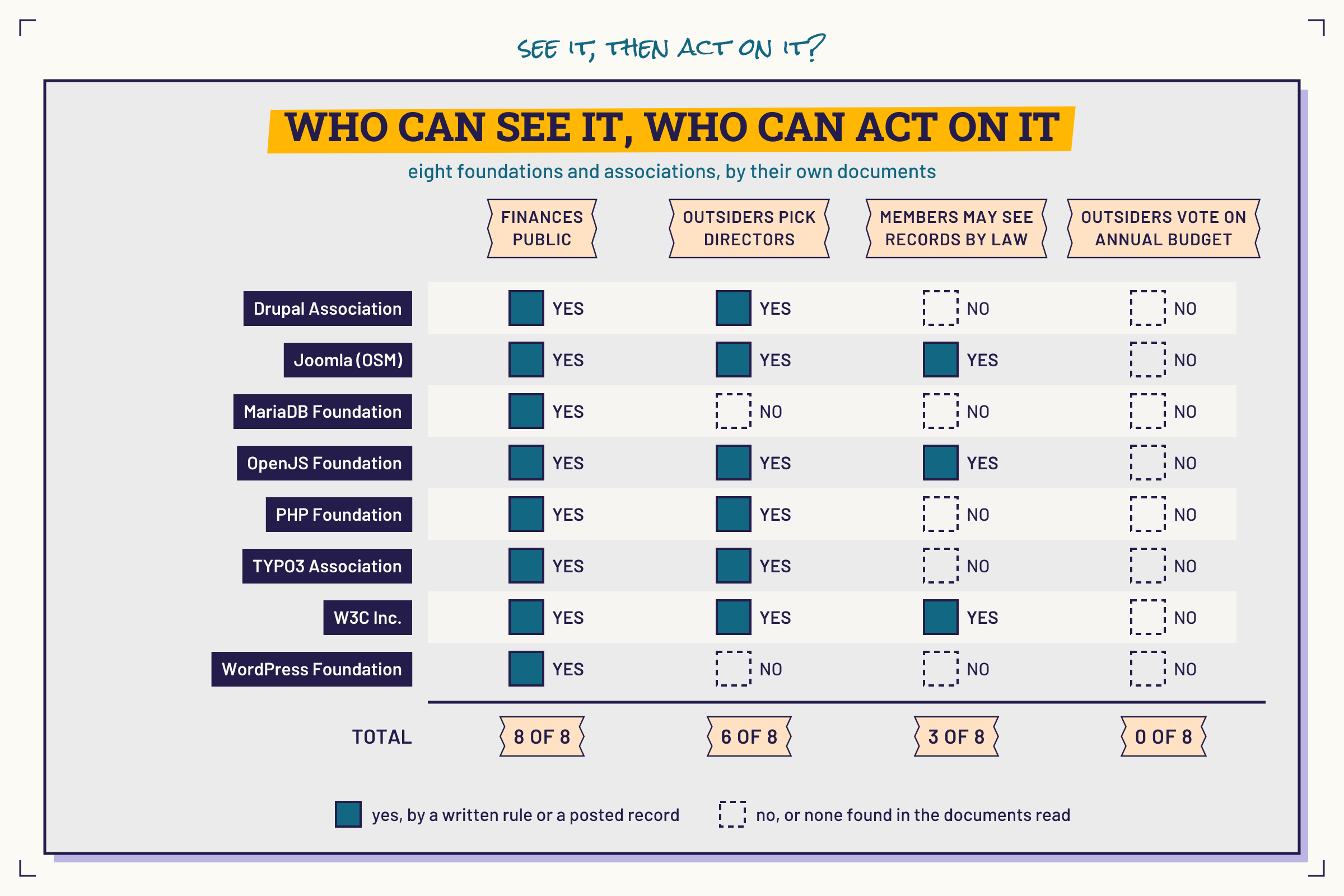
Text description and data for the four checks chart
What this chart shows
- What it shows: A grid with eight organizations in rows, A to Z, and four checks in columns. A filled box with “YES” means a written rule or a posted record says yes. A dashed box with “NO” means no, or none found in the documents read. Each column ends with a total out of 8. The lists below split those boxes into three states: yes, no and not determined.
- Finances public, 8 of 8: Drupal Association, Joomla’s Open Source Matters, MariaDB Foundation, OpenJS Foundation, PHP Foundation, TYPO3 Association, W3C and the WordPress Foundation.
- Who picks directors (the image’s “Outsiders pick directors”): members elect, one vote each, at the TYPO3 Association, W3C, Joomla’s Open Source Matters and the Drupal Association, whose At-Large seats the board ratifies. Paying sponsors hold or choose seats at the OpenJS Foundation and the PHP Foundation, which has automatic Platinum seats. Neither applies at the MariaDB Foundation or the WordPress Foundation.
- Members may see records by law: yes at W3C, through Delaware law, and at Joomla’s Open Source Matters, through New York law. Yes at the OpenJS Foundation by my reading of Delaware’s Section 220, which is analysis. No at the MariaDB Foundation, whose directors are its only members, and at the WordPress Foundation, which reports no members. Not determined at the TYPO3 Association, because I didn’t read Swiss law. Also not determined at the Drupal Association and PHP Foundation, because the documents read don’t name the governing law for member rights.
- Outsiders vote on the annual budget: no document found gives outsiders this vote. TYPO3’s statutes have members approve the annual accounts, and TYPO3 runs a binding Community Ideas vote. Neither is a vote on the annual budget.
The WordPress Foundation’s minutes record money decisions, too. In October 2024, its board carried a motion “to approve a $100,000 donation to the Internet Archive.” The agenda request gives the reason “as they are currently in need.”531 Money coming in gets vetted as well. A 2025 community post says “all sponsorships need to be approved by” two people “from project leadership.”532
Even so, Drupal shows the two can sit side by side. Its “individual members” elect At-Large board seats. In 2026, 307 of 1,274 eligible voters cast ballots.533 Disclosure and a vote sit together there.
Whose published finances are you reading?
- A fiscal host: A fiscal host holds and pays out money for a project. The PHP Foundation’s host is Open Source Collective, and its public ledger sits on the Open Collective platform.534 PHP has two collectives there, one of them in euros.535
- The foundation itself: W3C, the Drupal Association and the MariaDB Foundation each report as one organization.536537538
- A parent with a subsidiary: The WordPress Foundation owns all of WordPress Community Support, PBC (WPCS), a taxable company that runs the WordCamp money.539 In 2025, WPCS reported $4,241,714 of operating revenue. The Foundation itself took in $93,131.540 TYPO3 also owns 100% of a company, TYPO3 GmbH.541
- A small volunteer nonprofit: Open Source Matters reported $15,567 of total income for the year ending June 2025. Interest added $2,468.542
Cash isn’t the whole budget either. For example, WPCS booked $2,629,992 of donated salary services in 2025, on both sides of its ledger. The page doesn’t name the donor.543 Also, the Foundation’s return reports zero employees, while it reports sharing paid employees with WPCS.544
Who can open the books?
- Directors only: The Drupal Association opens its books “to inspection by the Directors.”545 At MariaDB, the directors are the members, so the right is theirs.546
- Members, by Delaware statute: W3C’s bylaws send member access to Delaware’s Section 220.547 That section covers “a member of a nonstock corporation.”548 OpenJS is a Delaware “non-stock, not for profit membership corporation,” and its members are the paying companies. So Section 220 reaches them too. Its directors also hold an “absolute right” to inspect.549
- Members, by New York statute: Open Source Matters is “a New York Not-For-Profit Corporation.”550 There, a member of six months may inspect minutes and the member list on five days’ written demand. They may also request the yearly balance sheet and profit and loss.551
- No members to ask: The WordPress Foundation’s return reports no members at all.552
TYPO3 sits under Swiss law. I didn’t read the Swiss statute, so its members’ inspection rights are unknown, not absent.
How to read the labels
Many rows and lists on this page carry an evidence label, and the Merge Conflicts methods page explains each one.
Every claim about a project’s open source governance procedures carries one of six labels, in the research’s own words.555 Verified: read in a primary document or record, cited with its passage. Source-derived: stated by a reliable secondary source, not yet checked against a primary record. Account: a named participant’s attributed account, never a finding, including mine. Analysis: the researcher’s reading of cited facts. Hypothesis: a claim to test. Unknown: searched for and not established, which isn’t the same as absent.
Corrections work in the open here, as they do on the posts. Reply from your own site or in a post’s public discussion thread. Prefer a quiet note? The contact form works too. When a correction changes a claim, the methods page logs what changed and when, and the corrected claim stays visible. This page then gets a new revision date.
Footnotes (555)
- Courtney Robertson. “What does the series compare?” Merge Conflicts methods page, courtneyr.dev. 2026-10-31. https://courtneyr.dev/merge-conflicts-methods/#h-what-does-the-series-compare. The public version of the series outline (internal, 2026-10-30). ↩︎
- Courtney Robertson. “What does the series compare?” Merge Conflicts methods page, courtneyr.dev. 2026-10-31. https://courtneyr.dev/merge-conflicts-methods/#h-what-does-the-series-compare. The public version of the series outline (internal, 2026-10-30). ↩︎
- Courtney Robertson. “What does the series compare?” Merge Conflicts methods page, courtneyr.dev. 2026-10-31. https://courtneyr.dev/merge-conflicts-methods/#h-what-does-the-series-compare. The public version of the series outline (internal, 2026-10-30). ↩︎
- Free Software Foundation. “FSF celebrates thirty-fifth anniversary with week of surprises and online event.” fsf.org. 2020-10-06. https://www.fsf.org/news/fsf-celebrates-thirty-fifth-anniversary-with-week-of-surprises-and-online-event. Accessed 2026-11-03: “On October 4, 1985, Harold Abelson, Robert J. Chassell, Richard M. Stallman, Gerald Jay Sussman, and Leonard H. Tower, Jr. incorporated the Free Software Foundation, Inc.” For the 1986 definition: Free Software Foundation. “FSF History.” https://www.fsf.org/history/. Accessed 2026-11-03: under a heading dated OCT 1985, “an initial definition of free software was published in the first Bulletin in 1986.” That timeline also heads the incorporation entry “MAR 1985”; the dated anniversary statement is used here. ↩︎
- Free Software Foundation. “FSF celebrates thirty-fifth anniversary with week of surprises and online event.” fsf.org. 2020-10-06. https://www.fsf.org/news/fsf-celebrates-thirty-fifth-anniversary-with-week-of-surprises-and-online-event. Accessed 2026-11-03: “On October 4, 1985, Harold Abelson, Robert J. Chassell, Richard M. Stallman, Gerald Jay Sussman, and Leonard H. Tower, Jr. incorporated the Free Software Foundation, Inc.” For the 1986 definition: Free Software Foundation. “FSF History.” https://www.fsf.org/history/. Accessed 2026-11-03: under a heading dated OCT 1985, “an initial definition of free software was published in the first Bulletin in 1986.” That timeline also heads the incorporation entry “MAR 1985”; the dated anniversary statement is used here. ↩︎
- Free Software Foundation. “GNU General Public License, version 1.” gnu.org. February 1989. https://www.gnu.org/licenses/old-licenses/gpl-1.0-standalone.html. Accessed 2026-11-03. ↩︎
- Free Software Foundation. “GNU General Public License, version 2.” gnu.org. June 1991. https://www.gnu.org/licenses/old-licenses/gpl-2.0-standalone.html. Accessed 2026-11-03. ↩︎
- WordPress.org. “License.” WordPress.org. https://wordpress.org/about/license/. Accessed 2026-11-01. ↩︎
- WordPress.org. “The Only Blogger in Corsica.” WordPress Book (Milestones). 2015-11. https://wordpress.org/book/2015/11/the-only-blogger-in-corsica/. Accessed 2026-11-03. “In June 2001, Michel started developing b2”; and, for August 2001, that he stated “b2 isn’t released under the GPL yet.” The author’s name appears in this footnote only (GP1). ↩︎
- b2/cafelog. “b2 > ReadMe.” cafelog.com. Readme for b2 0.6.1, dated 20021102 in its first line; copyright notes read “b2 is ©2001, 2002” and “b2 is released under the GPL (see license.txt).” https://cafelog.com/readme. Accessed 2026-11-03. The same text is in the Internet Archive capture of 2003-02-16, https://web.archive.org/web/20030216072921/http://cafelog.com/readme.html. ↩︎
- WordPress.org. “WordPress Now Available.” WordPress News. 2003-05-27. https://wordpress.org/news/2003/05/wordpress-now-available/. Accessed 2026-11-03. “the first release of WordPress is now available for download.” ↩︎
- Open Source Initiative. “History of the Open Source Initiative.” opensource.org. https://opensource.org/about/history-of-the-open-source-initiative. Accessed 2026-11-01. ↩︎
- Open Source Initiative. “History of the Open Source Initiative.” opensource.org. https://opensource.org/about/history-of-the-open-source-initiative. Accessed 2026-11-01. ↩︎
- Open Source Initiative. “The Open Source Definition.” opensource.org. https://opensource.org/osd. Accessed 2026-11-01. ↩︎
- WordPress.org. “Learn about WordPress origins and version history.” WordPress Documentation. https://wordpress.org/documentation/article/learn-about-wordpress-and-version-history/. Accessed 2026-11-03. The page also says WordPress was “licensed under the GPL” from the start and lists b2 cafelog’s 2001 launch. ↩︎
- Backdrop CMS. “About Backdrop CMS.” backdropcms.org. https://backdropcms.org/about. Accessed 2026-11-20. The GitHub repository record (https://api.github.com/repos/backdrop/backdrop, accessed 2026-11-01) shows it was created 2013-08-22. ↩︎
- MariaDB Foundation. “MariaDB Trademark.” mariadb.org. Agreement effective 2012-04-30, signed 2014-10-06. https://mariadb.org/about/trademark/. Accessed 2026-11-01. ↩︎
- Gem Cooperative. “gem.coop.” https://gem.coop/. Linked post dated 2025-11-21. Accessed 2026-11-01. ↩︎
- Richard Stallman. “Why Open Source Misses the Point of Free Software.” GNU Project. Page updated 2024-01-01. https://www.gnu.org/philosophy/open-source-misses-the-point.html. Accessed 2026-11-04. ↩︎
- Open Source Initiative. “Frequently Answered Questions.” opensource.org. https://opensource.org/faq. Accessed 2026-11-04. Answers to “Can Open Source software be used for commercial purposes?” and “What is ‘free software’ and is it the same as ‘open source’?” ↩︎
- Richard Stallman. “Why Open Source Misses the Point of Free Software.” GNU Project. Page updated 2024-01-01. https://www.gnu.org/philosophy/open-source-misses-the-point.html. Accessed 2026-11-04. ↩︎
- Open Source Initiative. “History of the OSI.” opensource.org. https://opensource.org/history. Accessed 2026-11-04. Section “Coining ‘Open Source.’” ↩︎
- Free Software Foundation. “What is Free Software?” GNU Project. Page updated 2026-06-09. https://www.gnu.org/philosophy/free-sw.html. Accessed 2026-11-04. Claim C-XF-029 reads the same page (S-XF-012, 2026-10-28). ↩︎
- Open Source Initiative. “Frequently Answered Questions.” opensource.org. https://opensource.org/faq. Accessed 2026-11-04. Answers to “Can Open Source software be used for commercial purposes?” and “What is ‘free software’ and is it the same as ‘open source’?” ↩︎
- WordPress.org. “History.” WordPress.org. https://wordpress.org/about/history/. Accessed 2026-11-04. ↩︎
- WordPress.org. “Git.” Core Contributor Handbook, Make WordPress Core. https://make.wordpress.org/core/handbook/contribute/git/. Accessed 2026-11-04. ↩︎
- WordPress. “wordpress-develop” README. GitHub. https://github.com/WordPress/wordpress-develop. Accessed 2026-11-04. ↩︎
- WordPress.org. “Git.” Core Contributor Handbook, Make WordPress Core. https://make.wordpress.org/core/handbook/contribute/git/. Accessed 2026-11-04. ↩︎
- WordPress.org. “Git.” Core Contributor Handbook, Make WordPress Core. https://make.wordpress.org/core/handbook/contribute/git/. Accessed 2026-11-04. ↩︎
- WordPress. “gutenberg” README. GitHub. https://github.com/WordPress/gutenberg. Accessed 2026-11-04. ↩︎
- WordPress.org. “Git.” Core Contributor Handbook, Make WordPress Core. https://make.wordpress.org/core/handbook/contribute/git/. Accessed 2026-11-04. ↩︎
- WordPress.org. “Making WordPress.org” (Meta Trac home page). https://meta.trac.wordpress.org/. Accessed 2026-11-05. ↩︎
- WordPress.org. “Working with Trac.” Theme Handbook, Make WordPress Themes. https://make.wordpress.org/themes/handbook/review/working-with-trac/. Accessed 2026-11-05. ↩︎
- Open Source Initiative. “The Open Source Definition.” opensource.org. Version 1.9, last modified 2007-03-22; page modified 2024-02-16. https://opensource.org/osd. Accessed 2026-11-06. ↩︎
- Open Source Initiative. “OSI Approved Licenses.” opensource.org. https://opensource.org/licenses. Accessed 2026-11-06. ↩︎
- PHP. “PHP RFC: PHP License Update.” PHP Wiki. Status Accepted; vote 51 yes, 0 no, 2 abstain. https://wiki.php.net/rfc/php_license_update. Accessed 2026-11-06. ↩︎
- PHP. “PHP RFC: PHP License Update.” PHP Wiki. Status Accepted; vote 51 yes, 0 no, 2 abstain. https://wiki.php.net/rfc/php_license_update. Accessed 2026-11-06. ↩︎
- Ghost Foundation. “CONTRIBUTING.md,” contributor license agreement section. Ghost repository, GitHub. https://github.com/TryGhost/Ghost/blob/main/.github/CONTRIBUTING.md. Accessed 2026-11-20. Oracle. “Oracle Contributor Agreement,” section 2. Oracle. https://www.oracle.com/technetwork/oca-405177.pdf [PDF]. Accessed 2026-11-20. Oracle. “Contributing to MySQL.” MySQL Developer Zone. https://dev.mysql.com/community/contributing/. Accessed 2026-11-20. WordPress. “CONTRIBUTING.md.” wordpress-develop repository, trunk. GitHub. https://github.com/WordPress/wordpress-develop/blob/trunk/CONTRIBUTING.md. Accessed 2026-11-20. Drupal, Node.js and PHP rows: Drupal licensing FAQ, https://www.drupal.org/about/licensing; Node.js LICENSE and pull request guide, https://github.com/nodejs/node; PHP CONTRIBUTING.md, https://github.com/php/php-src. Read 2026-10-26 to 2026-10-27. ↩︎
- WordPress Core Trac. “Ticket #64498, comment 12.” core.trac.wordpress.org. https://core.trac.wordpress.org/ticket/64498#comment:12. Accessed 2026-11-07. The revert is recorded in comment 21 and the replacement in comment 37. ↩︎
- Aaron Jorbin. “Your Content Is Going To Get More Random!” Make WordPress Core. 2026-11-05. https://make.wordpress.org/core/2026/11/05/your-content-is-going-to-get-more-random/. Accessed 2026-11-07. Implementation and default described in the dev note. ↩︎
- Backdrop CMS. “Leadership.” backdropcms.org. https://backdropcms.org/about/leadership. Accessed 2026-11-07. ↩︎
- ClassicPress. “Governance.” classicpress.net. https://www.classicpress.net/governance/. Accessed 2026-11-07. ↩︎
- Drupal. “Drupal core.” Project governance. https://project.pages.drupalcode.org/governance/core/drupal-core/. Accessed 2026-11-07. Section “How are decisions made?” ↩︎
- Node.js. “GOVERNANCE.md.” GitHub. https://github.com/nodejs/node/blob/main/GOVERNANCE.md. Accessed 2026-11-07. ↩︎
- Node.js. “GOVERNANCE.md.” github.com. No date shown. https://raw.githubusercontent.com/nodejs/node/main/GOVERNANCE.md. Accessed 2026-11-11. ↩︎
- PHP. “Request for Comments: Voting on PHP features.” PHP RFC wiki. Last modified 2025-02-10. https://wiki.php.net/rfc/voting. Accessed 2026-11-07. ↩︎
- WordPress. “Features as Plugins.” Core Handbook. Last updated 2018-02-07. https://make.wordpress.org/core/handbook/about/release-cycle/features-as-plugins/. Accessed 2026-11-07. ↩︎
- WordPress. “Project Organization.” Core Handbook. Last updated 2026-09-07. https://make.wordpress.org/core/handbook/about/organization/. Accessed 2026-11-07. ↩︎
- United States Patent and Trademark Office. “BACKDROP CMS,” US Reg. 4776517, status record. TSDR. Renewed 2025-11-07. https://tsdr.uspto.gov/#caseNumber=86459551&caseType=SERIAL_NO&searchType=statusSearch. Accessed 2026-11-06. ↩︎
- United States Patent and Trademark Office. “DRUPAL,” US Reg. 4781198, status record. TSDR. Renewed 2024-10-27. https://tsdr.uspto.gov/#caseNumber=86464584&caseType=SERIAL_NO&searchType=statusSearch. Accessed 2026-11-06. Owner listed as an individual. ↩︎
- Ghost. “About Ghost.” ghost.org. https://ghost.org/about/. Accessed 2026-11-06 and 2026-11-20. ↩︎
- Ghost. “Ghost trademark policy.” ghost.org. Version 2.0, 2025-08-14. https://ghost.org/trademark. Accessed 2026-11-07. ↩︎
- Ghost. “LICENSE.” Ghost repository, GitHub. https://github.com/TryGhost/Ghost/blob/main/LICENSE. Accessed 2026-11-07. ↩︎
- MariaDB Foundation. “MariaDB Trademark.” mariadb.org. Agreement effective 2012-04-30. https://mariadb.org/about/trademark/. Accessed 2026-11-06. See also MariaDB. “Legal.” mariadb.com. https://mariadb.com/legal/. Accessed 2026-11-06. ↩︎
- MariaDB. “COPYING.” MariaDB server repository. https://github.com/MariaDB/server/blob/main/COPYING. Accessed 2026-11-06. ↩︎
- Oracle. “MySQL Commercial License for OEMs, ISVs and VARs.” mysql.com. https://www.mysql.com/about/legal/licensing/oem/. Accessed 2026-11-07. ↩︎
- PHP. “PHP RFC: PHP License Update.” PHP Wiki. Status Accepted; vote 51 yes, 0 no, 2 abstain. https://wiki.php.net/rfc/php_license_update. Accessed 2026-11-06. ↩︎
- TYPO3 Association. “TYPO3 Association.” typo3.org. https://typo3.org/project/association. Accessed 2026-11-06. ↩︎
- World Wide Web Consortium. “W3C Trademarks and Generic Terms.” w3.org. https://www.w3.org/trademarks/. Accessed 2026-11-06. ↩︎
- WHATWG. “Acknowledgments” and “Intellectual property rights,” HTML Living Standard. html.spec.whatwg.org. https://html.spec.whatwg.org/multipage/acknowledgements.html. Accessed 2026-11-06. ↩︎
- WordPress Foundation. “Trademark Policy.” wordpressfoundation.org. Last modified 2026-05-08. https://wordpressfoundation.org/trademark-policy/. Accessed 2026-11-06. ↩︎
- MariaDB Foundation. “MariaDB Trademark.” mariadb.org. Agreement effective 2012-04-30. https://mariadb.org/about/trademark/. Accessed 2026-11-06. See also MariaDB. “Legal.” mariadb.com. https://mariadb.com/legal/. Accessed 2026-11-06. ↩︎
- Backdrop CMS. “Leadership.” backdropcms.org. https://backdropcms.org/about/leadership. Accessed 2026-11-06. ↩︎
- Drupal. “Licensing Working Group charter.” Drupal project governance. https://project.pages.drupalcode.org/governance/charters/licensing-working-group-charter/. Accessed 2026-11-07. ↩︎
- Ghost. “About Ghost.” ghost.org. https://ghost.org/about/. Accessed 2026-11-06 and 2026-11-20. ↩︎
- Joomla. “Board of Directors.” Joomla Volunteers Portal. https://volunteers.joomla.org/departments/board-of-directors. Accessed 2026-11-06. ↩︎
- Open Source Matters. “Election Policy.” opensourcematters.org. https://www.opensourcematters.org/organisation/directors/election-policy.html. Accessed 2026-11-07. ↩︎
- MariaDB Foundation. “About MariaDB Foundation.” mariadb.org. https://mariadb.org/about/. Accessed 2026-11-06. ↩︎
- Oracle. “MySQL Community Governance Model.” dev.mysql.com. https://dev.mysql.com/community/governance-model/. Accessed 2026-11-10. ↩︎
- Node.js. “GOVERNANCE.md.” Node.js repository. https://github.com/nodejs/node/blob/main/GOVERNANCE.md. Accessed 2026-11-06. ↩︎
- OpenJS Foundation. “Meet Our 2026 OpenJS Foundation Board of Directors.” openjsf.org. https://openjsf.org/blog/meet-our-2026-openjs-foundation-board-of-directors. Accessed 2026-11-06. ↩︎
- PHP. “Request for Comments: Voting on PHP features.” PHP RFC wiki. Last modified 2025-02-10. https://wiki.php.net/rfc/voting. Accessed 2026-11-07. ↩︎
- TYPO3 Association. “TYPO3 Association.” typo3.org. https://typo3.org/project/association. Accessed 2026-11-06. ↩︎
- World Wide Web Consortium. “Groups.” w3.org. https://www.w3.org/groups/. Accessed 2026-11-07. See also “W3C Process Document.” 18 August 2025. https://www.w3.org/policies/process/. Accessed 2026-11-06. ↩︎
- WHATWG. “Steering Group Agreement.” whatwg.org. Commencing 2017-11-30. https://whatwg.org/sg-agreement. Accessed 2026-11-06. ↩︎
- WordPress. “Project Organization.” Core Handbook, Make WordPress Core. Last updated 2026-09-07. https://make.wordpress.org/core/handbook/about/organization/. Accessed 2026-11-06. ↩︎
- WordPress. “Requirements.” wordpress.org. https://wordpress.org/about/requirements/. Accessed 2026-11-06; reread 2026-11-20, when it listed MySQL 8.4 (the post said 8.0 on 2026-11-09). ↩︎
- WordPress. “HTML Coding Standards.” Coding Standards Handbook, Developer.WordPress.org. https://developer.wordpress.org/coding-standards/wordpress-coding-standards/html/. Accessed 2026-11-06. ↩︎
- WordPress. “Block Editor Handbook: Development environment.” Developer.WordPress.org. https://developer.wordpress.org/block-editor/getting-started/devenv/. Accessed 2026-11-06. ↩︎
- NATO CCDCOE. “XZ Utils backdoor (2024).” International Cyber Law: Interactive Toolkit. https://cyberlaw.ccdcoe.org/wiki/XZ_Utils_backdoor_(2024). Accessed 2026-11-06. ↩︎
- oss-security mailing list. “backdoor in upstream xz/liblzma leading to ssh server compromise.” Openwall. 2024-03-29. https://www.openwall.com/lists/oss-security/2024/03/29/. Accessed 2026-11-06. ↩︎
- Cybersecurity and Infrastructure Security Agency. “Reported Supply Chain Compromise Affecting XZ Utils Data Compression Library, CVE-2024-3094.” cisa.gov. 2024-03-29. https://www.cisa.gov/news-events/alerts/2024/03/29/reported-supply-chain-compromise-affecting-xz-utils-data-compression-library-cve-2024-3094. Accessed 2026-11-06. ↩︎
- oss-security mailing list. XZ Utils maintainer statement. Openwall. 2024-03-30. https://www.openwall.com/lists/oss-security/2024/03/30/27. Accessed 2026-11-06. ↩︎
- WP Tavern. “ClassicPress on the Rocks: Directors Resign, New Leadership Installed.” wptavern.com. 2022-06-27. https://wptavern.com/classicpress-on-the-rocks-directors-resign-new-leadership-installed. Accessed 2026-11-06. ↩︎
- WP Tavern. “ClassicPress Community Votes to Re-Fork WordPress.” wptavern.com. 2023-01-11. https://wptavern.com/classicpress-community-votes-to-re-fork-wordpress. Accessed 2026-11-06. ↩︎
- Ruby. “RubyGems repository transition.” ruby-lang.org. 2025-10-17. https://www.ruby-lang.org/en/news/2025/10/17/rubygems-repository-transition/. Accessed 2026-11-06. ↩︎
- Ruby Central. “RubyGems Fracture Incident Report.” rubycentral.org. 2026-03-31, modified 2026-09-17. https://rubycentral.org/news/rubygems-fracture-incident-report/. Accessed 2026-11-06. ↩︎
- MariaDB Server project. “MariaDB/server” repository, README and About. GitHub. https://github.com/MariaDB/server. Accessed 2026-11-09. See also MariaDB Foundation. “About MariaDB Server.” mariadb.org. https://mariadb.org/about/. Accessed 2026-11-09. ↩︎
- Rod Vagg. “Was This Trip Really Necessary?” NodeSource blog. 2015-05-29. https://nodesource.com/blog/was-this-trip-really-necessary. Accessed 2026-11-09. ↩︎
- Node.js Foundation. “Node.js Foundation Combines Node.js and io.js Into Single Codebase in New Release.” nodejs.org. 2015-09-14. https://nodejs.org/en/blog/announcements/foundation-v4-announce. Accessed 2026-11-09. ↩︎
- Mayank Sharma. “Mambo and Joomla: One year on.” Linux.com. 2006-10-03. https://linux.com/?p=520931. Accessed 2026-11-09. ↩︎
- Jennifer Lea Lampton. “Introducing Backdrop CMS, a Drupal fork.” jenlampton.com. 2013-09-16. https://www.jenlampton.com/blog/introducing-backdrop-cms-drupal-fork. Accessed 2026-11-09. ↩︎
- Courtney Robertson. “Merge Conflicts methods: labels, rules and corrections.” courtneyr.dev. Updated 2026-11-07. https://courtneyr.dev/merge-conflicts-methods/. Accessed 2026-11-09. Section “What do the counts show, as of October 30, 2026?” ↩︎
- Oracle. “MySQL Community Governance Model.” dev.mysql.com. https://dev.mysql.com/community/governance-model/. Accessed 2026-11-10. ↩︎
- The Apache Software Foundation. “ASF Contributor Agreements.” apache.org. https://www.apache.org/licenses/contributor-agreements.html. Accessed 2026-11-20. ↩︎
- NGINX. “CONTRIBUTING.md.” nginx/nginx repository, GitHub. https://github.com/nginx/nginx/blob/master/CONTRIBUTING.md. Accessed 2026-11-09 and 2026-11-20. ↩︎
- Drupal Association. “Drupal Association membership.” drupal.org. https://www.drupal.org/association/membership. Accessed 2026-11-10. ↩︎
- MariaDB Foundation. “Sponsor.” mariadb.org. https://mariadb.org/sponsor/. Accessed 2026-11-10. ↩︎
- OpenJS Foundation. “Meet Our 2026 OpenJS Foundation Board of Directors.” openjsf.org. https://openjsf.org/blog/meet-our-2026-openjs-foundation-board-of-directors. Accessed 2026-11-09. ↩︎
- The PHP Foundation. “Governance of the PHP Foundation,” sections 3.3.2 and 5.2. thephp.foundation. Undated. https://thephp.foundation/governance/. Accessed 2026-11-10. ↩︎
- TYPO3 Association. “Regular TYPO3 Association Memberships,” Benefits overview. typo3.org. https://typo3.org/association/membership/regular. Accessed 2026-11-11. ↩︎
- TYPO3 Association. “By-Laws & Proceedings (English translation),” Article 15. docs.typo3.org. https://docs.typo3.org/m/typo3/guide-policy/main/en-us/Association/BylawsAndProceedings.html. Accessed 2026-11-10. ↩︎
- W3C. “Amended and Restated Bylaws of World Wide Web Consortium, Inc.,” Article III, section 7. w3.org. 2024-09-25. https://www.w3.org/2024/09/25-w3c-bylaws.pdf [PDF]. Accessed 2026-10-26. ↩︎
- The PHP Foundation. “Governance of the PHP Foundation,” sections 3.3.2 and 5.2. thephp.foundation. Undated. https://thephp.foundation/governance/. Accessed 2026-11-10. ↩︎
- The PHP Foundation. Home page, sponsor lists. thephp.foundation. https://thephp.foundation/. Accessed 2026-11-10. ↩︎
- OpenJS Foundation. “Meet Our 2026 OpenJS Foundation Board of Directors.” openjsf.org. https://openjsf.org/blog/meet-our-2026-openjs-foundation-board-of-directors. Accessed 2026-11-09. ↩︎
- MariaDB Foundation. “Sponsor.” mariadb.org. https://mariadb.org/sponsor/. Accessed 2026-11-10. ↩︎
- The PHP Foundation. “Governance of the PHP Foundation,” sections 3.3.2 and 5.2. thephp.foundation. Undated. https://thephp.foundation/governance/. Accessed 2026-11-10. ↩︎
- MariaDB Foundation. “Sponsor.” mariadb.org. https://mariadb.org/sponsor/. Accessed 2026-11-10. ↩︎
- W3C. “Amended and Restated Bylaws of World Wide Web Consortium, Inc.,” Article III, section 7. w3.org. 2024-09-25. https://www.w3.org/2024/09/25-w3c-bylaws.pdf [PDF]. Accessed 2026-10-26. ↩︎
- Drupal Association. “Drupal Association membership.” drupal.org. https://www.drupal.org/association/membership. Accessed 2026-11-10. ↩︎
- TYPO3 Association. “By-Laws & Proceedings (English translation),” Article 15. docs.typo3.org. https://docs.typo3.org/m/typo3/guide-policy/main/en-us/Association/BylawsAndProceedings.html. Accessed 2026-11-10. ↩︎
- TYPO3 Association. “Regular TYPO3 Association Memberships,” Benefits overview. typo3.org. https://typo3.org/association/membership/regular. Accessed 2026-11-11. ↩︎
- TYPO3 Association. “TYPO3 Units.” TYPO3 Community. https://typo3.community/contribute/units. Accessed 2026-11-11. ↩︎
- TYPO3 Association. “Rules for TYPO3 Units,” section 3.3.1. docs.typo3.org. https://docs.typo3.org/permalink/guide-policy:unit-rules. Accessed 2026-11-11. ↩︎
- MariaDB. “Maintainers,” governance repository. GitHub. https://github.com/MariaDB/governance/blob/main/lists/maintainers.md. Accessed 2026-11-10. ↩︎
- The PHP Foundation. “The PHP Foundation Impact and Transparency Report 2025.” thephp.foundation. 2026-05-27. https://thephp.foundation/blog/2026/05/27/impact-and-transparency-report-2025/. Accessed 2026-10-26. ↩︎
- Make WordPress Core. “WordPress Core Team,” Core Handbook. make.wordpress.org. Updated 2026-09-07. https://make.wordpress.org/core/handbook/about/organization/. Accessed 2026-11-10. ↩︎
- Drupal. “Drupal core governance.” project.pages.drupalcode.org. Undated. https://project.pages.drupalcode.org/governance/core/drupal-core/. Accessed 2026-11-10. ↩︎
- Oracle. “MySQL Community Governance Model.” dev.mysql.com. https://dev.mysql.com/community/governance-model/. Accessed 2026-11-10. ↩︎
- WordPress Foundation. “Donate.” wordpressfoundation.org. https://wordpressfoundation.org/donate/. Accessed 2026-11-10. ↩︎
- WordPress Foundation. “Donors.” wordpressfoundation.org. Modified 2026-10-26. https://wordpressfoundation.org/donors/. Accessed 2026-11-10. ↩︎
- WordPress Foundation. Form 990 for tax year 2024, Part VI. ProPublica Nonprofit Explorer. https://projects.propublica.org/nonprofits/organizations/205498932/202511269349302756/full. Accessed 2026-10-26. ↩︎
- WordPress Foundation. “2025 Financials.” wordpressfoundation.org. https://wordpressfoundation.org/2025-financials/. Accessed 2026-11-10. ↩︎
- WordPress Foundation. “2024 Financials.” wordpressfoundation.org. https://wordpressfoundation.org/about/financials/2024_financials/. Accessed 2026-11-11. ↩︎
- Harmony Romo. “WordPress Foundation Donates $100,000 to Internet Archive.” WordPress Foundation. 2024-10-17, modified 2026-03-31. https://wordpressfoundation.org/news/2024/wordpress-foundation-donation/. Accessed 2026-11-11. ↩︎
- WordPress Foundation. “Donate.” wordpressfoundation.org. https://wordpressfoundation.org/donate/. Accessed 2026-11-10. ↩︎
- WordPress Community Team. “2026 Global Partner Program Announcement.” make.wordpress.org. 2025-11-12. https://make.wordpress.org/community/2025/11/12/2026-global-partner-program-announcement/. Accessed 2026-11-10. ↩︎
- WordPress Foundation. “2025 Financials.” wordpressfoundation.org. https://wordpressfoundation.org/2025-financials/. Accessed 2026-11-10. ↩︎
- WordPress Community Team. “Announcement: Sponsor review process changes.” make.wordpress.org. 2025-01-31, modified 2025-07-25. https://make.wordpress.org/community/2025/01/31/announcement-sponsor-review-process-changes/. Accessed 2026-11-10. ↩︎
- WordPress.org. “Sponsorships,” Five for the Future. wordpress.org. https://wordpress.org/five-for-the-future/sponsorships/. Accessed 2026-11-10. ↩︎
- Andrea Middleton. “Proposal: Five for the Future acknowledgement page.” Make WordPress Updates. 2018-11-05. https://make.wordpress.org/updates/2018/11/05/proposal-five-for-the-future-acknowledgement-page/. Accessed 2026-11-10. ↩︎
- WordPress.org. “Pledges,” Five for the Future. wordpress.org. https://wordpress.org/five-for-the-future/pledges/. Accessed 2026-11-10. ↩︎
- Hari Shanker R. “Proposal: Updates to Five for the Future from the Community Summit.” Make WordPress Project. 2024-01-24. https://make.wordpress.org/project/2024/01/24/proposal-updates-to-five-for-the-future-from-the-community-summit/. Accessed 2026-11-10. ↩︎
- Harmony Romo. “WordPress Community Support Financial Health Update.” Make WordPress Community. 2024-05-15. https://make.wordpress.org/community/2024/05/15/wordpress-community-support-financial-health-update/. Accessed 2026-11-10. ↩︎
- Destiny Kanno. “Proposal: WordCamp Education Sponsor Fund for Flagships.” Make WordPress Community. 2026-09-10. https://make.wordpress.org/community/2026/09/10/proposal-wordcamp-education-sponsor-fund-for-flagships/. Accessed 2026-11-10. ↩︎
- Open Collective. “WordPress Foundation (Host).” opencollective.com. https://opencollective.com/wpf. Accessed 2026-11-11. ↩︎
- Hugh Lashbrooke. “Financial Management Docs for do_action Charity Hackathons and Intro to OS Workshops are now Live!” Make WordPress Community. 2019-04-16. https://make.wordpress.org/community/2019/04/16/financial-management-docs-for-do_action-charity-hackathons-and-intro-to-os-workshops-are-now-live/. Accessed 2026-11-11. ↩︎
- WordPress.org. “Hosting.” wordpress.org. https://wordpress.org/hosting/. Accessed 2026-11-10. ↩︎
- WordPress Meta Trac. Ticket 5500, “Remove the current page?” meta.trac.wordpress.org. https://meta.trac.wordpress.org/ticket/5500. Accessed 2026-11-10. ↩︎
- WordPress Hosting Team contributors. “WordPress.org Recommended Hosts Page ‘Requirement Matrix’ Criteria, Working Draft.” Google Docs. Created 2019-09-06; linked from the 2023-07-26 and 2024-05-10 Make posts. https://docs.google.com/document/d/1uvb3LsOyTZ0D2mVw7yokfCxMb0lCkFWdSnXD1b-2HWU/. Accessed 2026-11-10. ↩︎
- Kira Schroder. “Hosting Chat Recap, Wednesday June 17, 2020.” Make WordPress Hosting. 2020-06-22. https://make.wordpress.org/hosting/2020/06/22/hosting-chat-recap-wednesday-june-17-2020/. Accessed 2026-11-10. ↩︎
- Javier Casares. “Project Bedrock, aka WordPress /hosting.” Google Docs. Created 2022-12-07; linked from the 2023-07-26 and 2024-05-10 Make posts. https://docs.google.com/document/d/1FhjFjY9I6gn6uqz4oBsHvYzxnrUg0RfAYuRhlLjdWec/. Accessed 2026-11-10. ↩︎
- Courtney Robertson. “Hosting Application Rubric.” Google Sheets. 2023-07-21; linked from the 2023-07-26 and 2024-05-10 Make posts. https://docs.google.com/spreadsheets/d/1dImuG_wzrimUuJ3hPGZjzxHlL0QqQCpM4Ond5CcNT0A/. Accessed 2026-11-10. ↩︎
- Javier Casares. “Proposal: WordPress Hosting Directory.” Make WordPress Hosting. 2024-05-10. https://make.wordpress.org/hosting/2024/05/10/proposal-wordpress-hosting-directory/. Accessed 2026-11-10. ↩︎
- Jessica Frick (jessibelle). “WordPress Hosting Survey.” Make WordPress Hosting. 2023-07-26. https://make.wordpress.org/hosting/2023/07/26/wordpress-hosting-survey/. Accessed 2026-11-10. ↩︎
- WordPress.org. “WordPress Hosting.” Internet Archive Wayback Machine capture. 2005-06-02. https://web.archive.org/web/20050602032639/http://wordpress.org:80/hosting/. Accessed 2026-11-11. ↩︎
- Sarah Gooding. “Bluehost Misuses WordPress Trademark, Reigniting Controversy Over Recommended Hosts Page.” WP Tavern. 2021-02-24. https://wptavern.com/2021/02/24/bluehost-misuses-wordpress-trademark-reigniting-controversy-over-recommended-hosts-page/. Accessed 2026-11-10. ↩︎
- Matthew Mullenweg. Declaration, Dkt. 186-2, WPEngine, Inc. v. Automattic Inc., N.D. Cal. No. 24-cv-06917-AMO. 2025-10-10. https://storage.courtlistener.com/recap/gov.uscourts.cand.437474/gov.uscourts.cand.437474.186.2.pdf [PDF]. Accessed 2026-11-10. ↩︎
- WP Engine, Inc. Third Amended Complaint (redacted public version), Dkt. 233, paragraph 220. 2026-02-10. https://storage.courtlistener.com/recap/gov.uscourts.cand.437474/gov.uscourts.cand.437474.233.0.pdf [PDF]. Accessed 2026-11-10. ↩︎
- Automattic Inc. and others. Answer to Third Amended Complaint and Counterclaims, Dkt. 238. 2026-02-17. https://storage.courtlistener.com/recap/gov.uscourts.cand.437474/gov.uscourts.cand.437474.238.0.pdf [PDF]. Accessed 2026-10-26. ↩︎
- WordPress.org. “Hosting.” wordpress.org. https://wordpress.org/hosting/. Accessed 2026-11-10. ↩︎
- WordPress Foundation. “Donors.” wordpressfoundation.org. Modified 2026-10-26. https://wordpressfoundation.org/donors/. Accessed 2026-11-10. ↩︎
- WordPress Community Team. “Announcing our 2026 Global Partners.” make.wordpress.org. 2026-04-15. https://make.wordpress.org/community/2026/04/15/%f0%9f%8e%89-announcing-our-2026-global-partners/. Accessed 2026-10-26. ↩︎
- WordPress Foundation. “Trademark Policy,” archive captures of 2024-11-02, 2024-12-02, 2025-01-14 and 2025-02-01. wordpressfoundation.org. https://wordpressfoundation.org/trademark-policy/. Accessed 2026-10-26. ↩︎
- Woo. “Trademark guidelines.” woocommerce.com. Modified 2026-08-06. https://woocommerce.com/trademark-guidelines/. Accessed 2026-11-10. ↩︎
- WooCommerce. “WooCommerce Monorepo,” README. GitHub. https://github.com/woocommerce/woocommerce. Accessed 2026-11-10. ↩︎
- WooCommerce. “WooCommerce Monorepo,” README. GitHub. https://github.com/woocommerce/woocommerce. Accessed 2026-11-11. ↩︎
- WordPress. “license.txt.” wordpress-develop repository, trunk. https://github.com/WordPress/wordpress-develop/blob/trunk/src/license.txt [TXT]. Accessed 2026-11-06. ↩︎
- Automattic Inc. and WordPress Foundation. Trademark Donation, License and Security Agreement, effective 2010-06-07, filed as Exhibit A to Dkt. 238. https://storage.courtlistener.com/recap/gov.uscourts.cand.437474/gov.uscourts.cand.437474.238.1.pdf [PDF]. Accessed 2026-11-10. ↩︎
- Automattic. “Automattic and WP Engine Term Sheet.” automattic.com. 2024-10-01; term sheet dated 2024-09-20. https://automattic.com/2024/wp-engine-term-sheet.pdf [PDF]. Accessed 2026-11-10. ↩︎
- U.S. District Court, N.D. Cal. Order re Motion to Dismiss, Dkt. 169. 2025-09-12. https://storage.courtlistener.com/recap/gov.uscourts.cand.437474/gov.uscourts.cand.437474.169.0.pdf [PDF]. Accessed 2026-11-10. ↩︎
- U.S. District Court, N.D. Cal. Order re Motions to Dismiss, Dkt. 410. 2026-09-24. https://storage.courtlistener.com/recap/gov.uscourts.cand.437474/gov.uscourts.cand.437474.410.0.pdf [PDF]. Accessed 2026-11-10. ↩︎
- U.S. District Court, N.D. Cal. Order Granting Motion to Modify Summary Judgment Deadlines, Dkt. 373. https://storage.courtlistener.com/recap/gov.uscourts.cand.437474/gov.uscourts.cand.437474.373.0.pdf [PDF]. Accessed 2026-10-26. ↩︎
- Backdrop CMS. “Contribute.” backdropcms.org. No date shown. https://backdropcms.org/contribute. Accessed 2026-11-11. ↩︎
- Backdrop CMS. “Contribute to Backdrop core.” docs.backdropcms.org. No date shown. https://docs.backdropcms.org/documentation/contribute-to-backdrop-core. Accessed 2026-11-11. ↩︎
- Drupal. “Getting started contributing.” drupal.org. Updated 2025-10-16. https://www.drupal.org/community/contributor-guide/reference-information/quick-info/getting-started-contributing. Accessed 2026-11-11. ↩︎
- Drupal. “Obtaining Git access.” drupal.org. Updated 2025-01-21. https://www.drupal.org/docs/develop/git/setting-up-git-for-drupal/obtaining-git-access. Accessed 2026-11-11. ↩︎
- Ghost. “Contributing.” docs.ghost.org. No date shown. https://docs.ghost.org/contributing. Accessed 2026-11-11. ↩︎
- Ghost. “CONTRIBUTING.md.” github.com. No date shown. https://github.com/TryGhost/Ghost/blob/main/.github/CONTRIBUTING.md. Accessed 2026-11-11. ↩︎
- Joomla. “Contribute to Joomla.” joomla.org. No date shown. https://www.joomla.org/contribute-to-joomla.html. Accessed 2026-11-11. ↩︎
- Joomla. “Testing Joomla! patches.” docs.joomla.org. No date shown. https://docs.joomla.org/Testing_Joomla!_patches. Accessed 2026-11-11. ↩︎
- MariaDB Foundation. “Contribute.” mariadb.org. No date shown. https://mariadb.org/contribute/. Accessed 2026-11-11. ↩︎
- MariaDB. “COMMUNITY_CONTRIBUTIONS.md.” github.com. No date shown. https://raw.githubusercontent.com/MariaDB/server/main/COMMUNITY_CONTRIBUTIONS.md. Accessed 2026-11-11. ↩︎
- Oracle. “Contributing to MySQL.” dev.mysql.com. 2026. https://dev.mysql.com/community/contributing/. Accessed 2026-11-11. ↩︎
- Oracle. “Contributing to MySQL.” dev.mysql.com. 2026. https://dev.mysql.com/community/contributing/. Accessed 2026-11-11. ↩︎
- Node.js. “CONTRIBUTING.md.” github.com. No date shown. https://raw.githubusercontent.com/nodejs/node/main/CONTRIBUTING.md. Accessed 2026-11-11. ↩︎
- Node.js. “Pull requests.” github.com. No date shown. https://raw.githubusercontent.com/nodejs/node/main/doc/contributing/pull-requests.md. Accessed 2026-11-11. ↩︎
- PHP. “Get Involved.” php.net. No date shown. https://www.php.net/get-involved.php. Accessed 2026-11-11. ↩︎
- PHP. “CONTRIBUTING.md.” github.com. No date shown. https://raw.githubusercontent.com/php/php-src/master/CONTRIBUTING.md. Accessed 2026-11-11. ↩︎
- TYPO3. “Contribute.” typo3.community. 2026. https://typo3.community/contribute. Accessed 2026-11-11. ↩︎
- TYPO3. “Quick Start: Accounts.” docs.typo3.org. No date shown. https://docs.typo3.org/m/typo3/guide-contributionworkflow/main/en-us/Quickstart/2-Accounts.html. Accessed 2026-11-11. ↩︎
- W3C. “Get involved.” w3.org. No date shown. https://www.w3.org/get-involved/. Accessed 2026-11-11. ↩︎
- W3C. “W3C Process Document, section 6.2.7.” w3.org. 2025-08-18. https://www.w3.org/policies/process/#contributor-license. Accessed 2026-11-11. ↩︎
- WHATWG. “FAQ: How can I get involved?” whatwg.org. No date shown. https://whatwg.org/faq#get-involved. Accessed 2026-11-11. ↩︎
- WHATWG. “Participant Agreement.” participate.whatwg.org. No date shown. https://participate.whatwg.org/agreement. Accessed 2026-11-11. ↩︎
- Make WordPress. “Contribution Pathways.” make.wordpress.org. Updated 2026-10-14. https://make.wordpress.org/handbook/pathways/. Accessed 2026-11-11. ↩︎
- Make WordPress. “Licensing.” make.wordpress.org. 2026-10-26. https://make.wordpress.org/handbook/licensing/. Accessed 2026-11-11. ↩︎
- Make WordPress. “About Pathways.” make.wordpress.org. 2026-03-26. https://make.wordpress.org/handbook/pathways/about/. Accessed 2026-11-11. ↩︎
- Make WordPress. “Contribution Pathways.” make.wordpress.org. Updated 2026-10-14. https://make.wordpress.org/handbook/pathways/. Accessed 2026-11-11. ↩︎
- Make WordPress Meta. “Profile Badges.” make.wordpress.org. Updated 2026-10-20. https://make.wordpress.org/meta/handbook/documentation/profile-badges/. Accessed 2026-11-11. ↩︎
- Drupal. “Contribution areas.” drupal.org. 2021-02-14. https://www.drupal.org/community/contributor-guide/contribution-areas. Accessed 2026-11-11. ↩︎
- Joomla. “Help Wanted.” volunteers.joomla.org. No date shown. https://volunteers.joomla.org/help-wanted. Accessed 2026-11-11. ↩︎
- Make WordPress. “Licensing.” make.wordpress.org. 2026-10-26. https://make.wordpress.org/handbook/licensing/. Accessed 2026-11-11. ↩︎
- Node.js. “Pull requests.” github.com. No date shown. https://raw.githubusercontent.com/nodejs/node/main/doc/contributing/pull-requests.md. Accessed 2026-11-11. ↩︎
- MariaDB. “COMMUNITY_CONTRIBUTIONS.md.” github.com. No date shown. https://raw.githubusercontent.com/MariaDB/server/main/COMMUNITY_CONTRIBUTIONS.md. Accessed 2026-11-11. ↩︎
- Oracle. “Contributing to MySQL.” dev.mysql.com. 2026. https://dev.mysql.com/community/contributing/. Accessed 2026-11-11. ↩︎
- WHATWG. “Participant Agreement.” participate.whatwg.org. No date shown. https://participate.whatwg.org/agreement. Accessed 2026-11-11. ↩︎
- W3C. “W3C Process Document, section 6.2.7.” w3.org. 2025-08-18. https://www.w3.org/policies/process/#contributor-license. Accessed 2026-11-11. ↩︎
- MariaDB Foundation. “Response Times.” mariadb.org. No date shown. https://mariadb.org/governance/governance-response-times/. Accessed 2026-11-11. ↩︎
- MariaDB Foundation. “MariaDB Contribution Statistics, January to June 2026.” mariadb.org. 2026-08-25. https://mariadb.org/mariadb-contribution-statistics-january-june-2026/. Accessed 2026-11-11. ↩︎
- Make WordPress Core. “Components.” make.wordpress.org. No date shown. https://make.wordpress.org/core/components/. Accessed 2026-11-11. ↩︎
- Velda. “Help us help others contribute to WordPress.” Make WordPress Project. 2026-04-23. https://make.wordpress.org/project/2026/04/23/help-us-help-others-contribute-to-wordpress/. Accessed 2026-11-11. ↩︎
- WordPress.org. “WordPress 7.1 ‘Mary Lou’.” wordpress.org. 2026-08-19. https://wordpress.org/news/?p=21420. Accessed 2026-11-11. ↩︎
- Hasan, K. A., Macedo, M., Tian, Y., Adams, B., Ding, S. “Understanding the Time to First Response in GitHub Pull Requests.” arXiv. 2023-04. https://ar5iv.labs.arxiv.org/html/2304.08426. Accessed 2026-11-11. ↩︎
- Node.js. “Pull requests.” github.com. No date shown. https://raw.githubusercontent.com/nodejs/node/main/doc/contributing/pull-requests.md. Accessed 2026-11-11. ↩︎
- Backdrop CMS. “Backdrop 1.30 released!” backdropcms.org. 2025-01-14. https://backdropcms.org/news/backdrop-130-released. Accessed 2026-11-11. ↩︎
- Backdrop CMS. “Leadership.” backdropcms.org. No date shown. https://backdropcms.org/leadership. Accessed 2026-11-11. ↩︎
- Drupal. “Granting credit to issue contributors.” drupal.org. Updated 2026-10-29. https://www.drupal.org/docs/develop/issues/issue-procedures-and-etiquette/granting-credit-to-issue-contributors. Accessed 2026-11-11. ↩︎
- Drupal Association. “The Drupal Association Announces 2026 Board Election Winner.” drupal.org. 2026-08-31. https://www.drupal.org/association/blog/the-drupal-association-announces-2026-board-election-winner. Accessed 2026-11-11. ↩︎
- Ghost. “Releases.” github.com. No date shown. https://github.com/TryGhost/Ghost/releases. Accessed 2026-11-11. ↩︎
- Ghost. “About Ghost.” ghost.org. No date shown. https://ghost.org/about/. Accessed 2026-11-11. ↩︎
- Joomla. “Joomla 6.0 and Joomla 5.4 are here!” joomla.org. No date shown. https://www.joomla.org/announcements/release-news/joomla-6-0-and-joomla-5-4-are-here.html. Accessed 2026-11-11. ↩︎
- Open Source Matters. “Election Policy.” opensourcematters.org. No date shown. https://opensourcematters.org/organisation/directors/election-policy.html. Accessed 2026-11-11. ↩︎
- MariaDB. “Log of MariaDB Contributions.” mariadb.com. No date shown. https://mariadb.com/docs/general-resources/community/contributing-participating/log-of-mariadb-contributions. Accessed 2026-11-11. ↩︎
- MariaDB Foundation. “Governance of MariaDB Server.” mariadb.org. 2026-08. https://mariadb.org/governance/governance-framework/. Accessed 2026-11-11. ↩︎
- Oracle. “MySQL 9.7 Release Notes: Changes in MySQL 9.7.2.” dev.mysql.com. 2026-07-28. https://dev.mysql.com/doc/relnotes/mysql/9.7/en/news-9-7-2.html. Accessed 2026-11-11. ↩︎
- Oracle. “MySQL 26.7 and the power of community contribution.” blogs.oracle.com. 2026. https://blogs.oracle.com/mysql/mysql-26-7-and-the-power-of-community-contribution. Accessed 2026-11-11. ↩︎
- Oracle. “MySQL Community Governance Model.” dev.mysql.com. 2026. https://dev.mysql.com/community/governance-model/. Accessed 2026-11-11. ↩︎
- Node.js. “README.md.” github.com. No date shown. https://raw.githubusercontent.com/nodejs/node/main/README.md. Accessed 2026-11-11. ↩︎
- Node.js. “GOVERNANCE.md.” github.com. No date shown. https://raw.githubusercontent.com/nodejs/node/main/GOVERNANCE.md. Accessed 2026-11-11. ↩︎
- PHP. “PHP Credits.” php.net. No date shown. https://www.php.net/credits.php. Accessed 2026-11-11. ↩︎
- PHP. “Feature Proposals policy.” github.com. No date shown. https://raw.githubusercontent.com/php/policies/main/feature-proposals.rst. Accessed 2026-11-11. ↩︎
- TYPO3. “TYPO3 Contribution in Numbers: July 2026.” news.typo3.com. 2026. https://news.typo3.com/article/typo3-contribution-in-numbers-july-2026. Accessed 2026-11-11. ↩︎
- TYPO3 Association. “Regular TYPO3 Association Memberships,” Benefits overview. typo3.org. https://typo3.org/association/membership/regular. Accessed 2026-11-11. ↩︎
- Bolt Lesniak, Mathias. “TYPO3 Association Members Approve New Governance Structure.” TYPO3 News. 2026-10-29. https://news.typo3.com/article/typo3-association-members-approve-new-governance-structure. Accessed 2026-11-11. ↩︎
- W3C. “Translations of W3C standards.” w3.org. No date shown. https://www.w3.org/translations/. Accessed 2026-11-11. ↩︎
- W3C. “W3C Process Document: Advisory Committee votes.” w3.org. 2025-08-18. https://www.w3.org/policies/process/#ACVotes. Accessed 2026-11-11. ↩︎
- WHATWG. “CONTRIBUTING.md, HTML Standard.” github.com. No date shown. https://raw.githubusercontent.com/whatwg/html/main/.github/CONTRIBUTING.md. Accessed 2026-11-11. ↩︎
- WHATWG. “Steering Group Agreement.” whatwg.org. No date shown. https://whatwg.org/sg-agreement. Accessed 2026-11-11. ↩︎
- WHATWG. “Workstream Policy.” whatwg.org. No date shown. https://whatwg.org/workstream-policy. Accessed 2026-11-11 and 2026-11-20. ↩︎
- Make WordPress Meta. “Profile Badges.” make.wordpress.org. Updated 2026-10-20. https://make.wordpress.org/meta/handbook/documentation/profile-badges/. Accessed 2026-11-11. ↩︎
- Make WordPress. “Team Reps.” make.wordpress.org. Updated 2026-09-28. https://make.wordpress.org/updates/team-reps/. Accessed 2026-11-11 and 2026-11-20. ↩︎
- Desrosiers, Jonathan. “Aligning Committer-Level Access Across the Code Base.” Make WordPress Core. 2024-07-22. https://make.wordpress.org/core/2024/07/22/aligning-committer-level-access-across-the-code-base/. Accessed 2026-11-11. ↩︎
- Make WordPress Meta. “Profile Badges.” make.wordpress.org. Updated 2026-10-20. https://make.wordpress.org/meta/handbook/documentation/profile-badges/. Accessed 2026-11-11. ↩︎
- Make WordPress. “Answer WordPress Support Questions.” make.wordpress.org. Updated 2026-10-26. https://make.wordpress.org/handbook/pathways/write/answer-wordpress-questions/. Accessed 2026-11-11. ↩︎
- Make WordPress Support. “Volunteering in the forums.” make.wordpress.org. Updated 2025-07-30. https://make.wordpress.org/support/handbook/contributing-to-the-wordpress-forums/volunteering-in-the-forums/. Accessed 2026-11-12. ↩︎
- Make WordPress Meta. “Profile Badges.” make.wordpress.org. Updated 2026-10-20. https://make.wordpress.org/meta/handbook/documentation/profile-badges/. Accessed 2026-11-11. ↩︎
- Making WordPress.org. “#3043: Allow team reps to assign contributor badges.” meta.trac.wordpress.org. Closed 2026. https://meta.trac.wordpress.org/ticket/3043. Accessed 2026-11-12. ↩︎
- Make WordPress Core. “Contributor Attribution (Props).” make.wordpress.org. Updated 2025-12-22. https://make.wordpress.org/core/handbook/best-practices/contributor-attribution-props/. Accessed 2026-11-11. ↩︎
- Make WordPress Test. “Thank You to the WordPress 7.1 Test Contributors.” make.wordpress.org. 2026-09-18. https://make.wordpress.org/test/2026/09/18/thank-you-to-the-wordpress-7-1-test-contributors/. Accessed 2026-11-11. ↩︎
- Make WordPress Test. “Test Team Profile Badges.” make.wordpress.org. Updated 2026-10-14. https://make.wordpress.org/test/handbook/test-team-profile-badges/. Accessed 2026-11-12. ↩︎
- Make WordPress Meta. “Profile Badges.” make.wordpress.org. Updated 2026-10-20. https://make.wordpress.org/meta/handbook/documentation/profile-badges/. Accessed 2026-11-11. ↩︎
- Make WordPress Test. “Thank You to the WordPress 7.1 Test Contributors.” make.wordpress.org. 2026-09-18. https://make.wordpress.org/test/2026/09/18/thank-you-to-the-wordpress-7-1-test-contributors/. Accessed 2026-11-11. ↩︎
- Make WordPress Test. “Test Team Profile Badges.” make.wordpress.org. Updated 2026-10-14. https://make.wordpress.org/test/handbook/test-team-profile-badges/. Accessed 2026-11-12. ↩︎
- Making WordPress.org. “#3043: Allow team reps to assign contributor badges.” meta.trac.wordpress.org. Closed 2026. https://meta.trac.wordpress.org/ticket/3043. Accessed 2026-11-12. ↩︎
- Making WordPress.org. “#6410: Automatically grant ‘Core Performance Contributor’ badge based on GitHub contributions.” meta.trac.wordpress.org. Opened 2022. https://meta.trac.wordpress.org/ticket/6410. Accessed 2026-11-12. ↩︎
- Make WordPress. “Contributor Dashboard Pilot.” make.wordpress.org. 2026-02-24. https://make.wordpress.org/handbook/contributor-dashboard/contributor-dashboard-pilot/. Accessed 2026-11-11. ↩︎
- Drupal Association. “Individual membership.” drupal.org. No date shown. https://www.drupal.org/association/individual-membership. Accessed 2026-11-11. ↩︎
- TYPO3 Association. “Membership.” typo3.org. No date shown. https://typo3.org/association/membership. Accessed 2026-11-11. ↩︎
- Bolt Lesniak, Mathias. “TYPO3 Association Members Approve New Governance Structure.” TYPO3 News. 2026-10-29. https://news.typo3.com/article/typo3-association-members-approve-new-governance-structure. Accessed 2026-11-11. ↩︎
- Open Source Matters. “Election Policy.” opensourcematters.org. No date shown. https://opensourcematters.org/organisation/directors/election-policy.html. Accessed 2026-11-11. ↩︎
- PHP. “Feature Proposals policy.” github.com. No date shown. https://raw.githubusercontent.com/php/policies/main/feature-proposals.rst. Accessed 2026-11-11. ↩︎
- Make WordPress. “Team Reps.” make.wordpress.org. Updated 2026-09-28. https://make.wordpress.org/updates/team-reps/. Accessed 2026-11-11 and 2026-11-20. ↩︎
- Desrosiers, Jonathan. “Aligning Committer-Level Access Across the Code Base.” Make WordPress Core. 2024-07-22. https://make.wordpress.org/core/2024/07/22/aligning-committer-level-access-across-the-code-base/. Accessed 2026-11-11. ↩︎
- W3C. “W3C Process Document: Advisory Committee votes.” w3.org. 2025-08-18. https://www.w3.org/policies/process/#ACVotes. Accessed 2026-11-11. ↩︎
- Drupal Association. “The Drupal Association Announces 2026 Board Election Winner.” drupal.org. 2026-08-31. https://www.drupal.org/association/blog/the-drupal-association-announces-2026-board-election-winner. Accessed 2026-11-11. ↩︎
- Hari Shanker R. “The Inaugural Cohort of the WordPress Contributor Mentorship Program has Concluded.” Make WordPress Project. 2023-08-11. https://make.wordpress.org/project/2023/08/11/the-inaugural-cohort-of-the-wordpress-contributor-mentorship-program-has-concluded/. Accessed 2026-11-11. ↩︎
- Hari Shanker R. “WordPress Contributor Mentorship: 2024 Q1 Cohort Graduates.” Make WordPress Community. 2024-04-08. https://make.wordpress.org/community/2024/04/08/wordpress-contributor-mentorship-2024-q1-cohort-graduates/. Accessed 2026-11-11. ↩︎
- Make WordPress Community. “WordPress Contributor Mentorship: 2024 Q4 Cohort Graduates.” make.wordpress.org. 2024-11-21. https://make.wordpress.org/community/2024/11/21/wordpress-contributor-mentorship-2024-q4-cohort-graduates/. Accessed 2026-11-11. ↩︎
- Hari Shanker R. “WordPress Contributor Mentorship Program: Pilot Program Proposal.” Make WordPress Project. 2023-05-17. https://make.wordpress.org/project/2023/05/17/wordpress-contributor-mentorship-program-pilot-program-proposal/. Accessed 2026-11-11. ↩︎
- Make WordPress Community. “WordPress Contributor Mentorship: 2024 Q4 Cohort Graduates.” make.wordpress.org. 2024-11-21. https://make.wordpress.org/community/2024/11/21/wordpress-contributor-mentorship-2024-q4-cohort-graduates/. Accessed 2026-11-11. ↩︎
- Make WordPress Project. “WordPress End of Year Celebrations.” make.wordpress.org. 2023-12-22. https://make.wordpress.org/project/2023/12/22/wordpress-end-of-year-celebrations/. Accessed 2026-11-11. ↩︎
- Joomla Community Magazine. “Pizza Bugs & Fun 2026 first edition: event recap.” magazine.joomla.org. 2026-02-19. https://magazine.joomla.org/all-issues/february-2026/pizza-bugs-fun-2026-a-global-joomla-sprint-powered-by-community. Accessed 2026-11-11. ↩︎
- TYPO3. “The International TYPO3 Mentorship Program.” typo3.org. Updated 2021-02. https://typo3.org/community/contribute/mentorship. Accessed 2026-11-11. ↩︎
- Node.js. “nodejs/mentorship.” github.com. Archived 2022-02-26. https://github.com/nodejs/mentorship. Accessed 2026-11-11. ↩︎
- The PHP Foundation. “Kicking off the PHP Onboarding Initiative.” thephp.foundation. 2026-08-03. https://thephp.foundation/blog/2026/08/03/kicking-off-the-php-onboarding-initiative/. Accessed 2026-11-11. ↩︎
- Silva, J. O., Wiese, I. S., Steinmacher, I., Gerosa, M. A. “Students’ Engagement in Open Source Projects: An Analysis of Google Summer of Code.” SBES ’17. 2017. https://doi.org/10.1145/3131151.3131156. Accessed 2026-11-11. ↩︎
- Buytaert, Dries. “Who sponsors Drupal development? (2020-2021 edition).” dri.es. 2021. https://dri.es/who-sponsors-drupal-development-2021. Accessed 2026-11-11. ↩︎
- Young, J.-G., Casari, A., McLaughlin, K., Trujillo, M. Z., Hébert-Dufresne, L., Bagrow, J. P. “Which contributions count? Analysis of attribution in open source.” MSR 2021. 2021. https://ar5iv.labs.arxiv.org/html/2103.11007. Accessed 2026-11-11. ↩︎
- The PHP Foundation. “2027 Applications for Contractors are Open.” thephp.foundation. 2026-09-30. https://thephp.foundation/blog/2026/09/30/applications-for-2027-are-open/. Accessed 2026-11-11. ↩︎
- Drupal. “Granting credit to issue contributors.” drupal.org. Updated 2026-10-29. https://www.drupal.org/docs/develop/issues/issue-procedures-and-etiquette/granting-credit-to-issue-contributors. Accessed 2026-11-11. ↩︎
- Make WordPress Meta. “Profile Badges.” make.wordpress.org. Updated 2026-10-20. https://make.wordpress.org/meta/handbook/documentation/profile-badges/. Accessed 2026-11-11. ↩︎
- García-Linares, Fran. “The new Contribution Records system.” drupal.org. 2025-07-28. https://www.drupal.org/node/3537881. Accessed 2026-11-12. ↩︎
- Drupal. “Contribution Credit Weight and Impact on Ranking.” drupal.org. Updated 2026-07-23. https://drupal.org/contribution-credit. Accessed 2026-11-12. ↩︎
- TYPO3. “TYPO3 Contribution in Numbers: July 2026.” news.typo3.com. 2026. https://news.typo3.com/article/typo3-contribution-in-numbers-july-2026. Accessed 2026-11-11. ↩︎
- PHP. “PHP Credits.” php.net. No date shown. https://www.php.net/credits.php. Accessed 2026-11-11. ↩︎
- Joomla. “Tracker: Volunteer Activity.” developer.joomla.org. No date shown. https://developer.joomla.org/component/content/category/12-tracker.html. Accessed 2026-11-12. ↩︎
- Make WordPress Marketing. “WordPress Media Corps Next Steps.” make.wordpress.org. 2024-04-29. https://make.wordpress.org/marketing/2024/04/29/wordpress-media-corps-next-steps/. Accessed 2026-11-11. ↩︎
- Make WordPress Media Corps. “Ending the WordPress Media Corps Experiment.” make.wordpress.org. 2025-05-09. https://make.wordpress.org/media-corps/2025/05/09/ending-the-wordpress-media-corps-experiment/. Accessed 2026-11-11. ↩︎
- Make WordPress Marketing. “Make WordPress Marketing.” make.wordpress.org. No date shown. https://make.wordpress.org/marketing/. Accessed 2026-11-11. ↩︎
- Presner, Kathryn. “Project Thread: Retiring the Faculty Program.” Make WordPress Training. 2024-07-02. https://make.wordpress.org/training/2024/07/02/project-thread-retiring-the-faculty-program/. Accessed 2026-11-11. ↩︎
- Automattic. “Aligning Automattic’s Sponsored Contributions to WordPress.” automattic.com. 2025-01-09. https://automattic.com/2025/01/09/aligning-automattics-sponsored-contributions-to-wordpress/. Accessed 2026-11-11. ↩︎
- Automattic. “Returning to Core.” automattic.com. 2025-05-29. https://automattic.com/2025/05/29/returning-to-core/. Accessed 2026-11-11. ↩︎
- Lewis, Chris. “The disbanding of the WordPress Sustainability Team.” Wholegrain Digital. 2025-01-13. https://www.wholegraindigital.com/blog/the-disbanding-of-the-wordpress-sustainability-team/. Accessed 2026-11-11. ↩︎
- Morey, Rae. “Mullenweg Shuts Down WordPress Sustainability Team, Igniting Backlash.” The Repository. 2025-01-10. https://www.therepository.email/mullenweg-shuts-down-wordpress-sustainability-team-igniting-backlash. Accessed 2026-11-11. ↩︎
- Smith, Hannah. “Digital sustainability in WordPress.” Green Web Foundation. 2025-01-10. https://www.thegreenwebfoundation.org/news/digital-sustainability-in-wordpress/. Accessed 2026-11-11. ↩︎
- The Repository. “WordPress Leadership Says ‘No’ to Bringing Back Sustainability Team Despite Public Plea and Community Petition.” The Repository. 2025-06-13. https://www.therepository.email/wordpress-leadership-says-no-to-bringing-back-sustainability-team-despite-public-plea-and-community-petition. Accessed 2026-11-11. ↩︎
- Make WordPress Sustainability. “Make WordPress Sustainability.” make.wordpress.org. No date shown. https://make.wordpress.org/sustainability/. Accessed 2026-11-11. ↩︎
- Make WordPress Project. “Big Picture Goals for 2026.” make.wordpress.org. 2026-01-23. https://make.wordpress.org/project/2026/01/23/big-picture-goals-for-2026/. Accessed 2026-11-11. ↩︎
- Make WordPress. “Contributor Dashboard Pilot.” make.wordpress.org. 2026-02-24. https://make.wordpress.org/handbook/contributor-dashboard/contributor-dashboard-pilot/. Accessed 2026-11-11. ↩︎
- Velda. “Help us help others contribute to WordPress.” Make WordPress Project. 2026-04-23. https://make.wordpress.org/project/2026/04/23/help-us-help-others-contribute-to-wordpress/. Accessed 2026-11-11. ↩︎
- Merge Conflicts research dossier. Legal and IP matrix, sections 1 and 4. Claims C-BG-007, C-SUP-047, C-DRU-001, C-BG-037, C-TJ-118, C-MDB-010, C-MDB-105, C-JS-035, C-PHP-031, C-TJ-017, C-WPA-005, C-WPA-017. Drupal trademark policy, sections I.A and II, https://www.drupal.org/about/trademark; WordPress Foundation trademark policy, https://wordpressfoundation.org/trademark-policy/; OpenJS Foundation trademark policy (2021-01-12), https://trademark-policy.openjsf.org/. Accessed 2026-11-13. ↩︎
- Each project’s own pages, read 2026-11-13: ClassicPress privacy policy, https://www.classicpress.net/privacy-policy/; Drupal.org Terms of Service, https://drupal.org/terms; Ghost terms of service, https://forum.ghost.org/t/terms-of-service/4; Joomla privacy policy, https://www.joomla.org/privacy-policy.html; MariaDB Foundation privacy policy, https://mariadb.org/privacy-policy/; MySQL legal policies, https://www.mysql.com/about/legal/; nodejs.org README, https://github.com/nodejs/nodejs.org; PHP copyright, https://php.net/copyright; RubyGems.org policies, https://rubygems.org/policies; TYPO3 Association legal notice, https://typo3.community/legal-notice; Drupal Association copyright page, “Domain ownership,” modified 2017-10-13, https://www.drupal.org/association/copyright, claim C-DRU-004; Lasse Collin, “XZ Utils backdoor,” updated 2025-01-17, https://tukaani.org/xz-backdoor/, claim C-SUP-006; Backdrop about page, https://backdropcms.org/about; WHATWG FAQ, https://www.whatwg.org/faq. Accessed 2026-11-13. ↩︎
- Each project’s own pages, read 2026-11-13: ClassicPress privacy policy, https://www.classicpress.net/privacy-policy/; Drupal.org Terms of Service, https://drupal.org/terms; Ghost terms of service, https://forum.ghost.org/t/terms-of-service/4; Joomla privacy policy, https://www.joomla.org/privacy-policy.html; MariaDB Foundation privacy policy, https://mariadb.org/privacy-policy/; MySQL legal policies, https://www.mysql.com/about/legal/; nodejs.org README, https://github.com/nodejs/nodejs.org; PHP copyright, https://php.net/copyright; RubyGems.org policies, https://rubygems.org/policies; TYPO3 Association legal notice, https://typo3.community/legal-notice; Drupal Association copyright page, “Domain ownership,” modified 2017-10-13, https://www.drupal.org/association/copyright, claim C-DRU-004; Lasse Collin, “XZ Utils backdoor,” updated 2025-01-17, https://tukaani.org/xz-backdoor/, claim C-SUP-006; Backdrop about page, https://backdropcms.org/about; WHATWG FAQ, https://www.whatwg.org/faq. Accessed 2026-11-13. ↩︎
- Matthew Charles Mullenweg. Declaration, paragraph 2. WPEngine, Inc. v. Automattic Inc., No. 3:24-cv-06917-AMO, Dkt. 39. Filed 2024-10-30. https://storage.courtlistener.com/recap/gov.uscourts.cand.437474/gov.uscourts.cand.437474.39.0_1.pdf [PDF]. Claim C-WPA-001. Accessed 2026-11-13. ↩︎
- Merge Conflicts research dossier. “Mentorship and newcomers” synthesis, “Advancement: who decides” (analysis). Claims C-BG-006, S-DRU-021, S-MDB-101, C-JS-075, C-PHP-021, C-STD-005, S-STD-030, C-WPB-002, C-WPB-004. Drupal core governance, https://project.pages.drupalcode.org/governance/core/drupal-core/; MySQL Community Governance Model, section 3.2, https://dev.mysql.com/community/governance-model/. Accessed 2026-11-13. ↩︎
- OpenJS Foundation Cross Project Council. “COC_POLICY.md.” GitHub. https://github.com/openjs-foundation/cross-project-council/blob/main/conduct/COC_POLICY.md. Claim C-JS-061. Accessed 2026-11-13. ↩︎
- Merge Conflicts research dossier. Claim C-TJ-022. Accessed 2026-11-13. ↩︎
- WHATWG. “Workstream Policy.” whatwg.org. No date shown. https://whatwg.org/workstream-policy. Accessed 2026-11-11 and 2026-11-20. ↩︎
- WordPress Community. “Community Code of Conduct.” Make WordPress Handbook. Modified 2024-11-19. https://make.wordpress.org/handbook/community-code-of-conduct/. Claim C-WPB-012. Accessed 2026-11-13. ↩︎
- WordPress Community Team. “Incident report response procedure.” Make WordPress Community Handbook. https://make.wordpress.org/community/handbook/community-deputy/the-community-supporter-program/when-things-happen/incident-report-response-procedure/. Accessed 2026-11-13 and 2026-11-20. ↩︎
- Merge Conflicts research dossier. Claim C-WPB-001. Accessed 2026-11-13. ↩︎
- Backdrop CMS. “Leadership.” backdropcms.org. https://backdropcms.org/about/leadership. Read through a summarizing tool. Accessed 2026-11-13. ↩︎
- ClassicPress. “Governance.” classicpress.net. Modified 2026-01-13. https://www.classicpress.net/governance/. Accessed 2026-11-13. ↩︎
- PHP. “Voting on PHP features.” wiki.php.net, modified 2025-02-10. https://wiki.php.net/rfc/voting. And “feature-proposals.rst.” php/policies on GitHub. https://github.com/php/policies/blob/main/feature-proposals.rst. Accessed 2026-11-13. ↩︎
- Caleb White. “PHP RFC: Pipe Assignment Operator.” wiki.php.net. Declined, poll closed August 2026. https://wiki.php.net/rfc/pipe_assignment_operator. Accessed 2026-11-13. ↩︎
- Open Source Matters. “2026 OSM President Election Results.” Joomla Community, Leadership blog. 2026. https://community.joomla.org/blogs/leadership/osm-president-election-results-2026.html. And “Amended and Restated By-laws of Open Source Matters, Inc.” 2021-12-13. https://www.opensourcematters.org/images/documents/20211213-OSM-Bylaws.pdf [PDF]. The results page labels 63 of 84 as 69.05 percent, which is 58 of 84 (the winner’s votes); 63 of 84 is 75 percent. Accessed 2026-11-13. ↩︎
- Drupal Association. “The Drupal Association Announces 2026 Board Election Winner.” drupal.org. 2026-08-31. https://www.drupal.org/association/blog/the-drupal-association-announces-2026-board-election-winner. And “The Drupal Association Announces 2025 Board Election Winner and Additional Board Members.” 2025-07-29. https://www.drupal.org/association/blog/the-drupal-association-announces-2025-board-election-winner-and-additional-board-members. Accessed 2026-11-13. ↩︎
- TYPO3 Association. “Protocol General Assembly 2026.” typo3.org. April 2026. https://typo3.org/fileadmin/Association/General_Assembly/2026/GA_2026_Protocol.pdf [PDF]. Accessed 2026-11-13. ↩︎
- Mathias Bolt Lesniak. “TYPO3 Association members approve new governance structure.” TYPO3 News. 2026-10-29. https://news.typo3.com/article/typo3-association-members-approve-new-governance-structure. And “EGA 2026 Protocol.” typo3.org. https://typo3.org/fileadmin/Association/General_Assembly/2026_extraordinary/EGA_2026_Protocol_signed.pdf [PDF]. Accessed 2026-11-13. ↩︎
- TYPO3 Association. “Protocol General Assembly 2026.” typo3.org. April 2026. https://typo3.org/fileadmin/Association/General_Assembly/2026/GA_2026_Protocol.pdf [PDF]. Accessed 2026-11-13. ↩︎
- Martin Helmich. “TYPO3 Association Board Meeting Protocol (30 September 2026).” TYPO3 News. Published 2026-10-22. https://news.typo3.com/article/typo3-association-board-meeting-protocol-30-september-2026. Accessed 2026-11-13. ↩︎
- TYPO3 Association. “Statuten der TYPO3 Association” (German original, valid since October 2026), Art. 15, 19 and 43. docs.typo3.org. https://docs.typo3.org/m/typo3/guide-policy/main/en-us/Association/BylawsAndProceedingsGermanOriginal.html. Translations are mine. Accessed 2026-11-13. ↩︎
- Mathias Bolt Lesniak. “TYPO3 Association members approve new governance structure.” TYPO3 News. 2026-10-29. https://news.typo3.com/article/typo3-association-members-approve-new-governance-structure. And “EGA 2026 Protocol.” typo3.org. https://typo3.org/fileadmin/Association/General_Assembly/2026_extraordinary/EGA_2026_Protocol_signed.pdf [PDF]. Accessed 2026-11-13. ↩︎
- Node.js. “GOVERNANCE.md” (last changed 2026-09-12) and “Collaborator Guide.” nodejs/node on GitHub. https://github.com/nodejs/node/blob/main/GOVERNANCE.md; https://github.com/nodejs/node/blob/main/doc/contributing/collaborator-guide.md. And “TSC Charter.” https://github.com/nodejs/TSC/blob/main/TSC-Charter.md. Accessed 2026-11-13. ↩︎
- OpenJS Foundation. “CPC Charter” (last changed 2026-02-03). openjs-foundation/cross-project-council on GitHub. https://github.com/openjs-foundation/cross-project-council/blob/main/CPC-CHARTER.md. Accessed 2026-11-13. ↩︎
- W3C. “W3C Process Document” (18 August 2025), sections 5.2, 5.5 and 5.6. w3.org. https://www.w3.org/policies/process/. Accessed 2026-11-13. ↩︎
- WHATWG. “Working Mode.” whatwg.org. https://whatwg.org/working-mode. And the edit of 2026-11-09, whatwg/sg commit f900d0a. https://github.com/whatwg/sg/commit/f900d0a4adeb38c5eee83c6c228781c3e15629c3. Accessed 2026-11-13. ↩︎
- Drupal. “Drupal core governance.” Drupal governance pages. https://project.pages.drupalcode.org/governance/core/drupal-core/. Accessed 2026-11-13. ↩︎
- WordPress. “WordPress Release Team and Focus Leads” (updated 2026-09-28), “Post and Comment Guidelines” and “Block Editor Release Process for Major Releases.” Core Handbook. https://make.wordpress.org/core/handbook/about/how-the-release-cycle-works/wordpress-release-team-and-focus-leads/; https://make.wordpress.org/core/handbook/best-practices/post-comment-guidelines/; https://make.wordpress.org/core/handbook/about/how-the-release-cycle-works/block-editor-release-process-for-major-releases/. Accessed 2026-11-13. ↩︎
- The Apache Software Foundation. “Voting.” apache.org. https://www.apache.org/foundation/voting.html. Accessed 2026-11-20. ↩︎
- W3C. “W3C Council” index and the Digital Credentials council report (2026-06-19). w3.org. https://www.w3.org/about/council/; https://www.w3.org/2026/06/council-digital-credentials-report.html. Accessed 2026-11-13. ↩︎
- Drupal. “Drupal core governance.” Drupal governance pages. https://project.pages.drupalcode.org/governance/core/drupal-core/. Accessed 2026-11-13. ↩︎
- Ghost. “Product principles.” Ghost docs. https://docs.ghost.org/product. Accessed 2026-11-13. ↩︎
- Oracle. “MySQL Community Governance Model,” sections 3.2, 3.3 and 15.1. dev.mysql.com. https://dev.mysql.com/community/governance-model/. Section 10 (Conflict Resolution) also read. Read through a summarizing tool. Accessed 2026-11-13. ↩︎
- WHATWG. “Steering Group Agreement.” whatwg.org. 2017. https://whatwg.org/sg-agreement. And “Steering Group Policy.” https://whatwg.org/sg-policy. Accessed 2026-11-13. ↩︎
- WordPress. “Project Organization” (updated 2026-09-07). Core Handbook. https://make.wordpress.org/core/handbook/about/organization/. Accessed 2026-11-13. ↩︎
- Tukaani Project. “README” and “AUTHORS.” tukaani-project/xz on GitHub. https://github.com/tukaani-project/xz/blob/master/README. Accessed 2026-11-13. ↩︎
- WordPress. “Teams.” make.wordpress.org. https://make.wordpress.org/teams/. The count is my analysis of each team’s handbook and Make site, read 2026-11-14: 24 listed teams plus the Sustainability and Media Corps sites. Accessed 2026-11-14. ↩︎
- WordPress Themes Team. “Theme suspension.” Theme review handbook. https://make.wordpress.org/themes/handbook/review/theme-suspension/. Accessed 2026-11-14. ↩︎
- WordPress Community Team. “Incident report response procedure.” Community handbook. Updated 2023-08-10. https://make.wordpress.org/community/handbook/community-deputy/the-community-supporter-program/when-things-happen/incident-report-response-procedure/. Accessed 2026-11-14. ↩︎
- Making WordPress Slack. Public channels #core-committers, #sustainability and #themes; messages of 2018-12-15, 2025-01-08 and 2026-04-13. https://wordpress.slack.com/ (sign-in required). Accessed 2026-10-28. ↩︎
- Matt Mullenweg. Message in #core-committers, Making WordPress Slack. 2018-12-15. https://wordpress.slack.com/ (sign-in required). Accessed 2026-10-28. ↩︎
- Matt Mullenweg. “WebP in Core for 6.1.” Make WordPress Core. 2022-09-11. https://make.wordpress.org/core/2022/09/11/webp-in-core-for-6-1/. Accessed 2026-11-14. ↩︎
- Josepha Haden Chomphosy. “Making a WordPress Media Corps.” Make WordPress Marketing. 2024-03-20. https://make.wordpress.org/marketing/2024/03/20/making-a-wordpress-media-corps/. And “WordPress Media Corps Next Steps.” 2024-04-29. https://make.wordpress.org/marketing/2024/04/29/wordpress-media-corps-next-steps/. Accessed 2026-11-14. ↩︎
- Matt Mullenweg. Message in #sustainability, Making WordPress Slack. 2025-01-08. https://wordpress.slack.com/ (sign-in required). Accessed 2026-10-26. ↩︎
- WordPress Trac. “#65012.” core.trac.wordpress.org. Comments 38, 48 and 54, April to May 2026. https://core.trac.wordpress.org/ticket/65012. Accessed 2026-11-14. ↩︎
- Matt Mullenweg. Messages in #core-committers and #themes, Making WordPress Slack. 2026-04-13. https://wordpress.slack.com/ (sign-in required). Accessed 2026-10-28. ↩︎
- WordPress. “Meta Janitors.” Make WordPress Meta handbook. Updated 2026-04-23. https://make.wordpress.org/meta/handbook/about/projects/meta-janitors/. Accessed 2026-11-13. ↩︎
- annezazu. “Real-time collaboration will not ship in WordPress 7.0.” Make WordPress Core. 2026-05-08. https://make.wordpress.org/core/2026/05/08/rtc-removed-from-7-0/. Read through a summarizing tool. Accessed 2026-11-14. ↩︎
- Matt Mullenweg. Comments 73307 and 73308, 2026-08-01, on Joe Dolson, “Accessibility-ready Theme Reviews: Extending the Deadline.” Make WordPress Accessibility. 2026-07-23. https://make.wordpress.org/accessibility/2026/07/23/accessibility-ready-theme-reviews-extending-the-deadline/#comment-73307. Accessed 2026-11-14. ↩︎
- Matt Mullenweg. Reply of 2026-08-17 on Joe Dolson, “Accessibility-ready Theme Reviews: Extending the Deadline.” Make WordPress Accessibility. 2026-07-23. https://make.wordpress.org/accessibility/2026/07/23/accessibility-ready-theme-reviews-extending-the-deadline/. Accessed 2026-11-20. ↩︎
- Joe Dolson. “Accessibility-ready directory changes coming!” Make WordPress Accessibility. 2026-10-05. https://make.wordpress.org/accessibility/2026/10/05/accessibility-ready-directory-changes-coming/. Accessed 2026-11-14 and 2026-11-20. ↩︎
- Python. “PEP 1: PEP Purpose and Guidelines.” peps.python.org. https://peps.python.org/pep-0001/. Accessed 2026-11-14. ↩︎
- Node.js. “WORKING_GROUPS.md.” nodejs/TSC on GitHub. https://github.com/nodejs/TSC/blob/main/WORKING_GROUPS.md. Accessed 2026-11-14. ↩︎
- The Apache Software Foundation. “Bylaws,” section 6.3. apache.org. https://www.apache.org/foundation/bylaws.html. Accessed 2026-11-14. ↩︎
- Drupal. “Community Working Group charter.” Drupal governance pages. https://project.pages.drupalcode.org/governance/charters/community-working-group-charter/. Accessed 2026-11-14. ↩︎
- Drupal. “Drupal core governance.” Drupal governance pages. https://project.pages.drupalcode.org/governance/core/drupal-core/. Accessed 2026-11-13. ↩︎
- W3C. “W3C Process Document” (18 August 2025), sections 5.2, 5.5 and 5.6. w3.org. https://www.w3.org/policies/process/. Accessed 2026-11-13. ↩︎
- Drupal. “Drupal core governance.” Drupal governance pages. https://project.pages.drupalcode.org/governance/core/drupal-core/. Accessed 2026-11-13. ↩︎
- Oracle. “MySQL Community Governance Model,” sections 3.2, 3.3 and 15.1. dev.mysql.com. https://dev.mysql.com/community/governance-model/. Section 10 (Conflict Resolution) also read. Read through a summarizing tool. Accessed 2026-11-13. ↩︎
- TYPO3 Association. “Statuten der TYPO3 Association” (German original, valid since October 2026), Art. 15, 19 and 43. docs.typo3.org. https://docs.typo3.org/m/typo3/guide-policy/main/en-us/Association/BylawsAndProceedingsGermanOriginal.html. Translations are mine. Accessed 2026-11-13. ↩︎
- W3C. “W3C Process Document” (18 August 2025), sections 5.2, 5.5 and 5.6. w3.org. https://www.w3.org/policies/process/. Accessed 2026-11-13. ↩︎
- MariaDB. “governance.md,” sections 3.2 and 3.3. MariaDB/governance on GitHub. 2026-08-01. https://github.com/MariaDB/governance/blob/main/governance.md. Accessed 2026-11-13. ↩︎
- Node.js. “GOVERNANCE.md” (last changed 2026-09-12) and “Collaborator Guide.” nodejs/node on GitHub. https://github.com/nodejs/node/blob/main/GOVERNANCE.md; https://github.com/nodejs/node/blob/main/doc/contributing/collaborator-guide.md. And “TSC Charter.” https://github.com/nodejs/TSC/blob/main/TSC-Charter.md. Accessed 2026-11-13. ↩︎
- PHP. “Voting on PHP features.” wiki.php.net, modified 2025-02-10. https://wiki.php.net/rfc/voting. And “feature-proposals.rst.” php/policies on GitHub. https://github.com/php/policies/blob/main/feature-proposals.rst. Accessed 2026-11-13. ↩︎
- OpenJS Foundation. “CPC Charter” (last changed 2026-02-03). openjs-foundation/cross-project-council on GitHub. https://github.com/openjs-foundation/cross-project-council/blob/main/CPC-CHARTER.md. Accessed 2026-11-13. ↩︎
- WordPress. “WordPress Release Team and Focus Leads” (updated 2026-09-28), “Post and Comment Guidelines” and “Block Editor Release Process for Major Releases.” Core Handbook. https://make.wordpress.org/core/handbook/about/how-the-release-cycle-works/wordpress-release-team-and-focus-leads/; https://make.wordpress.org/core/handbook/best-practices/post-comment-guidelines/; https://make.wordpress.org/core/handbook/about/how-the-release-cycle-works/block-editor-release-process-for-major-releases/. Accessed 2026-11-13. ↩︎
- WP Tavern. “ClassicPress Community Votes to Re-Fork WordPress.” wptavern.com. 2023-01-11. https://wptavern.com/classicpress-community-votes-to-re-fork-wordpress. Accessed 2026-11-06. ↩︎
- ClassicPress. “Governance.” classicpress.net. Modified 2026-01-13. https://www.classicpress.net/governance/. Accessed 2026-11-13. ↩︎
- Jakub Zelenka and Larry Garfield. “PHP RFC: PHP Technical Committee.” Declined 10 to 21 on 2023-05-12. wiki.php.net. https://wiki.php.net/rfc/php_technical_committee. Accessed 2026-11-13. ↩︎
- PHP. “Voting on PHP features.” wiki.php.net, modified 2025-02-10. https://wiki.php.net/rfc/voting. And “feature-proposals.rst.” php/policies on GitHub. https://github.com/php/policies/blob/main/feature-proposals.rst. Accessed 2026-11-13. ↩︎
- TYPO3 Association. “Statuten der TYPO3 Association” (German original, valid since October 2026), Art. 15, 19 and 43. docs.typo3.org. https://docs.typo3.org/m/typo3/guide-policy/main/en-us/Association/BylawsAndProceedingsGermanOriginal.html. Translations are mine. Accessed 2026-11-13. ↩︎
- Open Source Matters. “2026 OSM President Election Results.” Joomla Community, Leadership blog. 2026. https://community.joomla.org/blogs/leadership/osm-president-election-results-2026.html. And “Amended and Restated By-laws of Open Source Matters, Inc.” 2021-12-13. https://www.opensourcematters.org/images/documents/20211213-OSM-Bylaws.pdf [PDF]. The results page labels 63 of 84 as 69.05 percent, which is 58 of 84 (the winner’s votes); 63 of 84 is 75 percent. Accessed 2026-11-13. ↩︎
- Drupal Association. “Second Restated Bylaws” (updated 2017-12-12). drupal.org. https://drupal.org/files/board-bylaws.pdf [PDF]. Accessed 2026-11-13. ↩︎
- MariaDB. “governance.md,” sections 3.2 and 3.3. MariaDB/governance on GitHub. 2026-08-01. https://github.com/MariaDB/governance/blob/main/governance.md. Accessed 2026-11-13. ↩︎
- Node.js. “GOVERNANCE.md” (last changed 2026-09-12) and “Collaborator Guide.” nodejs/node on GitHub. https://github.com/nodejs/node/blob/main/GOVERNANCE.md; https://github.com/nodejs/node/blob/main/doc/contributing/collaborator-guide.md. And “TSC Charter.” https://github.com/nodejs/TSC/blob/main/TSC-Charter.md. Accessed 2026-11-13. ↩︎
- W3C. “W3C Process Document” (18 August 2025), sections 5.2, 5.5 and 5.6. w3.org. https://www.w3.org/policies/process/. Accessed 2026-11-13. ↩︎
- WordPress. “Project Organization” (updated 2026-09-07). Core Handbook. https://make.wordpress.org/core/handbook/about/organization/. Accessed 2026-11-13. ↩︎
- WordPress. “WordPress Release Team and Focus Leads” (updated 2026-09-28), “Post and Comment Guidelines” and “Block Editor Release Process for Major Releases.” Core Handbook. https://make.wordpress.org/core/handbook/about/how-the-release-cycle-works/wordpress-release-team-and-focus-leads/; https://make.wordpress.org/core/handbook/best-practices/post-comment-guidelines/; https://make.wordpress.org/core/handbook/about/how-the-release-cycle-works/block-editor-release-process-for-major-releases/. Accessed 2026-11-13. ↩︎
- PHP. “PHP RFC: End PEAR Project Endorsement.” wiki.php.net. 2026. https://wiki.php.net/rfc/end_pear_endorsement. Accessed 2026-11-13. ↩︎
- Node.js. “GOVERNANCE.md” (last changed 2026-09-12) and “Collaborator Guide.” nodejs/node on GitHub. https://github.com/nodejs/node/blob/main/GOVERNANCE.md; https://github.com/nodejs/node/blob/main/doc/contributing/collaborator-guide.md. And “TSC Charter.” https://github.com/nodejs/TSC/blob/main/TSC-Charter.md. Accessed 2026-11-13. ↩︎
- WHATWG. “Steering Group Agreement.” whatwg.org. 2017. https://whatwg.org/sg-agreement. And “Steering Group Policy.” https://whatwg.org/sg-policy. Accessed 2026-11-13. ↩︎
- W3C. “W3C Process Document” (18 August 2025), sections 5.2, 5.5 and 5.6. w3.org. https://www.w3.org/policies/process/. Accessed 2026-11-13. ↩︎
- Henrique Iamarino. “Introducing Mētis, our new flagship theme.” Make WordPress Core. 2026-11-13. https://make.wordpress.org/core/2026/11/13/introducing-metis-our-new-flagship-theme/. Accessed 2026-11-13. ↩︎
- Anne McCarthy. “WordPress 7.1 Release Lead Decision Log.” nomad.blog. 2026-08-21. https://nomad.blog/2026/08/21/wordpress-7-1-release-lead-decision-log/. Accessed 2026-11-13. ↩︎
- Backdrop CMS. “Issue #386: Report the update server as ‘not implemented’ until it starts reporting HTTP 200,” commit 7f7ab99b, 2014-12-21. GitHub. https://github.com/backdrop/backdrop/commit/7f7ab99ba. Accessed 2026-11-14. ↩︎
- ClassicPress. “Committee meeting: a focus on v1 roadblocks.” ClassicPress. Meeting of 2018-09-07, posted 2018-09-08. https://www.classicpress.net/committee-meeting-a-focus-on-v1-roadblocks/. Accessed 2026-11-14 and 2026-11-20. ↩︎
- ClassicPress. “update.php,” commit b577653e. GitHub. https://github.com/ClassicPress/ClassicPress/blob/b577653eb1cf13f3bf80d4cf8e493be1b1fc5202/src/wp-includes/update.php. Accessed 2026-11-14. ↩︎
- Backdrop CMS. “backdrop/backdrop” 1.x history: 19,285 commits dated before 2013-09-15 00:00 UTC (
git rev-list --count --before). GitHub. https://github.com/backdrop/backdrop. Accessed 2026-11-14. ↩︎ - ClassicPress. “New repository initialized by cvs2svn,” commit 51902156, the repository start, 2003-04-01. GitHub. https://github.com/ClassicPress/ClassicPress/commit/51902156. Accessed 2026-11-14. ↩︎
- io.js. “README.md” at v1.0.0. GitHub. 2015-01-14. https://raw.githubusercontent.com/nodejs/node/v1.0.0/README.md. Accessed 2026-11-14. ↩︎
- Open Source Matters. “Introducing Joomla! 1.0.” joomla.org. 2005-09-15. Archived 2005-09-24. https://web.archive.org/web/20050924093136/http://joomla.org:80/. Accessed 2026-11-14. ↩︎
- Joomla. “joomla/joomla-cms” repository, oldest commit 5169e6a0 (“Initial import into SCM,” Mitch Pirtle, 2005-09-15), checked from a clone. GitHub. https://github.com/joomla/joomla-cms/commit/5169e6a03c4013c911293fef82413817fec04635. Accessed 2026-11-20. ↩︎
- MariaDB. “MariaDB 5.1.38 Release Notes.” MariaDB Documentation. 2009-10-29. https://mariadb.com/docs/release-notes/community-server/old-releases/5.1/5.1.38. Accessed 2026-11-14. ↩︎
- OpenTofu. “opentofu/opentofu” repository, oldest commit 649cf336 (“Initial commit,” Mitchell Hashimoto, 2014-05-21); 31,551 commits across all branches before 2023-08-25, counted from a clone. GitHub. https://github.com/opentofu/opentofu/commit/649cf336e86da10910f6e50ea3cfaad507a2e336. Accessed 2026-11-20. ↩︎
- Valkey. “valkey-io/valkey” repository, oldest commit ed9b544e (“first commit,” antirez, 2009-03-22); 18,643 commits across all branches before 2024-03-28, counted from a clone. GitHub. https://github.com/valkey-io/valkey/commit/ed9b544e10b84cd43348ddfab7068b610a5df1f7. Accessed 2026-11-20. ↩︎
- Dries Buytaert. “Drupal trademark and logo policy.” Drupal.org. https://www.drupal.org/about/trademark. Accessed 2026-11-14. ↩︎
- Oracle. “Oracle Trademarks.” oracle.com. https://www.oracle.com/legal/trademarks/. Accessed 2026-10-26. ↩︎
- Redis. “Redis Trademark Policy.” redis.io. Last updated 2026-09-15. https://redis.io/legal/trademark-policy/. Accessed 2026-11-14. ↩︎
- WordPress Foundation. “Trademark Policy.” wordpressfoundation.org. https://wordpressfoundation.org/trademark-policy/. Accessed 2026-11-14. ↩︎
- Public Interest Registry. RDAP record for mariadb.org. https://rdap.publicinterestregistry.org/rdap/domain/mariadb.org. Accessed 2026-11-14. ↩︎
- United States Patent and Trademark Office. “BACKDROP CMS,” Registration 4776517, status and assignment records. TSDR. https://tsdr.uspto.gov/#caseNumber=4776517&caseType=US_REGISTRATION_NO&searchType=statusSearch. Accessed 2026-11-14. ↩︎
- MariaDB Foundation. “MariaDB Trademark.” mariadb.org. https://mariadb.org/about/trademark/. Accessed 2026-11-14. ↩︎
- Backdrop CMS. “update.module” at commit ddbffceb, 2013-09-16. GitHub. https://github.com/backdrop/backdrop/blob/ddbffcebcffa532991bbb9733872b95df3527dca/core/modules/update/update.module. Accessed 2026-11-14. ↩︎
- Backdrop CMS. “Issue #386: Report the update server as ‘not implemented’ until it starts reporting HTTP 200,” commit 7f7ab99b, 2014-12-21. GitHub. https://github.com/backdrop/backdrop/commit/7f7ab99ba. Accessed 2026-11-14. ↩︎
- ClassicPress. “Committee meeting: a focus on v1 roadblocks.” ClassicPress. Meeting of 2018-09-07, posted 2018-09-08. https://www.classicpress.net/committee-meeting-a-focus-on-v1-roadblocks/. Accessed 2026-11-14 and 2026-11-20. ↩︎
- ClassicPress. “Introducing ClassicPress 1.0.0 Aurora.” ClassicPress. 2019-03-05. https://www.classicpress.net/introducing-classicpress-1-0-0-aurora/. Accessed 2026-11-14. ↩︎
- ClassicPress. “update.php,” commit b577653e. GitHub. https://github.com/ClassicPress/ClassicPress/blob/b577653eb1cf13f3bf80d4cf8e493be1b1fc5202/src/wp-includes/update.php. Accessed 2026-11-14. ↩︎
- io.js. “README.md” at v1.0.0, project goals section. GitHub. 2015-01-14. https://github.com/nodejs/node/blob/v1.0.0/README.md. Accessed 2026-11-14. ↩︎
- OpenTofu. “Provider Requirements.” OpenTofu documentation. https://opentofu.org/docs/language/providers/requirements/. Accessed 2026-11-14. ↩︎
- OpenTofu. “FAQ.” opentofu.org. https://opentofu.org/faq/. Accessed 2026-11-14 and 2026-11-20. ↩︎
- Gem Cooperative. “gem.coop.” https://gem.coop/. Accessed 2026-10-26. And Ruby Central board. “A New Chapter for Ruby Central.” 2026-04-16. https://rubycentral.org/news/a-new-chapter-for-ruby-central/. Accessed 2026-10-27. ↩︎
- Oracle. “Contributing to MySQL.” MySQL. https://dev.mysql.com/community/contributing/. Accessed 2026-11-14. ↩︎
- Oracle. “Oracle Contributor Agreement,” version 1.5. 2010. https://openoffice-org.staged.apache.org/licenses/oca.pdf [PDF]. Accessed 2026-10-26. ↩︎
- HashiCorp. “Contributor License Agreement.” hashicorp.com. https://www.hashicorp.com/cla. Accessed 2026-11-14. ↩︎
- Armon Dadgar. “HashiCorp adopts Business Source License.” HashiCorp. 2023-08-10. https://www.hashicorp.com/en/blog/hashicorp-adopts-business-source-license. Accessed 2026-11-14. ↩︎
- Redis. “Redis Adopts Dual Source-Available Licensing.” Redis blog. 2024-03-20. https://redis.io/blog/redis-adopts-dual-source-available-licensing/. Accessed 2026-11-14. ↩︎
- Rowan Trollope. “Redis is now available under the AGPLv3 open source license.” Redis blog. 2025-05-01. https://redis.io/blog/agplv3/. Accessed 2026-11-14. ↩︎
- Redis. “REDISCONTRIBUTIONS.txt.” GitHub, redis/redis. https://github.com/redis/redis/blob/unstable/REDISCONTRIBUTIONS.txt [TXT]. Accessed 2026-11-14. ↩︎
- Backdrop CMS. “README.md” at commit 2136eff0, 2013-09-16; the line was added 2013-09-13 in commit 32f99965, “Restore copyright information.” GitHub. https://github.com/backdrop/backdrop/blob/2136eff03f38930a8c9b04ee32737c174661aaa5/README.md. Accessed 2026-11-14. ↩︎
- ClassicPress. “license.txt,” develop branch. GitHub. https://github.com/ClassicPress/ClassicPress/blob/develop/src/license.txt [TXT]. Accessed 2026-11-14. ↩︎
- WordPress. “license.txt,” wordpress-develop trunk. GitHub. https://github.com/WordPress/wordpress-develop/blob/trunk/src/license.txt [TXT]. Accessed 2026-11-13. ↩︎
- The PHP Foundation. “The PHP Foundation.” The PHP Foundation (home page, sponsor lists). https://thephp.foundation/. Accessed 2026-11-15. ↩︎
- OpenJS Foundation. “Members.” OpenJS Foundation. https://openjsf.org/members. Accessed 2026-11-15. ↩︎
- The PHP Foundation. “Governance.” The PHP Foundation. https://thephp.foundation/governance/. Accessed 2026-11-15. ↩︎
- The PHP Foundation. “Structure.” The PHP Foundation. https://thephp.foundation/structure/. Accessed 2026-11-15. ↩︎
- Elizabeth Barron. “Anne McCarthy Joins The PHP Foundation Board.” The PHP Foundation. 2026-08-04. https://thephp.foundation/blog/2026/08/04/anne-mccarthy-joins-the-board/. Accessed 2026-11-15. ↩︎
- Elizabeth Barron. “Roman Pronskiy Leaves The PHP Foundation Board and Brent Roose Joins.” The PHP Foundation. 2026-09-01. https://thephp.foundation/blog/2026/09/01/welcome-brent-roose/. Accessed 2026-11-15. ↩︎
- The PHP Foundation. “The PHP Foundation.” The PHP Foundation (home page, sponsor lists). https://thephp.foundation/. Accessed 2026-11-15. ↩︎
- The PHP Foundation. “Governance.” The PHP Foundation. https://thephp.foundation/governance/. Accessed 2026-11-15. ↩︎
- The PHP Foundation. “Governance.” The PHP Foundation. https://thephp.foundation/governance/. Accessed 2026-11-15. ↩︎
- The PHP Foundation. “Code of Conduct.” The PHP Foundation. https://thephp.foundation/code-of-conduct/. Accessed 2026-11-15. ↩︎
- OpenJS Foundation. “Bylaws.” OpenJS Foundation. https://bylaws.openjsf.org. Accessed 2026-11-15. ↩︎
- OpenJS Foundation. “Governance.” OpenJS Foundation. https://openjsf.org/governance. Accessed 2026-11-15. ↩︎
- OpenJS Foundation. “Bylaws.” OpenJS Foundation. https://bylaws.openjsf.org. Accessed 2026-11-15. ↩︎
- OpenJS Foundation. “Meet Our 2025 OpenJS Foundation Board of Directors.” OpenJS Foundation. https://openjsf.org/blog/openjs-board-directors-2025. Accessed 2026-11-15. ↩︎
- OpenJS Foundation. “Bylaws.” OpenJS Foundation. https://bylaws.openjsf.org. Accessed 2026-11-15. ↩︎
- OpenJS Foundation. “Join.” OpenJS Foundation. https://openjsf.org/join. Accessed 2026-11-15. ↩︎
- MariaDB Foundation. “Sponsor.” MariaDB.org. https://mariadb.org/sponsor/. Accessed 2026-11-15. ↩︎
- MariaDB Foundation. “By-laws.” MariaDB.org. https://mariadb.org/bylaws/. Accessed 2026-11-15. ↩︎
- MariaDB Foundation. “About MariaDB Server.” MariaDB.org. https://mariadb.org/about/. Accessed 2026-11-15. ↩︎
- MariaDB Foundation. “By-laws.” MariaDB.org. https://mariadb.org/bylaws/. Accessed 2026-11-15. ↩︎
- MariaDB Foundation. “Sponsor.” MariaDB.org. https://mariadb.org/sponsor/. Accessed 2026-11-15. ↩︎
- W3C. “Bylaws of World Wide Web Consortium, Inc.” W3C. 2024-09-25. https://www.w3.org/2024/09/25-w3c-bylaws.pdf [PDF]. Accessed 2026-11-15. ↩︎
- W3C. “Membership Fees: Fee Table for United States.” W3C. https://www.w3.org/Consortium/fees?countryCode=US&quarter=10&year=2026. Accessed 2026-11-15. ↩︎
- W3C. “W3C Board of Directors.” W3C. https://www.w3.org/groups/other/board/. Accessed 2026-11-15. ↩︎
- W3C. “W3C Board of Directors.” W3C. https://www.w3.org/groups/other/board/. Accessed 2026-11-15. ↩︎
- W3C. “W3C Process Document.” W3C. https://www.w3.org/policies/process/. Accessed 2026-11-15. ↩︎
- TYPO3 Association. “Membership.” TYPO3. https://typo3.org/association/membership. Accessed 2026-11-15. ↩︎
- TYPO3 Association. “Regular Memberships.” TYPO3. https://typo3.org/association/membership/regular. Accessed 2026-11-15. ↩︎
- Drupal Association. “Bylaws of Drupal Association.” Drupal.org. https://drupal.org/files/board-bylaws.pdf [PDF]. Accessed 2026-11-15. ↩︎
- Drupal Association. “Become a Drupal Certified Partner.” Drupal.org. https://new.drupal.org/association/become-a-drupal-certified-partner. Accessed 2026-11-15. ↩︎
- Drupal Association. “Board of Directors.” Drupal.org. https://www.drupal.org/association/board. Accessed 2026-11-15. ↩︎
- Drupal Association. “Bylaws of Drupal Association.” Drupal.org. https://drupal.org/files/board-bylaws.pdf [PDF]. Accessed 2026-11-15. ↩︎
- The DropTimes. “Janna Malikova Wins 2026 Drupal Association At-Large Board Election.” The DropTimes. 2026-08-31. https://www.thedroptimes.com/node/71997. Accessed 2026-11-15. ↩︎
- Drupal Association. “Membership.” Drupal.org. https://www.drupal.org/membership. Accessed 2026-11-15. ↩︎
- Dries Buytaert. “Announcing the Drupal Starshot Advisory Council.” Drupal.org. 2024-07-12. https://www.drupal.org/about/starshot/blog/announcing-the-drupal-starshot-advisory-council. Accessed 2026-11-15. ↩︎
- Drupal Association. “Drupal Certified Partners.” Drupal.org. https://new.drupal.org/drupal-services. Accessed 2026-11-15. ↩︎
- Dries Buytaert. “Announcing the Drupal Starshot Advisory Council.” Drupal.org. 2024-07-12. https://www.drupal.org/about/starshot/blog/announcing-the-drupal-starshot-advisory-council. Accessed 2026-11-15. ↩︎
- Open Source Matters. “Joomla! Sponsorship Opportunities.” Joomla.org. https://www.joomla.org/sponsor.html. Accessed 2026-11-15. ↩︎
- Open Source Matters. “By-Laws of Open Source Matters, Inc.” Open Source Matters. 2021-12-13. https://www.opensourcematters.org/images/documents/20211213-OSM-Bylaws.pdf [PDF]. Accessed 2026-11-15. ↩︎
- Joomla! Volunteers Portal. “Board of Directors.” Joomla.org. https://volunteers.joomla.org/board-of-directors. Accessed 2026-11-15. ↩︎
- WordPress Foundation. “Form 990, tax year 2024.” ProPublica Nonprofit Explorer. 2025-05-01. https://projects.propublica.org/nonprofits/full_text/202511269349302756/IRS990. Accessed 2026-11-15. ↩︎
- Harmony Romo. “2026 Global Partner Program Announcement.” WordPress.org. 2025-11-12. https://make.wordpress.org/community/2025/11/12/2026-global-partner-program-announcement/. Accessed 2026-11-15. ↩︎
- WordPress Foundation. “Form 990, tax year 2024.” ProPublica Nonprofit Explorer. 2025-05-01. https://projects.propublica.org/nonprofits/full_text/202511269349302756/IRS990. Accessed 2026-11-15. ↩︎
- WordPress.org. “Five for the Future.” WordPress.org. https://wordpress.org/five-for-the-future/. Accessed 2026-11-15. ↩︎
- Oracle. “MySQL Community Governance Model.” MySQL. https://dev.mysql.com/community/governance-model/. Accessed 2026-11-15. ↩︎
- Oracle. “MySQL Community Steering Committee.” MySQL. https://dev.mysql.com/community/steering-committee/. Accessed 2026-11-15. ↩︎
- The PHP Foundation. “Code of Conduct.” The PHP Foundation. https://thephp.foundation/code-of-conduct/. Accessed 2026-11-15. ↩︎
- The PHP Foundation. “Governance.” The PHP Foundation. https://thephp.foundation/governance/. Accessed 2026-11-15. ↩︎
- OpenJS Foundation. “Join.” OpenJS Foundation. https://openjsf.org/join. Accessed 2026-11-15. ↩︎
- OpenJS Foundation. “Bylaws.” OpenJS Foundation. https://bylaws.openjsf.org. Accessed 2026-11-15. ↩︎
- MariaDB Foundation. “Sponsor.” MariaDB.org. https://mariadb.org/sponsor/. Accessed 2026-11-15. ↩︎
- W3C. “W3C Process Document.” W3C. https://www.w3.org/policies/process/. Accessed 2026-11-15. ↩︎
- W3C. “Bylaws of World Wide Web Consortium, Inc.” W3C. 2024-09-25. https://www.w3.org/2024/09/25-w3c-bylaws.pdf [PDF]. Accessed 2026-11-15. ↩︎
- TYPO3 Association. “Membership.” TYPO3. https://typo3.org/association/membership. Accessed 2026-11-15. ↩︎
- Drupal Association. “Membership.” Drupal.org. https://www.drupal.org/membership. Accessed 2026-11-15. ↩︎
- Open Source Matters. “Joomla! Sponsorship Opportunities.” Joomla.org. https://www.joomla.org/sponsor.html. Accessed 2026-11-15. ↩︎
- WordPress.org. “Courtney Robertson (courane01).” WordPress.org profile, archived 2022. Internet Archive. https://web.archive.org/web/2022/https://profiles.wordpress.org/courane01/. Accessed 2026-11-15. ↩︎
- Make WordPress. “Team Reps.” make.wordpress.org. Updated 2026-09-28. https://make.wordpress.org/updates/team-reps/. Accessed 2026-11-11 and 2026-11-20. ↩︎
- WordPress.org. “Automattic.” Five for the Future, archived captures of 2019-12-19, 2022-07-01, 2023-07-14, 2024-11-17, 2025-02-12, 2025-07-09 and 2025-12-08 (replace the date in the address to open each). Internet Archive. https://web.archive.org/web/20191219/https://wordpress.org/five-for-the-future/pledge/automattic/. Accessed 2026-11-15. ↩︎
- Make WordPress Updates. “Experiment: Coordinating Sponsored Contributor Teams.” WordPress.org. 2021-03-19. https://make.wordpress.org/updates/2021/03/19/experiment-coordinating-sponsored-contributor-teams/. Accessed 2026-11-15. ↩︎
- Matt Mullenweg. “Expanding WordPress Leadership.” Make WordPress Updates. 2019-01-16. https://make.wordpress.org/updates/2019/01/16/expanding-wordpress-leadership/. Accessed 2026-11-20. Names Josepha Haden as executive director. ↩︎
- Make WordPress Marketing. “2022 team nominations for marketing.” WordPress.org. 2021-11-22. https://make.wordpress.org/marketing/2021/11/22/2022-team-nominations-for-marketing/. Accessed 2026-11-15. ↩︎
- Automattic. “Aligning Automattic’s Sponsored Contributions to WordPress.” Automattic. 2025-01-09. https://automattic.com/2025/01/09/aligning-automattics-sponsored-contributions-to-wordpress/. Accessed 2026-11-15. ↩︎
- Automattic. “Returning to Core.” Automattic. 2025-05-29. https://automattic.com/2025/05/29/returning-to-core/. Accessed 2026-11-15. ↩︎
- Automattic. “Aligning Automattic’s Sponsored Contributions to WordPress.” Automattic. 2025-01-09. https://automattic.com/2025/01/09/aligning-automattics-sponsored-contributions-to-wordpress/. Accessed 2026-11-15. ↩︎
- WordPress.org. “Automattic.” Five for the Future, archived captures of 2019-12-19, 2022-07-01, 2023-07-14, 2024-11-17, 2025-02-12, 2025-07-09 and 2025-12-08 (replace the date in the address to open each). Internet Archive. https://web.archive.org/web/20191219/https://wordpress.org/five-for-the-future/pledge/automattic/. Accessed 2026-11-15. ↩︎
- Open Source Matters. “By-Laws of Open Source Matters, Inc.” Open Source Matters. 2021-12-13. https://www.opensourcematters.org/images/documents/20211213-OSM-Bylaws.pdf [PDF]. Accessed 2026-11-15. ↩︎
- MariaDB Foundation. “By-laws.” MariaDB.org. https://mariadb.org/bylaws/. Accessed 2026-11-15. ↩︎
- Oracle. “MySQL Community Governance Model.” MySQL. https://dev.mysql.com/community/governance-model/. Accessed 2026-11-15. ↩︎
- Oracle. “MySQL Community Steering Committee.” MySQL. https://dev.mysql.com/community/steering-committee/. Accessed 2026-11-15. ↩︎
- TYPO3 Association. “Statuten der TYPO3 Association.” TYPO3 Policy Guide. https://docs.typo3.org/m/typo3/guide-policy/main/en-us/Association/BylawsAndProceedingsGermanOriginal.html. Accessed 2026-11-15. ↩︎
- Stefan Busemann, TYPO3 Association. “TYPO3 Association Members to Vote on New Governance Structure.” TYPO3 News. 2026-10-15. https://news.typo3.com/article/typo3-association-members-to-vote-on-new-governance-structure. Accessed 2026-11-15. ↩︎
- Node.js. “TSC Charter.” GitHub. https://github.com/nodejs/TSC/blob/main/TSC-Charter.md. Accessed 2026-11-15. ↩︎
- OpenJS Foundation. “CPC Charter.” GitHub. https://github.com/openjs-foundation/cross-project-council/blob/main/CPC-CHARTER.md. Accessed 2026-11-15. ↩︎
- W3C. “W3C Process Document.” W3C. https://www.w3.org/policies/process/. Accessed 2026-11-15. ↩︎
- Node.js. “TSC Charter.” GitHub. https://github.com/nodejs/TSC/blob/main/TSC-Charter.md. Accessed 2026-11-15. ↩︎
- OpenJS Foundation. “CPC Charter.” GitHub. https://github.com/openjs-foundation/cross-project-council/blob/main/CPC-CHARTER.md. Accessed 2026-11-15. ↩︎
- Node.js. “TSC Charter.” GitHub. https://github.com/nodejs/TSC/blob/main/TSC-Charter.md. Accessed 2026-11-15. ↩︎
- OpenJS Foundation. “CPC Charter.” GitHub. https://github.com/openjs-foundation/cross-project-council/blob/main/CPC-CHARTER.md. Accessed 2026-11-15. ↩︎
- W3C. “W3C Process Document.” W3C. https://www.w3.org/policies/process/. Accessed 2026-11-15. ↩︎
- The PHP Foundation. “The PHP Foundation Impact and Transparency Report 2025.” The PHP Foundation. 2026-05-27. https://thephp.foundation/blog/2026/05/27/impact-and-transparency-report-2025/. Accessed 2026-11-15. ↩︎
- MariaDB. “Maintainers.” MariaDB governance repository, GitHub. https://github.com/MariaDB/governance/blob/main/lists/maintainers.md. Accessed 2026-11-15. ↩︎
- Ben Ramsey. “PHP RFC: PHP License Update.” PHP Wiki. 2025-07-10. https://wiki.php.net/rfc/php_license_update. Accessed 2026-11-15. ↩︎
- The PHP Foundation. “The PHP Foundation Impact and Transparency Report 2025.” The PHP Foundation. 2026-05-27. https://thephp.foundation/blog/2026/05/27/impact-and-transparency-report-2025/. Accessed 2026-11-15. ↩︎
- TYPO3 Association. “General Assembly 2026 Protocol.” TYPO3.org. 2026-04-22. https://typo3.org/fileadmin/Association/General_Assembly/2026/GA_2026_Protocol.pdf [PDF]. Accessed 2026-11-15 and 2026-11-20. ↩︎
- TYPO3 Association. “Report of the statutory auditor on the limited statutory examination, 2025.” TYPO3.org. https://typo3.org/fileadmin/Association/financial_statements/2025-Audit-Report.pdf [PDF]. Accessed 2026-11-15. ↩︎
- Drupal Association. “Accountability.” Drupal.org. https://www.drupal.org/association/accountability. Accessed 2026-11-15. ↩︎
- W3C Inc. “Form 990, tax year 2024.” W3C. https://www.w3.org/cms-uploads/990-form-w3c-inc-2024.pdf [PDF]. Accessed 2026-11-15. ↩︎
- WordPress Foundation. “Form 990, tax year 2024.” ProPublica Nonprofit Explorer. 2025-05-01. https://projects.propublica.org/nonprofits/full_text/202511269349302756/IRS990. Accessed 2026-11-15. ↩︎
- WordPress Foundation. “2025 Financials.” WordPress Foundation. 2026-06-04. https://wordpressfoundation.org/2025-financials/. Accessed 2026-11-15. ↩︎
- OpenJS Foundation. “Form 990, tax year 2024.” ProPublica Nonprofit Explorer. https://projects.propublica.org/nonprofits/full_text/202503179349304515/IRS990. Accessed 2026-11-15. ↩︎
- Open Source Matters. “Profit and Loss by Class, fiscal year 2024 to 2025.” Open Source Matters. https://www.opensourcematters.org/images/financials/2025/2024-5_OSM_YE_Profit_and_Loss_by_Class.pdf [PDF]. Accessed 2026-11-15. ↩︎
- MariaDB Foundation. “Board meeting minutes, 27 November 2024.” MariaDB.org. https://mariadb.org/bodminutes/2024-11-27/. Accessed 2026-11-15. ↩︎
- Drupal Association. “Bylaws of Drupal Association.” Drupal.org. https://drupal.org/files/board-bylaws.pdf [PDF]. Accessed 2026-11-15. ↩︎
- Open Source Matters. “Financial Policy.” Open Source Matters. https://www.opensourcematters.org/organisation/finances/financial-policy.html. Accessed 2026-11-15. ↩︎
- Open Source Matters. “By-Laws of Open Source Matters, Inc.” Open Source Matters. 2021-12-13. https://www.opensourcematters.org/images/documents/20211213-OSM-Bylaws.pdf [PDF]. Accessed 2026-11-15. ↩︎
- MariaDB Foundation. “Board meeting minutes, 27 November 2024.” MariaDB.org. https://mariadb.org/bodminutes/2024-11-27/. Accessed 2026-11-15. ↩︎
- MariaDB Foundation. “By-laws.” MariaDB.org. https://mariadb.org/bylaws/. Accessed 2026-11-15. ↩︎
- OpenJS Foundation. “CPC Charter.” GitHub. https://github.com/openjs-foundation/cross-project-council/blob/main/CPC-CHARTER.md. Accessed 2026-11-15. ↩︎
- OpenJS Foundation. “First Amended and Restated By-laws.” OpenJS Foundation. https://bylaws.openjsf.org/. Accessed 2026-11-15. ↩︎
- The PHP Foundation. “Governance.” The PHP Foundation. https://thephp.foundation/governance/. Accessed 2026-11-15. ↩︎
- TYPO3 Association. “Statuten der TYPO3 Association.” TYPO3 Policy Guide. https://docs.typo3.org/m/typo3/guide-policy/main/en-us/Association/BylawsAndProceedingsGermanOriginal.html. Accessed 2026-11-15. ↩︎
- W3C. “Bylaws of World Wide Web Consortium, Inc.” W3C. 2024-09-25. https://www.w3.org/2024/09/25-w3c-bylaws.pdf [PDF]. Accessed 2026-11-15. ↩︎
- WordPress Foundation. “Form 990, tax year 2024.” ProPublica Nonprofit Explorer. 2025-05-01. https://projects.propublica.org/nonprofits/full_text/202511269349302756/IRS990. Accessed 2026-11-15. ↩︎
- Stefan Busemann, TYPO3 Association. “Voting Procedure of the TYPO3 Association.” TYPO3 Policy Guide. 2025-11-13. https://docs.typo3.org/m/typo3/guide-policy/main/en-us/Association/VotingProcedure.html. Accessed 2026-11-15. ↩︎
- Stefan Busemann, TYPO3 Association. “Voting Procedure of the TYPO3 Association.” TYPO3 Policy Guide. 2025-11-13. https://docs.typo3.org/m/typo3/guide-policy/main/en-us/Association/VotingProcedure.html. Accessed 2026-11-15. ↩︎
- TYPO3 Association. “Statuten der TYPO3 Association.” TYPO3 Policy Guide. https://docs.typo3.org/m/typo3/guide-policy/main/en-us/Association/BylawsAndProceedingsGermanOriginal.html. Accessed 2026-11-15. ↩︎
- TYPO3 Association. “General Assembly 2026 Protocol.” TYPO3.org. 2026-04-22. https://typo3.org/fileadmin/Association/General_Assembly/2026/GA_2026_Protocol.pdf [PDF]. Accessed 2026-11-15 and 2026-11-20. ↩︎
- TYPO3 Association. “General Assembly 2026 Protocol.” TYPO3.org. 2026-04-22. https://typo3.org/fileadmin/Association/General_Assembly/2026/GA_2026_Protocol.pdf [PDF]. Accessed 2026-11-15 and 2026-11-20. ↩︎
- TYPO3 Association. “Third call for community budget ideas in 2026.” TYPO3 News. https://news.typo3.com/article/third-call-for-community-budget-ideas-in-2026. Accessed 2026-11-15 and 2026-11-20. ↩︎
- WordPress Foundation. “2024 meeting minutes,” meeting of 2024-10-17. WordPress Foundation. https://wordpressfoundation.org/news/2024/meeting-minutes/. Accessed 2026-11-15 and 2026-11-20. ↩︎
- Make WordPress Community. “Announcement: Sponsor review process changes.” WordPress.org. 2025-01-31. https://make.wordpress.org/community/2025/01/31/announcement-sponsor-review-process-changes/. Accessed 2026-11-15. ↩︎
- Drupal Association. “The Drupal Association Announces 2026 Board Election Winner.” Drupal.org. 2026-08-31. https://www.drupal.org/association/blog/the-drupal-association-announces-2026-board-election-winner. Accessed 2026-11-15. ↩︎
- The PHP Foundation. “Governance.” The PHP Foundation. https://thephp.foundation/governance/. Accessed 2026-11-15. ↩︎
- Open Collective. “The PHP Foundation (EUR).” Open Collective. https://opencollective.com/php-foundation-eur. Accessed 2026-11-15. ↩︎
- W3C Inc. “Form 990, tax year 2024.” W3C. https://www.w3.org/cms-uploads/990-form-w3c-inc-2024.pdf [PDF]. Accessed 2026-11-15. ↩︎
- Drupal Association. “Accountability.” Drupal.org. https://www.drupal.org/association/accountability. Accessed 2026-11-15. ↩︎
- MariaDB Foundation. “Board meeting minutes, 27 November 2024.” MariaDB.org. https://mariadb.org/bodminutes/2024-11-27/. Accessed 2026-11-15. ↩︎
- WordPress Foundation. “Form 990, tax year 2024.” ProPublica Nonprofit Explorer. 2025-05-01. https://projects.propublica.org/nonprofits/full_text/202511269349302756/IRS990. Accessed 2026-11-15. ↩︎
- WordPress Foundation. “2025 Financials.” WordPress Foundation. 2026-06-04. https://wordpressfoundation.org/2025-financials/. Accessed 2026-11-15. ↩︎
- TYPO3 Association. “Report of the statutory auditor on the limited statutory examination, 2025.” TYPO3.org. https://typo3.org/fileadmin/Association/financial_statements/2025-Audit-Report.pdf [PDF]. Accessed 2026-11-15. ↩︎
- Open Source Matters. “Profit and Loss by Class, fiscal year 2024 to 2025.” Open Source Matters. https://www.opensourcematters.org/images/financials/2025/2024-5_OSM_YE_Profit_and_Loss_by_Class.pdf [PDF]. Accessed 2026-11-15. ↩︎
- WordPress Foundation. “2025 Financials.” WordPress Foundation. 2026-06-04. https://wordpressfoundation.org/2025-financials/. Accessed 2026-11-15. ↩︎
- WordPress Foundation. “Form 990, tax year 2024.” ProPublica Nonprofit Explorer. 2025-05-01. https://projects.propublica.org/nonprofits/full_text/202511269349302756/IRS990. Accessed 2026-11-15. ↩︎
- Drupal Association. “Bylaws of Drupal Association.” Drupal.org. https://drupal.org/files/board-bylaws.pdf [PDF]. Accessed 2026-11-15. ↩︎
- MariaDB Foundation. “By-laws.” MariaDB.org. https://mariadb.org/bylaws/. Accessed 2026-11-15. ↩︎
- W3C. “Bylaws of World Wide Web Consortium, Inc.” W3C. 2024-09-25. https://www.w3.org/2024/09/25-w3c-bylaws.pdf [PDF]. Accessed 2026-11-15. ↩︎
- State of Delaware. “Title 8, Chapter 1, Subchapter VII, § 220. Inspection of books and records.” Delaware Code Online. https://delcode.delaware.gov/title8/c001/sc07/index.html. Accessed 2026-11-15. ↩︎
- OpenJS Foundation. “First Amended and Restated By-laws.” OpenJS Foundation. https://bylaws.openjsf.org/. Accessed 2026-11-15. ↩︎
- Open Source Matters. “By-Laws of Open Source Matters, Inc.” Open Source Matters. 2021-12-13. https://www.opensourcematters.org/images/documents/20211213-OSM-Bylaws.pdf [PDF]. Accessed 2026-11-15. ↩︎
- State of New York. “Not-for-Profit Corporation Law § 621.” New York State Senate. https://www.nysenate.gov/legislation/laws/NPC/621. Accessed 2026-11-15. ↩︎
- WordPress Foundation. “Form 990, tax year 2024.” ProPublica Nonprofit Explorer. 2025-05-01. https://projects.propublica.org/nonprofits/full_text/202511269349302756/IRS990. Accessed 2026-11-15. ↩︎
- The PHP Foundation. “The PHP Foundation Impact and Transparency Report 2025.” The PHP Foundation. 2026-05-27. https://thephp.foundation/blog/2026/05/27/impact-and-transparency-report-2025/. Accessed 2026-11-15. ↩︎
- Open Collective. “Expenses FAQ.” Open Collective Documentation. https://docs.opencollective.com/help/expenses-and-getting-paid/expenses. Accessed 2026-11-15. ↩︎
- Courtney Robertson. “What does the series claim, and what cuts against it?” and “Which six evidence labels do the Merge Conflicts methods use?” Merge Conflicts methods page, courtneyr.dev. 2026-10-31. https://courtneyr.dev/merge-conflicts-methods/#h-what-does-the-series-claim-and-what-cuts-against-it. The public version of the series rules (internal, 2026-10-30). ↩︎