---
title: "Why pay for free software? Who decides the open source stack under WordPress?"
date: 2026-11-10
author: "Courtney Robertson"
featured_image: "https://courtneyr.dev/wp-content/uploads/2026/11/oss-1.6-open-source-stack-cover-v1.png"
categories:
- name: "Open Source"
url: "/category/open-source.md"
- name: "WordPress"
url: "/category/wptips.md"
tags:
- name: "MySQL"
url: "/tag/mysql.md"
- name: "MariaDB"
url: "/tag/mariadb.md"
- name: "open source"
url: "/tag/open-source.md"
- name: "PHP"
url: "/tag/php.md"
- name: "Node.js"
url: "/tag/node-js.md"
- name: "open source governance"
url: "/tag/open-source-governance.md"
- name: "Merge Conflicts"
url: "/tag/merge-conflicts.md"
- name: "open source stack"
url: "/tag/open-source-stack.md"
- name: "apache"
url: "/tag/apache.md"
- name: "Linux"
url: "/tag/linux.md"
- name: "wordpress"
url: "/tag/wordpress.md"
- name: "NGINX"
url: "/tag/nginx.md"
---
# Why pay for free software? Who decides the open source stack under WordPress?
Every WordPress site runs on an open source stack. That stack includes an operating system, a web server, a database, PHP, WordPress itself and the browser on your end. Each layer writes its own rules for who approves a change. This post walks the stack one layer at a time and shows where each project keeps those rules.
## Key takeaways
- **The big picture:** a WordPress site runs on an open source stack of separate projects, from Linux to the browser, and each one writes its own rule for who approves a change.
- **Why it matters:** picking a host picks most of that stack for you, including the PHP version, the database and the web server.
- **Yes, but:** sponsorship buys different things at each layer, and nothing in this record shows a sponsor buying a decision.
- **What’s next:** open Tools > Site Health > Info, find your layers, and read one governance page.
## 🏠 When you pick a host, you pick an open source stack
You’ve done this. A client needs a site, you compare three hosts, and you pick the one with the friendliest support chat. Congratulations: you also picked an operating system, a web server, a database and a PHP version. Still, most of us skip that part of the plan.
Disclosure: I work at Pantheon, a WordPress and Drupal host.
[verified](https://courtneyr.dev/merge-conflicts-methods/#h-which-six-evidence-labels-do-the-merge-conflicts-methods-use)
WordPress says what it wants. Its requirements page recommends PHP 8.3 or greater, plus MariaDB 10.11 or MySQL 8.0 or greater. It also names Apache or Nginx, and HTTPS support.[1](#ad9e7a72-001f-42df-891d-e43bdbcec393) However, those are recommendations, not hard minimums. Still, they name four separate projects before WordPress loads a single plugin.
Disclosure: I worked at GoDaddy until July 2026. The full list of my relationships sits at the end of this post.
[account](https://courtneyr.dev/merge-conflicts-methods/#h-which-six-evidence-labels-do-the-merge-conflicts-methods-use)
For years, this stack was my budget line, not background noise. At GoDaddy, I chose which foundations and projects received its open source funding. Over time, the question I heard most from budget approvers was short. Why pay for software anyone can download for free?
This post, then, is my long answer. In short, free to download doesn’t mean free to keep running, and every layer of the open source stack has people deciding how it runs.
## 🧱 The open source stack under one WordPress page
[The last post compared who sits on each project’s board](https://courtneyr.dev/2026/11/09/open-source-projects-compared/). This one goes a level down: who approves one change, at each layer a page load passes through.
Every layer below gets the same three bullets: what it does, who approves a change, and where that’s written. Four layers also carry a note from my funding work. The listings in those notes are public. My reasons are my account, so they’re labeled that way.
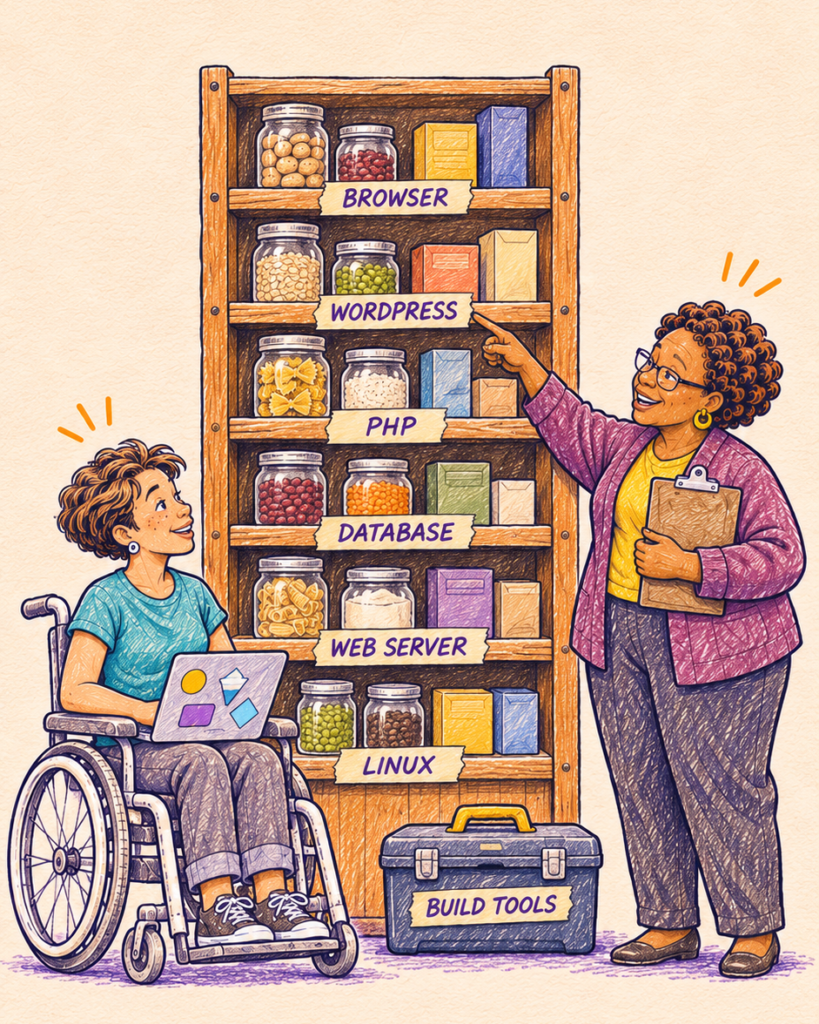Every page load passes through six shelves someone else stocks. Illustration made with ChatGPT at my direction.Text description of the illustration### What this illustration shows
- A tall wooden pantry unit has six shelves. From the bottom up, their tape labels read LINUX, WEB SERVER, DATABASE, PHP, WORDPRESS and BROWSER.
- Each shelf holds a few unlabeled jars and boxes, so the shelves look alike from a distance.
- On the floor beside the unit, a closed toolbox carries one label: BUILD TOOLS. It sits outside the shelves, just as build tools sit outside the page load.
- At the left, the developer sits in a manual wheelchair with a laptop on their lap and looks up at the bottom shelf.
- Meanwhile, at the right, the pantry coordinator holds a clipboard and points at the WORDPRESS shelf, near the top.
- In other words, WordPress is one shelf among six, and every shelf has its own rule for who restocks it.
### 🐧 The operating system: Linux
[verified](https://courtneyr.dev/merge-conflicts-methods/#h-which-six-evidence-labels-do-the-merge-conflicts-methods-use)
- **What it does:** first, it runs the server your site lives on, at the bottom of the open source stack.
- **Who approves a change:** subsystem maintainers accept patches, and maintainers pull from each other in what the kernel docs call a “chain of trust.”[2](#aa13547e-bbb4-4fa0-b9e3-995efe3e1ff6) Only one person, the top maintainer, can merge into the main kernel repository. So your client’s homepage depends on a merge button exactly one person can press.
- **Where it’s written:** “A guide to the kernel development process,” which the kernel also publishes in its own documentation.[3](#818106b6-eba8-4e68-833e-06cfcadf145d)
That one person rarely sees a patch first, though. The same guide notes the top maintainer picked only about 1.3 percent of the patches in the 2.6.38 kernel directly.[4](#c90ad3fa-c670-4c24-b399-d0890b7aceef) That figure is old, so treat it as an illustration of the design, not a current count. So the merge button works less like a bottleneck and more like the last signature on paperwork that subsystem maintainers already checked.
### 🌐 The web server: Apache or NGINX
[verified](https://courtneyr.dev/merge-conflicts-methods/#h-which-six-evidence-labels-do-the-merge-conflicts-methods-use)
- **What it does:** it takes each request, hands it to PHP, and sends the finished page back. WordPress also names both servers.[5](#9484f8e8-b80d-4884-b47c-be2e75fbb9a5)
- **Who approves a change:** at the Apache HTTP Server, a Project Management Committee governs. For example, a change that needs consensus needs at least three binding +1 votes and no veto.[6](#104c898f-4771-4905-bc21-a12ac7e060c5)[7](#b8e84ecd-3e17-4b50-a462-f324ee32792d) Meanwhile, NGINX sends every contribution through F5’s Contributor License Agreement, and “the technical committee for that project” reviews it.[8](#3c87e447-16bb-4561-af14-b6c9b8c5eefe)[9](#682eb8d4-a905-4d6e-b79d-9a738cb14ea5)
- **Where it’s written:** Apache’s voting guidelines, and also NGINX’s governance page and CONTRIBUTING file.
[verified](https://courtneyr.dev/merge-conflicts-methods/#h-which-six-evidence-labels-do-the-merge-conflicts-methods-use)
> “No veto can be overruled.”
>
> Apache HTTP Server Project, voting guidelines.[10](#a0c9f211-d39c-4cba-9ccc-ec42f1fd328c)
Apache’s page also lists open questions about its own rules. One reads, “We may need a better definition for ‘lazy consensus’.”[11](#78521d9e-4fe3-4805-9632-2b478308ba11) A rulebook that admits its gaps in writing is more than most of us keep for our own client work.
### 🗄️ The database: MySQL or MariaDB
[verified](https://courtneyr.dev/merge-conflicts-methods/#h-which-six-evidence-labels-do-the-merge-conflicts-methods-use)
- **What it does:** it stores your posts, users and settings.
- **Who approves a change:** Oracle’s MySQL governance page says “Oracle is the project lead for MySQL community edition.” Oracle also nominates the first project leads and committers.[12](#b6adb3a2-d6fa-4102-b104-b47f0c9f07eb) MariaDB, however, splits the job. Its Foundation board “does not make technical decisions.”[13](#3f638f17-b439-4ff6-94c3-012c786794db) Meanwhile, a 2025 agreement says MariaDB plc “employs the developers who contribute more than 90% of the code of MariaDB Server.”[14](#d221f637-22b6-4388-abd1-4e4029129908) So picking a database also picks between a company that decides and a foundation that pointedly doesn’t.
- **Where it’s written:** MySQL’s Community Governance Model; similarly, MariaDB’s Foundation pages and board minutes.
Same job, two different answers to who approves a change. And your host picked one of them before you ever logged in.
### 🐘 The language: PHP
[verified](https://courtneyr.dev/merge-conflicts-methods/#h-which-six-evidence-labels-do-the-merge-conflicts-methods-use)
- **What it does:** it runs every line of WordPress’s PHP code.
- **Who approves a change:** language changes go through RFCs, or requests for comments. Then each primary vote “requires a 2/3 majority.” Voters are people with php.net accounts who’ve contributed code, plus representatives they choose.[15](#50be6fec-15ba-4cf8-8f14-b8b712d38080)
- **Where it’s written:** PHP’s “Voting on PHP features” RFC, and also the PHP Foundation’s governance page.
- **From my funding work:** today, the PHP Foundation lists GoDaddy.com as a Gold sponsor, as of 2026-11-09.[16](#fca13bec-a9ed-4080-9bdd-63e530a2dd24) However, its governance page grants up to three board seats “automatically” to qualified Platinum sponsors.[17](#f9a344fb-44b7-4c58-b973-cd7c361a8b0d) Gold isn’t one of them. Meanwhile, the Foundation pays for work, and the RFC vote decides the language.
[account](https://courtneyr.dev/merge-conflicts-methods/#h-which-six-evidence-labels-do-the-merge-conflicts-methods-use)
I pointed budget approvers at PHP first. Fixing the language fixes it for every plugin, theme and site at once, which no single plugin budget can do.
### 📝 The application: WordPress
[verified](https://courtneyr.dev/merge-conflicts-methods/#h-which-six-evidence-labels-do-the-merge-conflicts-methods-use)
- **What it does:** it’s the part your client logs in to.
- **Who approves a change:** the Core Handbook says the project is “run by a core leadership team and led by co-founder and lead developer.” In addition, lead developers hold “final authority on technical decisions.”[18](#79e5caec-45b8-4342-b2d3-2194dccdae2e) Finally, release squads form by open nomination, and the Executive Director or a designee confirms them.[19](#791c4ee4-4f5a-4fda-b416-ad5efdd103a9)
- **Where it’s written:** WordPress’s Core Handbook, on its “Project Organization” page and its release team page.
The same handbook page describes no process for appointing or removing lead developers.[20](#a6686abf-0b61-4fc5-8d2b-88396d6923c4) On the other hand, release squads form through a public nomination call, and a later post announces the confirmed squad.[21](#67f596cc-701d-4688-ab95-328a08223e63) So if you’ve ever waited on a merge before a release, you know whose names to look for. So the release squad gets a public nomination call, and the final say gets no paperwork at all.
### 🖥️ The browser and the standards it follows
[verified](https://courtneyr.dev/merge-conflicts-methods/#h-which-six-evidence-labels-do-the-merge-conflicts-methods-use)
- **What it does:** it turns HTML and CSS into the page your client sees.
- **Who approves a change:** in Chromium, you need “a positive review from an owner of each directory your change touches.” Owners are committers with at least three months’ tenure.[22](#8e62e87a-5eb6-452c-b2c4-c480c83a407a) Similarly, Firefox requires “a module owner’s OK” to check code into that module.[23](#5625d22a-f932-4de5-bf27-7ae0a0c924eb) At WebKit, by contrast, existing reviewers select new committers and reviewers, and an objection goes to consensus, then a majority vote.[24](#058ecb0b-ef50-4d36-a771-e6dff02d977a) Finally, at W3C, Working Groups develop the specifications, and a W3C Council hears formal objections.[25](#4e66f154-37d9-4ee4-ac60-35f5c9b02131)
- **Where it’s written:** Chromium’s code review guide, Mozilla’s module ownership policy, WebKit’s commit and review policy, and W3C’s Process Document.
- **From my funding work:** W3C’s Diversity page names GoDaddy among the TPAC 2025 sponsors who “financially helped 26 of our attendees.”[26](#dc93cce1-60b7-46c2-aef3-dd3c718d4938) In other words, that’s the TPAC Inclusion Fund, not W3C membership.
[account](https://courtneyr.dev/merge-conflicts-methods/#h-which-six-evidence-labels-do-the-merge-conflicts-methods-use)
Standards are only as good as who’s in the room, and the fund paid for people who couldn’t otherwise get there.
### 🧰 Build tools: the software stack you never ship
[verified](https://courtneyr.dev/merge-conflicts-methods/#h-which-six-evidence-labels-do-the-merge-conflicts-methods-use)
- **What it does:** Node.js runs the build tools behind the block editor. In fact, WordPress’s docs call it “essential” for block editor work.[27](#4b820d69-8e48-4208-9bd5-692067e8c0b1) Likewise, PHP\_CodeSniffer runs the WordPress Coding Standards, which are “a collection of PHP\_CodeSniffer rules.”[28](#552b3b1c-747d-4bb3-a6eb-501419574193)
- **Who approves a change:** OpenJS hosts Node.js. Platinum members appoint directors, and “Gold and Silver members vote among themselves to select their representatives.”[29](#399abdbd-e8e5-483d-98f0-ab3c5043f63e) PHP\_CodeSniffer, on the other hand, now lives at PHPCSStandards, the “official continuation” of the original, abandoned package.[30](#0015e59b-11c5-4acf-8eda-fd0fb984fe24) However, its README names no maintainers. Its contributing guide says pull requests that fail their checks “will likely be ignored by the maintainers or closed.”[31](#ecdc57fc-b308-4bce-b9be-5404290355b4) Neither file names those maintainers, or who approves a release.
- **Where it’s written:** OpenJS’s board announcement and members page, and the PHP\_CodeSniffer README and contributing guide.
- **From my funding work:** OpenJS lists GoDaddy as a Silver member.[32](#64265799-137b-42ac-b2dc-3b7aa09a7fba) Also, PHP\_CodeSniffer’s Open Collective page lists “GoDaddy.com” as a corporate funder.[33](#b142b5f5-7059-4b94-b52e-b1586af987a1) Both readings date from 2026-11-09.
[account](https://courtneyr.dev/merge-conflicts-methods/#h-which-six-evidence-labels-do-the-merge-conflicts-methods-use)
Build tools sit outside the open source stack your visitors load. Even so, every site you build passes through them. If the tools that build and check your code break, you can’t ship a fix, even though no visitor ever loads them.
## 💸 Who pays for the open source layers?
Here’s the open source stack as a table, in stack order. WordPress is one row, sorted the same way as the rest. Each layer’s section above names the document.
[verified](https://courtneyr.dev/merge-conflicts-methods/#h-which-six-evidence-labels-do-the-merge-conflicts-methods-use)
LayerProjectWho approves a changeBrowserChromiumAn owner of each directory a change touchesBrowserFirefoxThe module ownerBrowserWebKitReviewers; reviewers also pick new reviewersStandardsW3CWorking Groups; a Council hears formal objectionsApplicationWordPressCore leadership team; lead developers on technical callsLanguagePHPRFC voters, two thirds majorityDatabaseMySQLOracle, as project leadDatabaseMariaDBDevelopers, most employed by MariaDB plc; the board doesn’t decide technical questionsWeb serverApache httpdCommitters by vote; any binding veto stops a consensus changeWeb serverNGINXA technical committee, under F5’s contributor agreementOperating systemLinuxSubsystem maintainers, then the top maintainerBuild toolsNode.jsOpenJS hosts it; members elect or appoint the boardBuild toolsPHP\_CodeSnifferNot stated in its README; label: unknownThe open source stack under a WordPress site, top to bottom, and who approves a change at each layer
[analysis](https://courtneyr.dev/merge-conflicts-methods/#h-which-six-evidence-labels-do-the-merge-conflicts-methods-use)
So, why pay for free? Because money buys different things at each layer of the open source stack. For example, a Gold sponsor at the PHP Foundation gets no automatic seat, and the language still changes only by RFC vote. By contrast, a Silver member at OpenJS gets a vote for a board representative. Meanwhile, a TPAC sponsor pays for people to attend.
In other words, none of that buys a commit. Still, the record here doesn’t show any sponsor changing any decision, and W3C’s Process says “no Member receives preferential treatment within W3C.”[34](#c087c5cf-2593-480f-ac92-6047db2a7148) Whether sponsorship buys a seat is its own question. Season 2 asks it in post 2.4.
## 🔎 Read one governance page in your open source stack
Find the open source stack under your own site, then read how one layer decides.
1. **Open Site Health**In WordPress, open **Tools > Site Health > Info**. WordPress documents the screen on its [Site Health Screen page](https://wordpress.org/documentation/article/site-health-screen/).
2. **Find your layers**The Server section shows the server architecture, the web server and the PHP version. The Database section shows the database server version. (I checked mine on 2026-11-09. It took less time than finding the coffee.)
3. **Pick one layer**Start with the layer that broke most recently. After all, you already care about that one.
4. **Read its governance page**Open that layer’s page from the list below, and look for who approves a change and where the rule is written.
- **Linux:** [the kernel development process guide](https://docs.kernel.org/process/2.Process.html).
- **Apache or NGINX:** [Apache’s voting guidelines](https://httpd.apache.org/dev/guidelines.html) or [NGINX’s governance page](https://nginx.org/en/docs/governance.html).
- **MySQL or MariaDB:** [MySQL’s Community Governance Model](https://dev.mysql.com/community/governance-model/) or [the MariaDB Foundation’s about page](https://mariadb.org/about/).
- **PHP:** [the PHP RFC voting rules](https://wiki.php.net/rfc/voting).
- **WordPress:** [the Core Handbook’s Project Organization page](https://make.wordpress.org/core/handbook/about/organization/).
- **Your browser:** [Chromium’s code review guide](https://chromium.googlesource.com/chromium/src/+/HEAD/docs/code_reviews.md), [Mozilla’s module ownership policy](https://www.mozilla.org/en-US/about/governance/policies/module-ownership/) or [WebKit’s commit and review policy](https://webkit.org/commit-and-review-policy/).
## 📋 Quick answers about the open source stack
**What is the open source stack under a WordPress site?**It’s the separate projects a page load passes through: an operating system such as Linux, a web server, a database, PHP, WordPress and your browser. Each one decides changes its own way.
**Who approves a change to PHP?**RFC voters do. A primary vote needs a two thirds majority. Voters are people with php.net accounts who’ve contributed code, plus representatives they choose.
**Does sponsoring an open source project buy a vote?**It depends on the layer. A Gold sponsor at the PHP Foundation gets no automatic board seat. OpenJS Silver members, on the other hand, elect a board representative.
**How do I see which layers my site runs on?**Open Tools > Site Health > Info in WordPress. The Server section lists the web server and PHP version, and the Database section lists the database version.
## ❓ Questions you can use
Ask these of any layer in any open source stack, including the ones I didn’t cover:
1. **Approval.** Who approves one change, and how are they chosen?
2. **Records.** Where is that rule written, and when did it last change?
3. **Blocking.** Can one person or one company stop a change?
4. **Money.** What does a sponsor get: a seat, a vote, or a thank you?
If you find a governance page I missed, send it. I’ll add it to the list.
My relationships that bear on this post- **Pantheon,** my employer, a WordPress and Drupal host.
- **GoDaddy,** where I managed the Five for the Future contributors until July 2026. I also chose which foundations and projects got its open source funding, among them the PHP Foundation, OpenJS, W3C’s TPAC Inclusion Fund and PHP\_CodeSniffer.
- **The WordPress Training Team,** where I was a faculty member and a team rep. I’m not active on the team now.
- **The FAIR Package Manager,** where I used to sit on the Technical Steering Committee.
- **The WPOCC,** where I’m one of the founding board members.
- **Questions I asked on stage** at WordCamp US 2024, the WordCamp Europe 2025 fireside and WordCamp Canada 2025.
- **My own words appear in court exhibits** in *WPEngine v. Automattic* (Dkt. 18-28, 107-4, 18-5 and 69-16). The series reports that litigation in pairs.
## 🧭 Where this post sits in the series
This post follows 1.5, [Which open source projects does Merge Conflicts compare, and why these?](https://courtneyr.dev/2026/11/09/open-source-projects-compared/) It uses the labels on [the Merge Conflicts methods page](https://courtneyr.dev/merge-conflicts-methods/). Next up is 1.7, where WordPress sits among other open source projects. Follow along on [the Merge Conflicts series page](https://courtneyr.dev/series/merge-conflicts/).
- [Merge Conflicts: what happens when open source governance procedures aren’t written down?](https://courtneyr.dev/2026/11/02/open-source-governance-procedures/)
- [What Makes a Good WordPress Theme?](https://courtneyr.dev/2013/02/20/what-makes-a-good-wordpress-theme/)
- [Migrating WordPress Webhost Servers](https://courtneyr.dev/2014/04/09/migrating-wordpress-webhost-servers/)
- [Before You Choose Your WordPress Webhost](https://courtneyr.dev/2014/04/02/choose-wordpress-webhost/)
- [LLM Wiki: From Brain Fog to AI-Organized Second Brain Clarity](https://courtneyr.dev/2026/04/15/llm-wiki-ai-second-brain-obsidian/)
Footnotes (34)1. WordPress. “Requirements.” wordpress.org. . Accessed 2026-11-09. [↩︎](#ad9e7a72-001f-42df-891d-e43bdbcec393-link)
2. The Linux kernel development community. “2. How the development process works.” A guide to the kernel development process, The Linux Kernel documentation. . Accessed 2026-11-09. [↩︎](#aa13547e-bbb4-4fa0-b9e3-995efe3e1ff6-link)
3. The Linux kernel development community. “2. How the development process works.” A guide to the kernel development process, The Linux Kernel documentation. . Accessed 2026-11-09. [↩︎](#818106b6-eba8-4e68-833e-06cfcadf145d-link)
4. The Linux kernel development community. “2. How the development process works.” A guide to the kernel development process, The Linux Kernel documentation. . Accessed 2026-11-09. [↩︎](#c90ad3fa-c670-4c24-b399-d0890b7aceef-link)
5. WordPress. “Requirements.” wordpress.org. . Accessed 2026-11-09. [↩︎](#9484f8e8-b80d-4884-b47c-be2e75fbb9a5-link)
6. The Apache Software Foundation. “How the ASF works.” apache.org. . Accessed 2026-11-09. [↩︎](#104c898f-4771-4905-bc21-a12ac7e060c5-link)
7. Apache HTTP Server Project. “Apache HTTP Server Project Guidelines and Voting Rules.” httpd.apache.org. . Accessed 2026-11-09. [↩︎](#b8e84ecd-3e17-4b50-a462-f324ee32792d-link)
8. NGINX. “CONTRIBUTING.md.” nginx/nginx repository, GitHub. . Accessed 2026-11-09. [↩︎](#3c87e447-16bb-4561-af14-b6c9b8c5eefe-link)
9. NGINX. “NGINX Open Source Governance.” nginx.org. . Accessed 2026-11-09. [↩︎](#682eb8d4-a905-4d6e-b79d-9a738cb14ea5-link)
10. Apache HTTP Server Project. “Apache HTTP Server Project Guidelines and Voting Rules.” httpd.apache.org. . Accessed 2026-11-09. [↩︎](#a0c9f211-d39c-4cba-9ccc-ec42f1fd328c-link)
11. Apache HTTP Server Project. “Apache HTTP Server Project Guidelines and Voting Rules.” httpd.apache.org. . Accessed 2026-11-09. [↩︎](#78521d9e-4fe3-4805-9632-2b478308ba11-link)
12. Oracle. “MySQL Community Governance Model.” dev.mysql.com. . Accessed 2026-11-09. [↩︎](#b6adb3a2-d6fa-4102-b104-b47f0c9f07eb-link)
13. MariaDB Foundation. “About MariaDB Foundation.” mariadb.org. . Accessed 2026-11-09. [↩︎](#3f638f17-b439-4ff6-94c3-012c786794db-link)
14. MariaDB Foundation. “Board Meeting 2/2025,” minutes with Memorandum of Understanding (Attachment A). mariadb.org. 2025-03-12. . Accessed 2026-11-09. [↩︎](#d221f637-22b6-4388-abd1-4e4029129908-link)
15. PHP. “Request for Comments: Voting on PHP features.” PHP RFC wiki. . Accessed 2026-11-09. [↩︎](#50be6fec-15ba-4cf8-8f14-b8b712d38080-link)
16. The PHP Foundation. Home page, sponsor lists. thephp.foundation. . Accessed 2026-11-09. [↩︎](#fca13bec-a9ed-4080-9bdd-63e530a2dd24-link)
17. The PHP Foundation. “Governance of the PHP Foundation,” section 3.3.2. thephp.foundation. . Accessed 2026-11-09. [↩︎](#f9a344fb-44b7-4c58-b973-cd7c361a8b0d-link)
18. WordPress. “Project Organization.” Core Handbook, Make WordPress Core. Last updated 2026-09-07. . Accessed 2026-11-09. [↩︎](#79e5caec-45b8-4342-b2d3-2194dccdae2e-link)
19. WordPress. “WordPress Release Team and Focus Leads.” Core Handbook, Make WordPress Core. . Accessed 2026-11-09. [↩︎](#791c4ee4-4f5a-4fda-b416-ad5efdd103a9-link)
20. WordPress. “Project Organization.” Core Handbook, Make WordPress Core. Last updated 2026-09-07. . Accessed 2026-11-09. [↩︎](#a6686abf-0b61-4fc5-8d2b-88396d6923c4-link)
21. WordPress. “WordPress Release Team and Focus Leads.” Core Handbook, Make WordPress Core. . Accessed 2026-11-09. [↩︎](#67f596cc-701d-4688-ab95-328a08223e63-link)
22. The Chromium Authors. “Code Reviews.” chromium/src docs. [https://chromium.googlesource.com/chromium/src/+/HEAD/docs/code\_reviews.md](https://chromium.googlesource.com/chromium/src/+/HEAD/docs/code_reviews.md). Accessed 2026-11-09. [↩︎](#8e62e87a-5eb6-452c-b2c4-c480c83a407a-link)
23. Mozilla. “Module Ownership System.” mozilla.org. . Accessed 2026-11-09. [↩︎](#5625d22a-f932-4de5-bf27-7ae0a0c924eb-link)
24. WebKit. “Commit and Review Policy.” webkit.org. . Accessed 2026-11-09. [↩︎](#058ecb0b-ef50-4d36-a771-e6dff02d977a-link)
25. World Wide Web Consortium. “W3C Process Document,” sections 1, 2.1 and 3.3. 18 August 2025. . Accessed 2026-11-09. [↩︎](#4e66f154-37d9-4ee4-ac60-35f5c9b02131-link)
26. World Wide Web Consortium. “Diversity.” w3.org. . Accessed 2026-11-09. [↩︎](#dc93cce1-60b7-46c2-aef3-dd3c718d4938-link)
27. WordPress. “Block Editor Handbook: Development environment.” Developer.WordPress.org. . Accessed 2026-11-09. [↩︎](#4b820d69-8e48-4208-9bd5-692067e8c0b1-link)
28. WordPress. “WordPress Coding Standards for PHP\_CodeSniffer,” README. GitHub. . Accessed 2026-11-09. [↩︎](#552b3b1c-747d-4bb3-a6eb-501419574193-link)
29. OpenJS Foundation. “Meet Our 2026 OpenJS Foundation Board of Directors.” openjsf.org. . Accessed 2026-11-09. [↩︎](#399abdbd-e8e5-483d-98f0-ab3c5043f63e-link)
30. PHPCSStandards. “PHP\_CodeSniffer,” README. GitHub. [https://github.com/PHPCSStandards/PHP\_CodeSniffer](https://github.com/PHPCSStandards/PHP_CodeSniffer). Accessed 2026-11-09. [↩︎](#0015e59b-11c5-4acf-8eda-fd0fb984fe24-link)
31. PHPCSStandards. “CONTRIBUTING.md.” PHP\_CodeSniffer repository, GitHub, 4.x branch. [https://github.com/PHPCSStandards/PHP\_CodeSniffer/blob/4.x/.github/CONTRIBUTING.md](https://github.com/PHPCSStandards/PHP_CodeSniffer/blob/4.x/.github/CONTRIBUTING.md). Accessed 2026-11-09. [↩︎](#ecdc57fc-b308-4bce-b9be-5404290355b4-link)
32. OpenJS Foundation. “Members.” openjsf.org. . Accessed 2026-11-09. [↩︎](#64265799-137b-42ac-b2dc-3b7aa09a7fba-link)
33. Open Collective. “PHP\_CodeSniffer.” opencollective.com. [https://opencollective.com/php\_codesniffer](https://opencollective.com/php_codesniffer). Accessed 2026-11-09. [↩︎](#b142b5f5-7059-4b94-b52e-b1586af987a1-link)
34. World Wide Web Consortium. “W3C Process Document,” sections 1, 2.1 and 3.3. 18 August 2025. . Accessed 2026-11-09. [↩︎](#c087c5cf-2593-480f-ac92-6047db2a7148-link)
Also on:- [ website](https://fed.brid.gy)
[](https://courtneyr.dev/2026/11/10/open-source-stack/)Courtney RobertsonWhy pay for free software? Who decides the open source stack under WordPress?